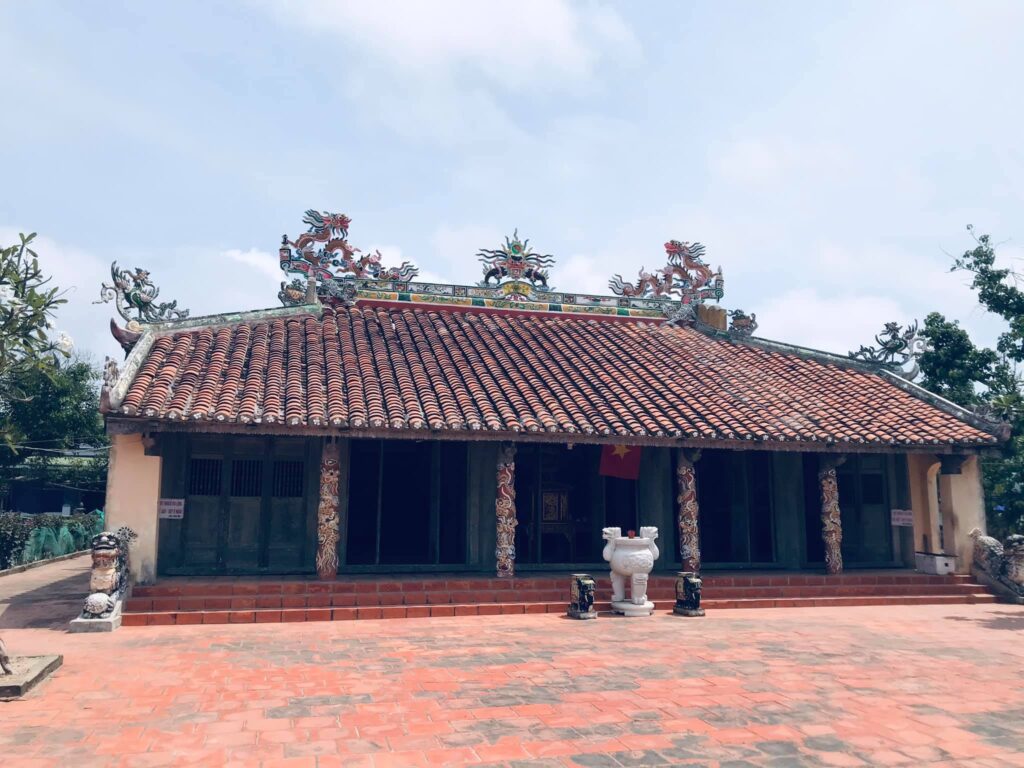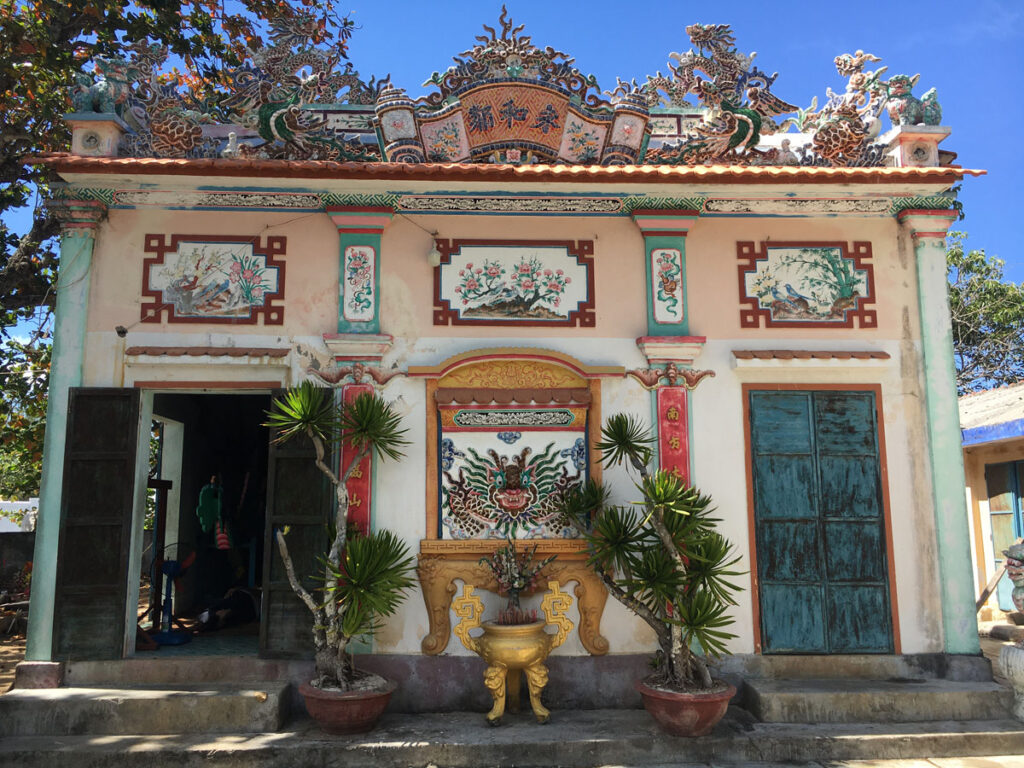
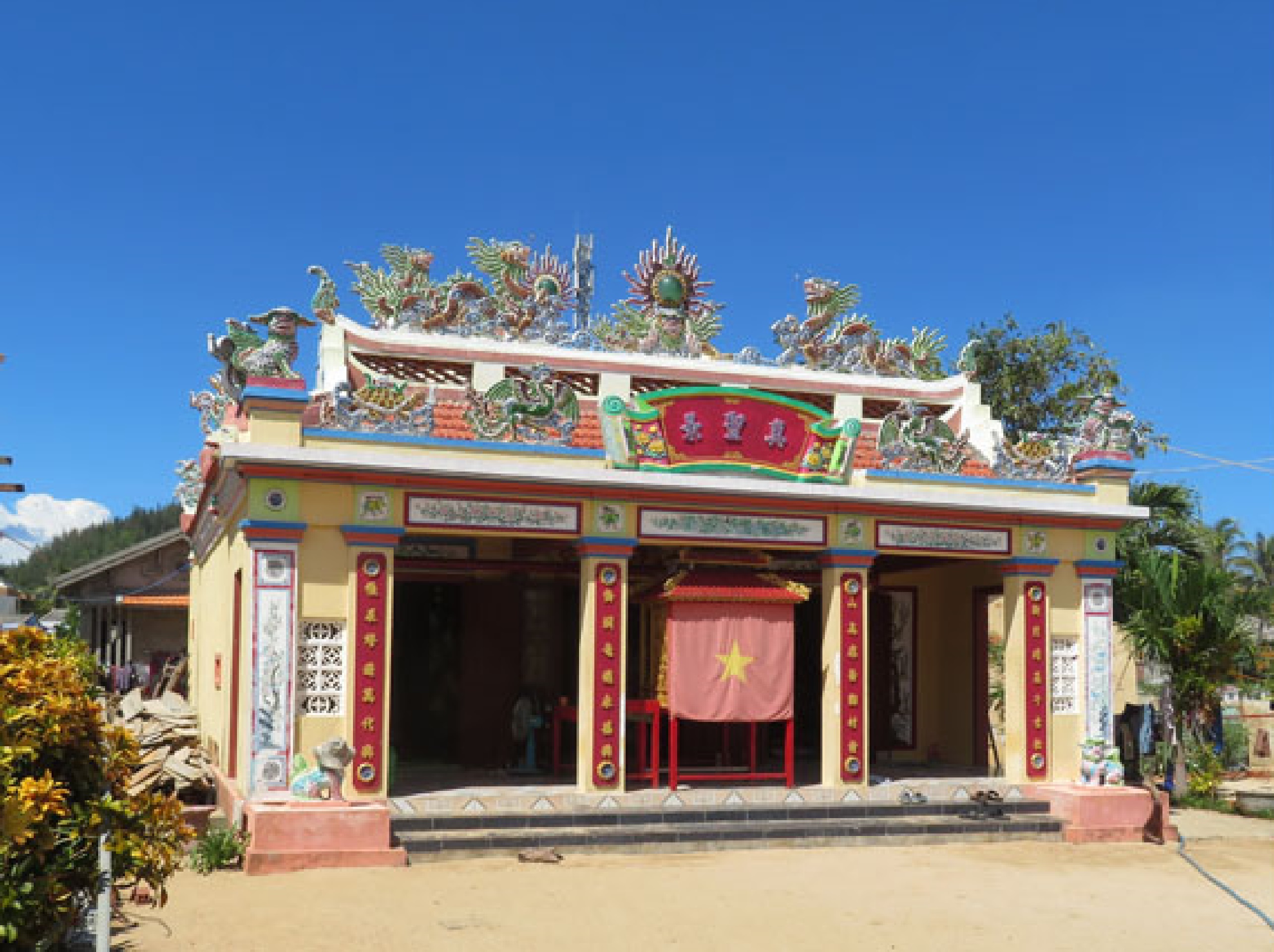
The Chanh Shrine (Lăng Chánh) is the principal Whale God Temple (Lăng thờ Cá Ông) of the Vinh Thanh fishing guild (Vạn Vĩnh Thạnh), located in Ben Dinh Hamlet, Dong Village, An Vinh Commune, Ly Son Island.
Whale Worship – A Shared Belief of Cham and Vietnamese Seafarers
In Cham legends, the whale is revered as a deity capable of rescuing sailors in distress.
In Vietnamese folk belief, the whale—known as Cá Ông—is said to originate from a sacred piece of the Bodhisattva Avalokiteshvara’s cassock, which was cast into the sea and transformed into a divine creature. The Bodhisattva then granted the whale a massive skeleton and the supernatural ability to “open the sea paths” so it could swiftly save distressed fishermen.
Thus, both Vietnamese and Cham traditions share an element of animism and oceanic worship, regarding the whale as a benevolent sea deity. Ly Son Island alone has eight Whale God temples, each housing numerous sets of whale bones.
For coastal communities, Cá Ông is considered a phúc thần—a patron deity who protects boats and fishermen at sea. If a whale is found dead (believed to have “gone to nirvana”), fishermen must bring it ashore for a formal burial. It is regarded as a sacred blessing and a sign of good fortune.
The person who discovers the whale is called the “eldest son” (trưởng tử) and must observe a 24-month mourning period. During rituals, the eldest son wears a red mourning headband and stands beside the officiant. After 3–7 years of burial—depending on the whale’s size—a ceremony called “Thượng Ngọc Cốt” is held to retrieve the bones, place them into a lacquered reliquary, and enshrine them in the temple. The funeral rites performed for Cá Ông mirror those for a human being.
A Distinctive Oceanic Faith of Ly Son
Whale worship is common across the central coast of Vietnam, but each region has its own variations in rituals and festivals. On Ly Son Island, Whale God worship plays a uniquely central role in the spiritual life of the entire community.
Here, it is not the belief of a single family or guild, but a shared cultural identity of the whole island.
Surrounded by an unpredictable ocean and armed only with modest fishing tools, Ly Son fishermen seek spiritual strength to face storms, dangerous waves, and the uncertainties of sea life. With deep faith in the Whale God’s ability to rescue boats in danger, the island’s fishing communities have embraced Cá Ông as their sacred protector.
History and Architecture of Chanh Shrine
According to preserved documents, the Chanh Shrine dates back to the Minh Mang era and has undergone numerous restorations. Originally built with earthen walls and a thatched roof, it collapsed during storms in 1901. Villagers petitioned the authorities for permission to rebuild the shrine, as recorded in a surviving document from the 15th year of Emperor Thanh Thai (1901).
In 1997, the shrine underwent a major restoration by the Vinh Thanh fishing guild, giving it the dignified and spacious architectural form seen today.
The shrine is designed in the traditional “three-section” layout (chữ Tam), including:
- Front Hall (Tiền đường): for preparations and guild meetings
- Main Sanctuary (Chánh điện): three bays supported by jackfruit-wood columns
- Rear Chamber (Hậu cung): elevated with eight intersecting roofs (cắt cổ diêm)
Inside the Main Sanctuary, a gilded red lacquered plaque displays the four Chinese characters “Đại Càn Quốc Gia”. The central bay honors the Whale God, while the side bays venerate Quang Tiền and Vũ Hậu.
The rear chamber houses multiple reliquaries containing whale bones and the sacred tablet of Nam Hải Thần Ngư (the God of the Southern Sea).
The shrine’s roof is tiled, and the ridge, gables, and eaves are adorned with lively dragon-and-phoenix reliefs. Outside stands a decorated screen wall and ceremonial pillars. To the east lies the shrine of Water Goddess Thuy Long (Thủy Long Thần Nữ), protector of rivers and seas.
A Cultural Center of Ly Son’s Maritime Rituals
Chanh Shrine is the ceremonial heart of the fishing guild, hosting all major rituals related to Whale God worship, including:
- Opening of the fishing season
- Gratitude and thanksgiving ceremonies
- Sea-opening festival
- Prayers for abundant catches
- Ground-breaking and launching rituals
Located within a larger cultural complex that includes An Vinh Communal House, Vinh An Pagoda, and the Ancestral Temple, Chanh Shrine contributes to one of the most significant spiritual heritage clusters on Ly Son Island.