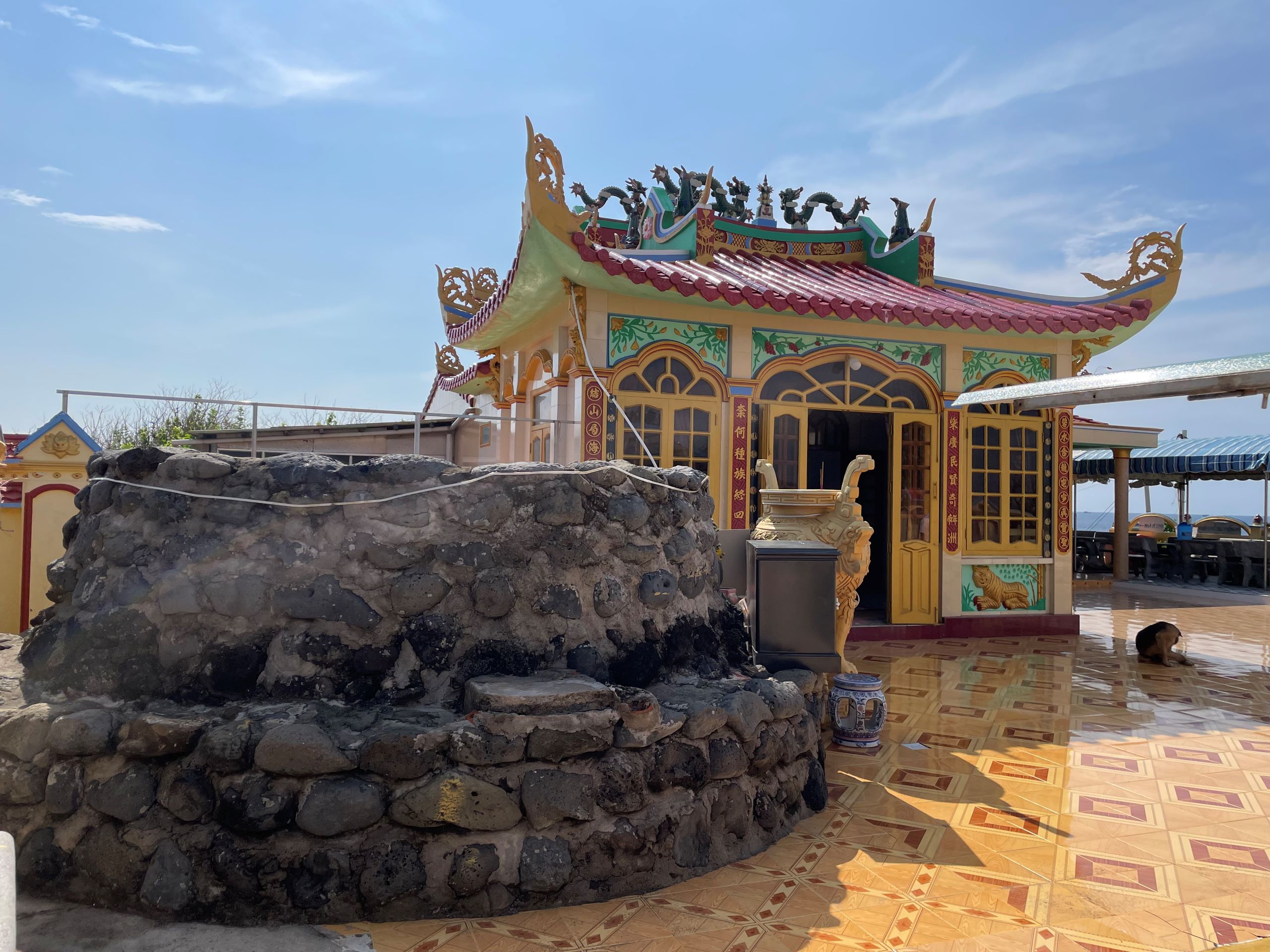
Exploring the legends of Thầy Nại (also called Thầy Chúa) not only reveals the profound influence of this revered spirit, but also offers insights into the deep cultural connections and shared origins between the Cham and Hoa (Chinese) communities. It is no coincidence that the tales describe Thầy Nại—known as a Chinese geomancer—as originally a Cham prince, nor is it accidental that he addresses Princess Bàn Tranh, also Cham, as his elder sister. In Cham cultural consciousness, origins and ancestry are sacred, and these legends echo that spirit:
“Before becoming a master of geomancy, Thầy Nại was a king of the Cham people, but due to fate, he drifted to China and lived there.”
Thus, folklore holds that Princess Bàn Tranh and Thầy Sài Nại share the same Cham lineage. When Thầy Nại learned she was older, calling her “sister” was natural—and meaningful.
Legend 1: The Cham Prince and the Origins of Thầy Sài Nại
Long ago, during the decline of the Champa Kingdom, the king died and left the throne to his six-year-old prince. For three years, drought devastated the land. Believing divine punishment had come, the child-king ordered himself locked inside a bronze cage and cast into the sea—if the cage sank, he was unfit to rule; if it floated, fate would decide.
Miraculously, the cage floated. A Chinese merchant ship discovered the drifting prince and rescued him. The shipmaster adopted the boy, who grew up educated and became an exceptional geomancer. After his adoptive father passed away, he inherited the trade and traveled widely.
On one voyage, he saw the shadow of Mount Cao Cát fall perfectly upon a rock formation at sunset. Recognizing a sacred “dragon vein” in the landscape, he drew a map and instructed his descendants to cremate his body and bury his ashes there when he died.
Years later, villagers discovered offerings and a mound of stones on the site. Attempts to dig it up unleashed swarms of black ants—an omen that halted them. Soon after, a mysterious young man appeared, revealing himself as the geomancer who had “borrowed a living body” to tell the villagers to build a shrine. Thus began the worship of Thầy Nại.
Legend 2: Thầy Chúa Manifesting to Defeat the Tàu Ô Pirates
Another tale recounts how Thầy Nại saved the island from marauding Tàu Ô pirates. One afternoon, as nine villages gathered for a traditional opera performance, a young man appeared warning them that enemy ships were anchored offshore. Doubting him, they followed anyway and discovered 21 pirate vessels at Bãi Lăng.
The stranger revealed his divine identity and agreed to seek help from his “sister”—Princess Bàn Tranh. Three days later he returned, declaring they would strike at 7 p.m.:
“We will destroy twenty ships. One must survive to carry the tale home.”
That night, fierce northern winds blew. Islanders launched blazing bundles of grass at the enemy fleet. Pirate cannons misfired, and twenty ships went up in flames while one escaped. After the victory, the spirit revealed his origins and how he had met Princess Bàn Tranh, buried her, and later guided settlers from China to Phu Quy. From then on, the islanders honored him as Thầy Chúa, the protector-spirit of the island.
Legend 3: Uprooting the Giant Ruối Tree and the Birth of Dinh Thầy
Near Mount Cấm, a massive ruối tree stood, its trunk so large that several men could not encircle it. Thầy Nại manifested again, instructing villagers to build his shrine there. When they tried to cut the tree, it resisted every axe swing. Suddenly, a handsome young man appeared, saying:
“You can chop all year and it still won’t fall. Let me handle it.”
He wrapped his arms around the colossal trunk, pulled it from the earth, and hurled it hundreds of meters away with superhuman strength. Recognizing divine intervention, villagers built Dinh Thầy, the shrine that stands to this day.
A local verse preserves his legacy:
“Thầy Nại thông linh
While alive, famed in the northern lands
In death, interred in the southern realm
Blessed by mountains and seas
His spirit shines for all eternity.”
Legend 4: His Divine Appearance During the Great Storm
One of the most recent tales dates to October 26, 1988, when a violent typhoon (force 11–12) struck the island. Residents saw a monstrous wave rising like a wall, threatening to engulf Phu Quy entirely. Suddenly, three explosive sounds echoed across the island, and a bright light shot out from the mountaintop. The towering wave split apart, lowering itself before dissolving into the sea.
The shrine keeper later reported that at the moment of the explosion, the shrine door flew open and the oil lamp on the altar burned steadily despite the raging winds. Islanders believed this was Thầy Nại manifesting to save them from disaster.
Cultural and Spiritual Meaning of Thầy Nại
Thầy Nại is more than a legendary geomancer—he is a guardian spirit woven deeply into the cultural identity of Phu Quy Island. His stories reflect the community’s longing for protection, connection with the divine, and respect for their Cham ancestry.
Through each legend, Thầy Nại becomes closer to the people: a protector in war, a guide in peace, and a symbol of resilience against nature’s fury. His worship embodies the islanders’ desire to live in harmony with the spiritual world—a reminder that even in a vast and perilous ocean, they are never alone.
Today, rituals, festivals, and prayers honoring Thầy Nại continue to bind the community together, keeping alive the belief that the “guardian spirit of Phu Quy” still watches over the island and its people.