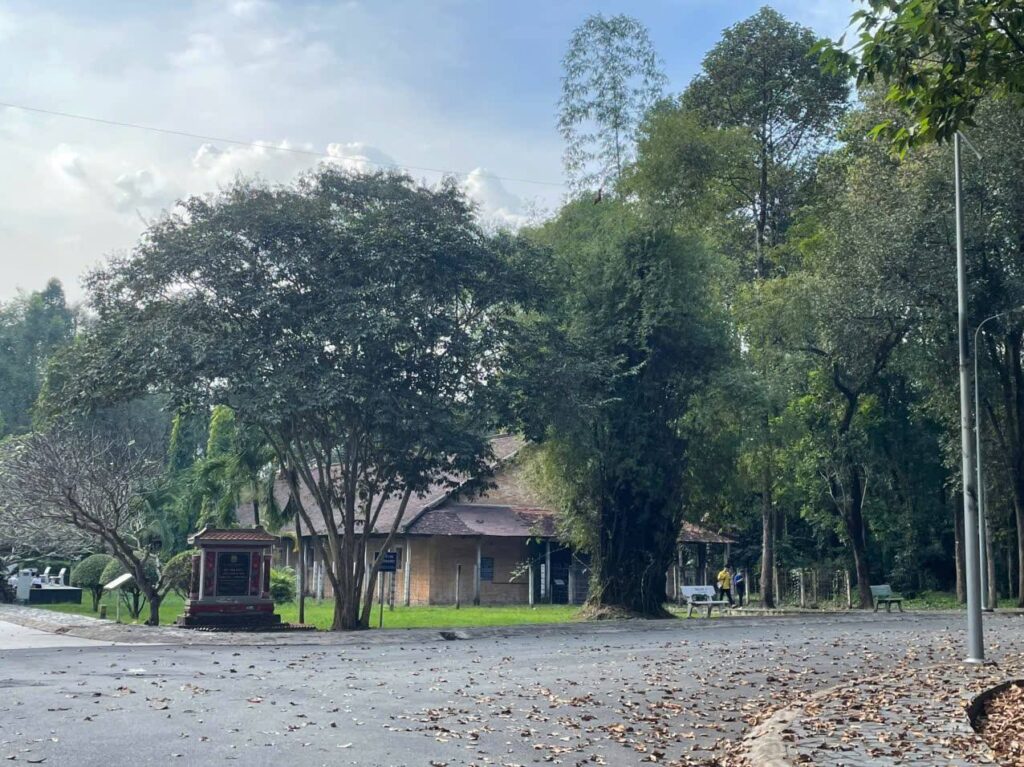
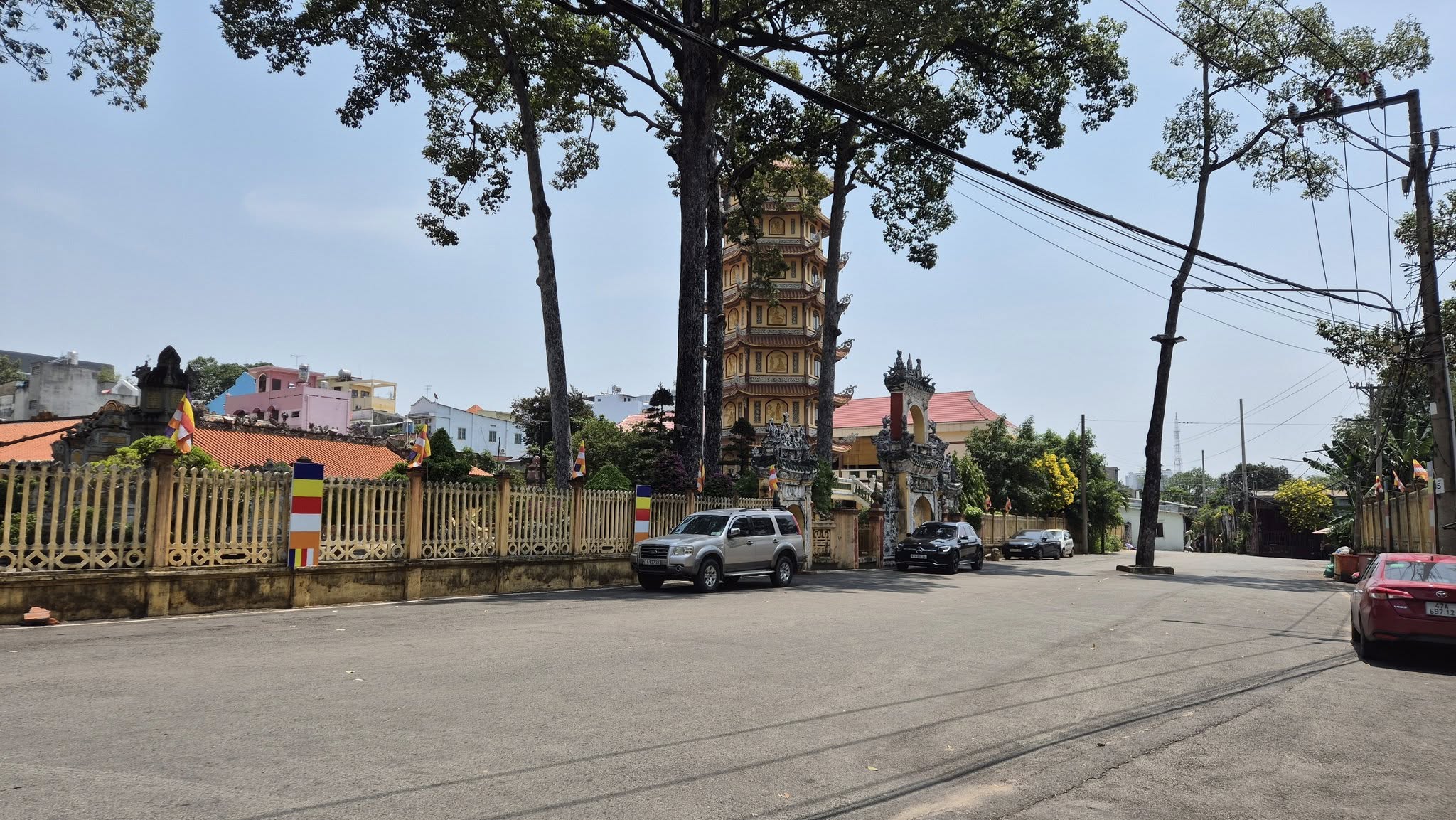
Hoi Khanh Pagoda is located on Chua Hoi Khanh Street, a road that bears the pagoda’s own name, in the heart of Thu Dau Mot. More than a long-standing religious structure, Hoi Khanh Pagoda is regarded as one of the earliest cradles of Buddhism in Binh Duong, closely connected to the region’s formation, cultural development, and patriotic spirit over centuries.
The pagoda was founded in 1741 by Zen Master Đại Ngạn Từ Tấn, a third-generation monk of the Linji (Lam Te) lineage. What began as a small thatched hermitage in a sparsely populated land gradually evolved into a major center of Buddhist practice, learning, and spiritual support for the local community.

More Than 270 Years of History
Throughout its long history, Hoi Khanh Pagoda has witnessed many pivotal moments in Vietnam’s past. In 1861, when French colonial forces occupied Thu Dau Mot, the pagoda was completely destroyed by fire. Seven years later, in 1868, Venerable Toàn Tánh – Chánh Đắc led the reconstruction, laying the foundation for the architectural form that remains today.
By 2018, Hoi Khanh Pagoda had existed for 277 years, passing through ten generations of abbots. Many of these eminent monks were not only known for their spiritual virtue but also left a profound imprint on southern Vietnamese Buddhism and patriotic movements.
Hoi Khanh Pagoda and the Patriotic Movement in the Early 20th Century
One of the most remarkable values of Hoi Khanh Pagoda lies in its historical and political role in the early twentieth century.
Between 1923 and 1926, the pagoda became a gathering place for scholars, Confucian intellectuals, monks, and patriotic figures, who together formed an organization known as the “Honor Society” (Hội Danh Dự). The group promoted moral integrity, personal honor, and national consciousness through activities such as teaching Han–Nom characters, providing herbal medicine, and assisting the poor.
Notably, Nguyễn Sinh Sắc, a Pho Bang (Imperial Scholar) and the father of President Hồ Chí Minh, once lived and worked at Hoi Khanh Pagoda. His personal belongings—such as a geomancy notebook, medicine-grinding tools, and a compass—are still preserved here, serving as vivid evidence of the close bond between Buddhism and the patriotic movement in Binh Duong.
Distinctive Southern Vietnamese Pagoda Architecture
Architecturally, Hoi Khanh Pagoda exemplifies the traditional Southern Vietnamese pagoda style, harmoniously combining classical layouts with local folk aesthetics. The complex consists of five main components:
- Front hall and main sanctuary
- Lecture hall, notable for its 92 precious wooden columns
- Eastern corridor
- Western corridor
- Rear hall
These structures follow the “trùng thiềm trùng lương” layout, with layered tiled roofs that convey a sense of solemnity, durability, and warmth.
The Tam Quan (Triple Gate) is a standout feature, decorated with intricate ceramic mosaic art that showcases the refined craftsmanship of traditional Thu Dau Mot artisans. Motifs such as lotus flowers, the Four Sacred Animals (dragon, qilin, tortoise, phoenix), and the Nine Dragons carry deep Buddhist symbolism while reflecting the identity of Binh Duong’s long-established ceramic craft villages.
A Treasure Trove of Sculpture and Precious Artifacts
Inside the main sanctuary, Hoi Khanh Pagoda preserves nearly 100 wooden statues, elaborately lacquered and gilded. Highlights include:
- The Eighteen Arhats, vividly sculpted in the classic Binh Duong woodcarving style; these statues were once exhibited by the French at the Marseille Colonial Exhibition in 1920.
- The Ten Kings of Hell (Thập Điện Minh Vương), illustrating the Buddhist concept of karma and moral consequence.
The pagoda also safeguards a set of woodblock scriptures carved in 1885, considered among the earliest woodblocks in Binh Duong. These blocks once served as a major center for printing and distributing Buddhist scriptures across southern Vietnam.
The Reclining Buddha – A Contemporary Symbol
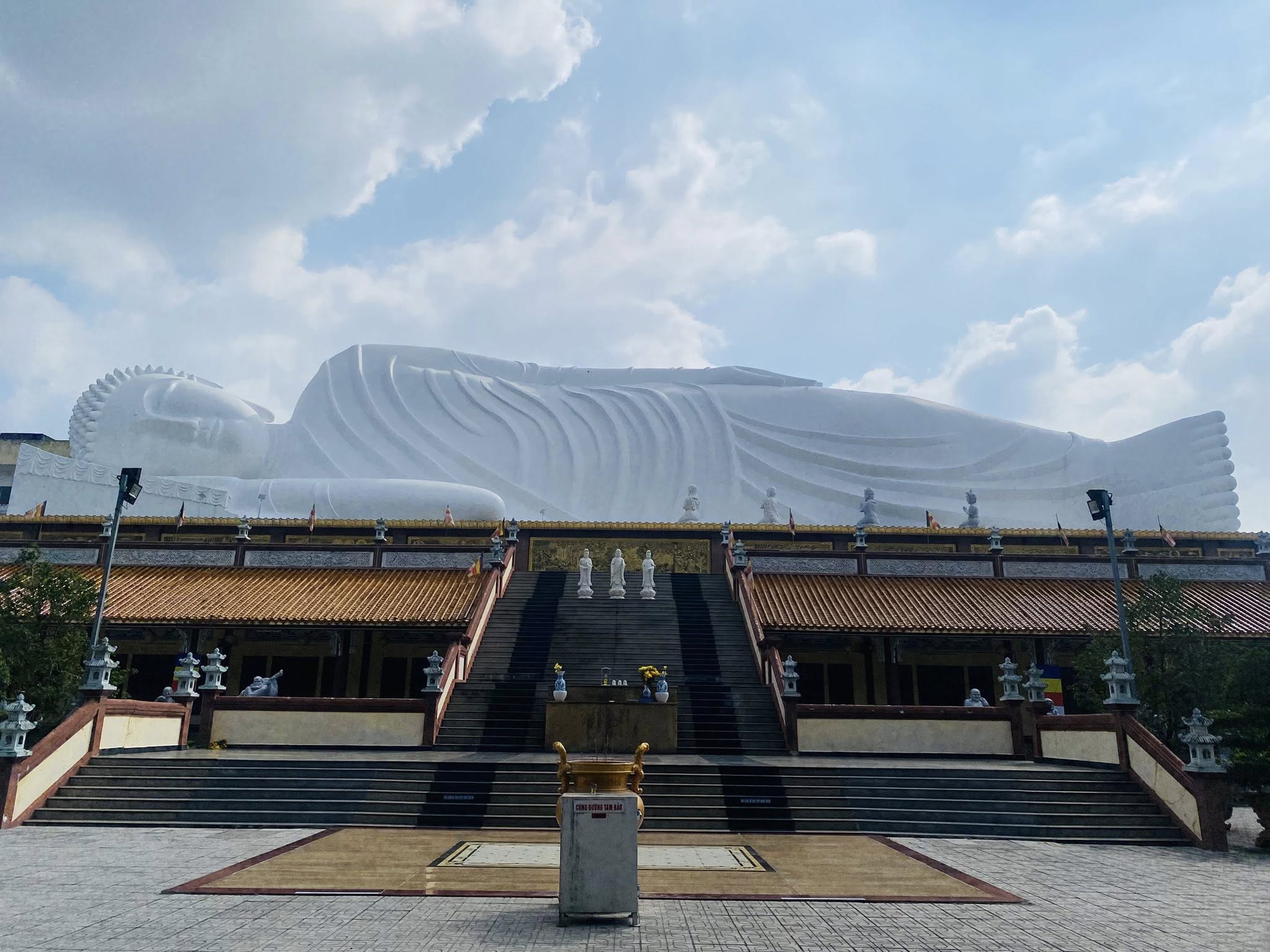
A modern highlight of Hoi Khanh Pagoda is the Reclining Buddha statue of Shakyamuni, installed on the rooftop of the Intermediate Buddhist Academy in 2010. In May 2013, the statue was recognized by the Asia Book of Records as the longest reclining Buddha statue on a pagoda rooftop in Asia.
Beyond its record-setting scale, the statue symbolizes the continuity of Buddhist teachings and is closely associated with the training of monks and nuns and the propagation of Dharma in Binh Duong.
A Center of Buddhism and Traditional Education
Following the August Revolution of 1945, Hoi Khanh Pagoda continued to play a central role in religious and social life:
- Headquarters of the Buddhist Association for National Salvation of Thu Dau Mot
- Later the headquarters of the Patriotic Buddhist Association of Binh Duong
- From 1983, the seat of the Binh Duong Provincial Buddhist Association
- In 1995, the establishment of the Intermediate Buddhist Academy, training monks and nuns for the Southeast region
A National Heritage and Spiritual Destination
With its outstanding historical, cultural, architectural, religious, and revolutionary values, Hoi Khanh Pagoda was designated a National Architectural and Artistic Monument on January 7, 1993, by the Ministry of Culture and Information.
Today, Hoi Khanh Pagoda is not only a place of worship and spiritual practice but also a prominent heritage and spiritual tourism destination in Binh Duong. Here, visitors can clearly sense the harmonious convergence of Buddhism, national history, and Southern Vietnamese cultural life.
Visitor Information
Address: No. 35, Chua Hoi Khanh Street, Thu Dau Mot Ward, Ho Chi Minh City
Contact: (+84) 274 3841 606 – Binh Duong Provincial Museum
Hoi Khanh Pagoda stands as a living testament to the spirit of “Buddhism walking alongside the nation”—a precious legacy of the Thu Dau Mot land, carefully preserved and carried forward through generations.