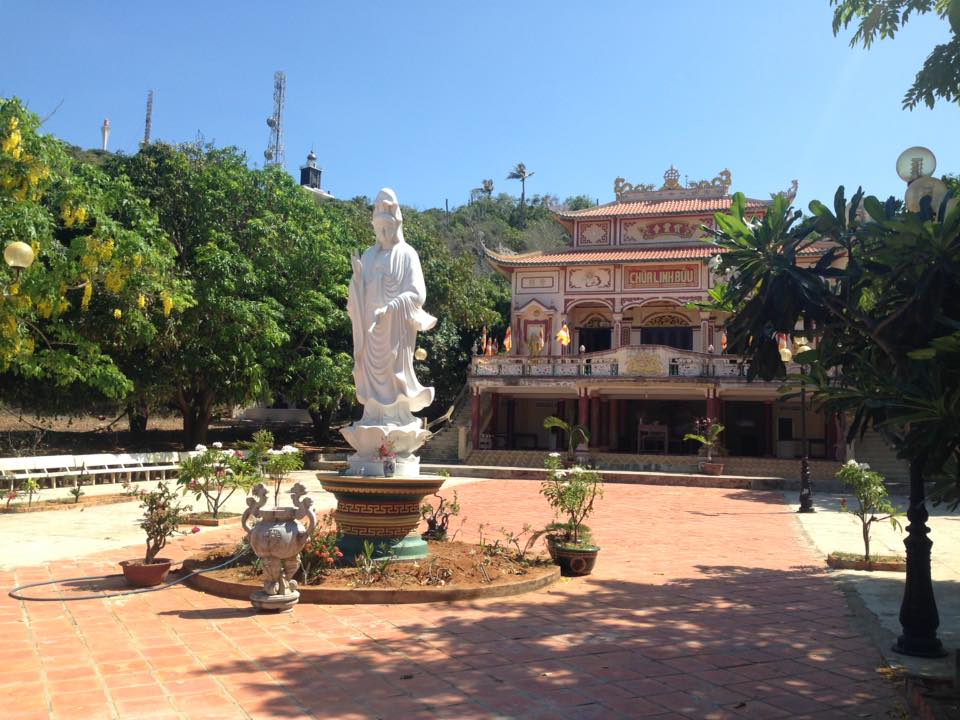
Linh Buu Pagoda is located in Hamlet 1 of Ngu Phung Commune, Phu Quy Island. It was founded in 1971 by Venerable Thich Tu Hue from Tra Can Pagoda in Ninh Thuan, together with local Buddhist devotees. Nestled at the foot of a small hill and shaded by old trees, the pagoda exudes serenity and seclusion, offering visitors a tranquil spiritual retreat.
In its early days, the pagoda was a simple structure built to serve the religious needs of local followers, consisting only of a main hall and a lecture house. In 1999, a majestic stupa was added—harmoniously blending Thai and Vietnamese architectural elements—to enshrine the relics of Venerable Tuong Kim. Today, Linh Buu Pagoda has been completely renovated by the temple committee into an elegant and solemn Buddhist complex. The main hall is built of reinforced concrete, featuring a front hall and a tall tower adorned with beautifully sculpted dragons and phoenixes. Seen from afar, the pagoda appears and disappears gently behind the canopy of ancient trees, evoking a sense of peace and transcendence.

A Harmonious Architectural Ensemble
The architectural layout of Linh Buu Pagoda includes several interconnected structures built on a spacious, airy, and tranquil compound—ideal for Buddhist practice. The two-tiered roof of the main hall resembles a blooming lotus: the upper tier rises gracefully, while the lower spreads wide. The walls are decorated with intricate reliefs depicting Buddhist stories and iconography, alongside finely crafted floral patterns and lotus motifs, creating an atmosphere imbued with spiritual elegance.
Visitors enter the main hall through three principal doors. On both sides of the entrance, relief sculptures symbolizing Good and Evil stand prominently. Inside, decorative themes express the peaceful and contemplative nature of Buddhist spaces. At the center of the altar sits a statue of the Bodhisattva Avalokitesvara (Guanyin) on a lotus pedestal, flanked by statues of Buddha riding a white elephant and a lion in devotional postures. Surrounding them are scenes of celestial beings and Buddhist disciples, while the backdrop features two dragons flanking the swastika symbol, representing auspiciousness and eternal harmony.
A Place of Festivals and Faith
Like other Buddhist temples, Linh Buu Pagoda hosts several important annual festivals: Vesak (the Buddha’s Birthday) on the 15th day of the 4th lunar month, Vu Lan (Ullambana) on the 15th day of the 7th lunar month, and the full-moon ceremony of the 10th lunar month. These events are celebrated to pray for peace, prosperity, and harmony for the island community. Each festival attracts a large number of local Buddhists and visitors who come to offer prayers and pay homage.
With its tranquil setting, meaningful architecture, and deep spiritual significance, Linh Buu Pagoda stands as a cherished cultural and religious landmark of Phu Quy Island.