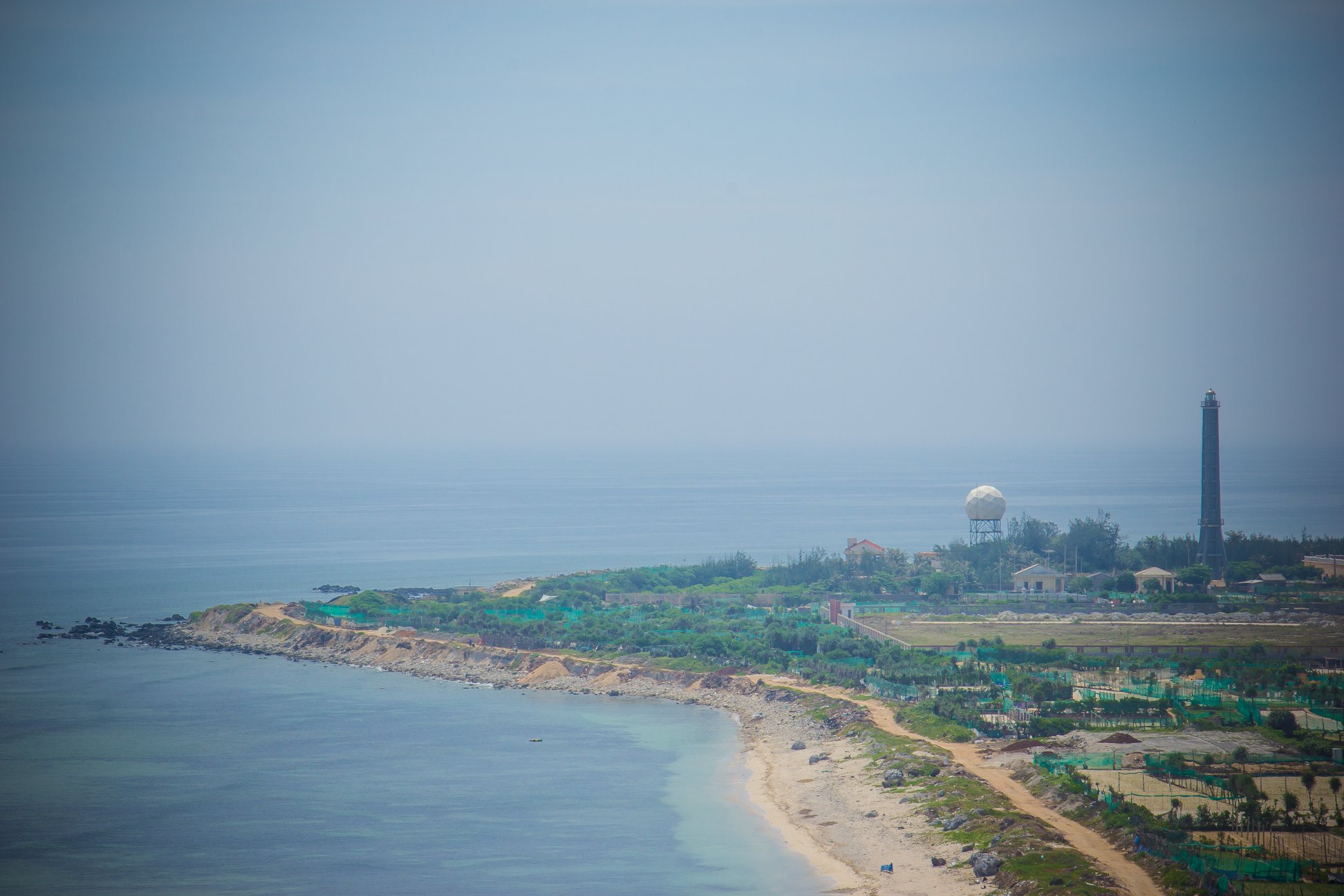
Ly Son Signal House (Nhà Pha Lý Sơn) is one of the most important historical sites on Ly Son Island. Built by the French in 1890 together with the lighthouse, this structure witnessed numerous key events during both the resistance wars against the French and the Americans. It also served as a place where many revolutionary soldiers and local residents were imprisoned and tortured.
Located in Thon Dong, An Hai Commune, the Signal House and Lighthouse today stand as symbols of Ly Son’s heroic past—while offering one of the most spectacular panoramic views on the island.
Vietnam’s Tallest Lighthouse
Standing at 45 meters, Ly Son Lighthouse is currently the tallest in Vietnam. From its top balcony, visitors can take in a breathtaking 360-degree view of the island: rolling waves, emerald coastline, vibrant garlic and onion fields, and small fishing boats drifting across the vast sea. It is a mesmerizing landscape that leaves a lasting impression.
Revolutionary Milestones Associated with the Signal House
The Resistance Against the French (1930–1954)
The Signal House played a pivotal role in the revolutionary movements on Ly Son:
- 1931: The iconic event of flying the Communist Party flag atop Thoi Loi Mountain (An Hai) and Hon Soi Mountain (An Vinh).
- 1945: On August 16, Ly Son residents rose up to seize power; the red flag with hammer and sickle was raised at the Signal House.
- 1951: The French reoccupied the island and imprisoned more than 120 people at the Signal House.
- 1953: The French continued to arrest around 100 resistance members; many were tortured and later transferred to Da Nang, where several died during transport.
Throughout this period, the Signal House functioned as a detention and interrogation center, aimed at breaking the local revolutionary network.
The Resistance Against the Americans
During the American-backed regime, the Signal House became the center of political resistance:
- Organized mass protests from Vinh Long Hamlet to the Signal House
- Demanded democratic rights
- Exposed atrocities committed by the U.S.–Saigon administration
- Distributed revolutionary leaflets, strengthening the island’s patriotic spirit
These movements fueled the resilience of Ly Son’s people and contributed significantly to the national struggle.
Development of Ly Son Lighthouse Through the Years
Initial Construction (1890–1982)
- Built by the French in 1890
- Steel structure, 45 meters tall
Relocation Period (1982–2000)
- The original lighthouse was dismantled
- Temporarily moved to Thoi Loi Volcano peak, but proved unsuitable
Modern Reconstruction (2000–Present)
- Rebuilt on the original site in 2000
- Officially put into operation on October 16, 2001
- Equipped with modern Spanish-manufactured marine lantern
- Light range: 21 nautical miles
- Coordinates: 15°23’10”N – 109°08’30”E
Today, Ly Son Lighthouse plays a crucial role in maritime navigation, ensuring safe passage for vessels traveling through central Vietnam’s waters.
Historical, Cultural & Tourism Value
The Signal House is not only a heritage site tied to the island’s revolutionary history, but also an architectural relic from the French colonial era. Combined with the towering lighthouse, it is one of Ly Son’s signature attractions.
Visitors coming here will experience:
- A solemn “red address” of Vietnamese revolutionary history
- Remarkable stories about Ly Son’s struggle for independence
- A stunning panoramic view from Vietnam’s tallest lighthouse
- A deep sense of connection between history, nature, and the sea