
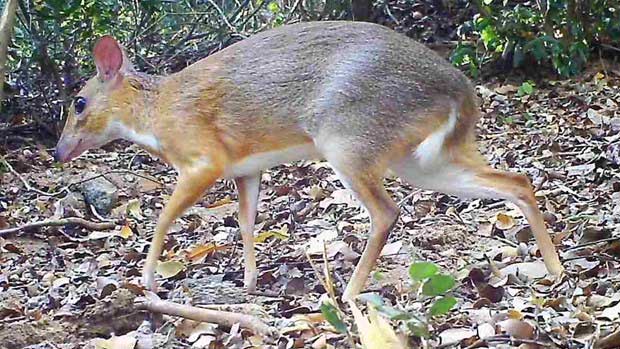
The mouse-deer, one of the rarest mammals in Vietnam and the world, has long existed in the natural forests of Con Dao National Park, Con Dao, Ho Chi Minh City This elusive species is listed in the global Red List and is considered a precious symbol of biodiversity in the region.
Also known as cheo cheo, the mouse-deer belongs to the family Tragulidae and is the smallest hoofed mammal in the world. About the size of a rabbit, it has a triangular head, slightly arched back, rounded body, long slender legs, and deer-like appearance but without antlers.
Mouse-deer are extremely rare and today can only be found in tropical forests of Africa, India, and Southeast Asia. According to scientists, there are currently 10 surviving species across three genera; several others are known only through fossil records.
Mouse-deer typically live alone or in pairs. They quietly forage along narrow trails in dense forest areas, feeding primarily on plants—grass, leaves, young shoots, fungi, and fallen fruits. They are highly timid; instead of fighting predators, they escape by sprinting swiftly. Asian mouse-deer weigh around 0.7–0.8 kg, while African species can reach 7–16 kg.
Their mating season falls between June and July. Before mating, the female taps the ground eight times within three seconds to signal the male. Gestation lasts about 140 days, and females usually give birth to one fawn at the end of the rainy season when food sources are plentiful.
In Vietnam, the species recorded is the silver-backed mouse-deer (Tragulus versicolor), first documented in 1910 from four specimens collected in the central mountainous region. This makes Vietnam home to one of the ten remaining species of mouse-deer worldwide.
For decades, scientists believed the mouse-deer in Vietnam had gone extinct by the late 20th century. According to Prof. Dang Huy Huynh, former Director of the Institute of Ecology and Biological Resources, mouse-deer populations were still present in Đồng Nai’s forests before the 1980s. However, rampant hunting for meat and trade led to their decline and presumed extinction.
In November 2019, conservation scientists announced that they had photographed living silver-backed mouse-deer in a southern Vietnamese forest. Major international media including CNN, The Guardian, and The New York Times reported the rediscovery, noting that the last known scientific record dated back to 1990 when a hunter sent a specimen to researchers.
Dr. Hoang Minh Duc, Deputy Director of the Southern Institute of Ecology, stated that the rediscovery of the silver-backed mouse-deer provides significant hope for biodiversity conservation, especially for threatened species in Vietnam.
More recently, multiple individuals of mouse-deer have been confirmed living in natural forest patches within Con Dao National Park. Evidence suggests that mouse-deer and several other rare animals have existed here for many years, indicating they may be native inhabitants of Con Dao’s untouched forests.
Con Dao National Park serves as an ecological bridge connecting biodiversity from the Indian Ocean–Western Pacific marine center to Vietnam’s coastal regions. To date, the park has recorded 144 terrestrial species, including 28 mammals, 69 birds, 39 reptiles, and 8 amphibians—many of which are listed in the Vietnam Red Book and the IUCN Red List.
The discovery of silver-backed mouse-deer in both Khanh Hoa and Con Dao further encourages collaboration between Vietnamese and international scientists to search for other rare mammals. It also highlights the urgent need for targeted research and conservation programs to protect this unique and endangered species.