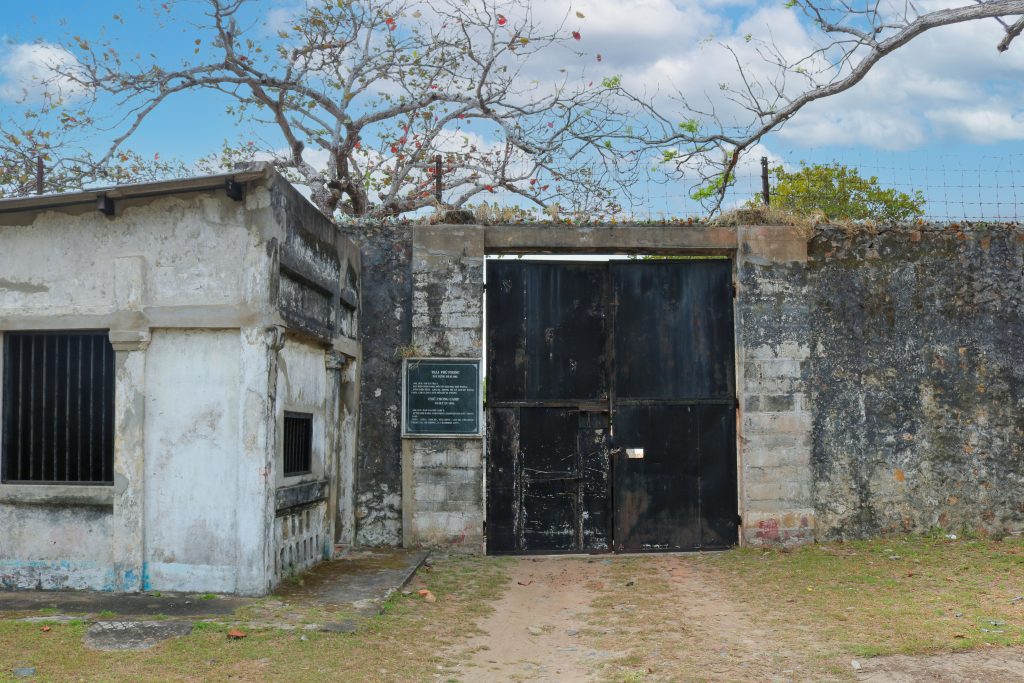
After the French transferred control of the Côn Đảo prison system in March 1955, the U.S.–Saigon regime continued to expand the complex to suppress revolutionary movements. In 1962, Camp V was constructed; following the Paris Peace Accords of 1973, it was renamed Phu Phong Prison Camp.
Covering 3,594 m², the camp consisted of 12 detention rooms arranged into three rows, each with four cells and an adjoining kitchen area. Its fibro-cement roofing and concealed position in front of the French Tiger Cages made it an ideal location for strict control and surveillance of prisoners.
By 1965, many newly arrested political prisoners and resistance fighters were transferred here, marking Phu Phong as a place of intensified repression.
The First Collective Women’s Prison in Côn Đảo (1966–1968)
Between 1966 and 1968, Phu Phong became the first collective detention area for female political prisoners on the island—a period marked by extreme hardship and remarkable courage.
On September 23, 1966, 36 patriotic women were exiled from mainland prisons to Côn Đảo and placed in Camp V. Despite harsh rules and brutal treatment, the women:
- Firmly refused to salute the enemy’s flag
- Rejected inhumane prison regulations
- Accepted severe punishment to protect their dignity and revolutionary spirit
Late in 1966, the women launched a hunger strike, demanding improved living conditions and repatriation to mainland prisons. Their struggle escalated dramatically when several prisoners resorted to the highest form of protest—self-inflicted stomach wounds—to condemn the regime’s brutality.
Confronted with intense pressure, the authorities were forced to transfer all female prisoners back to Chí Hòa Prison in March 1968, and later to Thủ Đức in September 1968.
A Testament to the Bravery of Vietnamese Women
Phu Phong Prison Camp stands as a powerful symbol of the resistance spirit of Vietnamese women. Despite relentless torture and deprivation, the female political prisoners remained:
- Unwavering in their loyalty to the revolution
- Courageous in the face of oppression
- United in their struggle against the U.S.–Saigon regime
- True embodiments of the virtues: “Heroic – Indomitable – Faithful – Diligent”
Their sacrifices at Phu Phong contributed to the proud legacy of women’s participation in Vietnam’s liberation struggle.
Recognition as a National Special Historic Site
The historical significance of Phu Phong Prison Camp has been formally acknowledged:
- April 29, 1979: The Ministry of Culture and Information issued Decision 54-VHQĐ, recognizing Phu Phong as a Nationally Important Historic Site.
- May 10, 2012: The Prime Minister issued Decision 548/QĐ-TTg, officially classifying the Côn Đảo Prison System—including Phu Phong Camp—as a National Special Historic Site.
Phu Phong Today
Today, Phu Phong Prison Camp is not only an important historical attraction on Côn Đảo, but also a sacred reminder of patriotism, resilience, and the unbroken courage of Vietnamese women.
Visitors to the site can deeply appreciate:
- The harsh realities of wartime imprisonment
- The extraordinary resolve of the female political prisoners
- The profound human spirit that endured amid suffering
Phu Phong remains a place of remembrance—honoring those who fought with bravery and conviction for Vietnam’s freedom.