


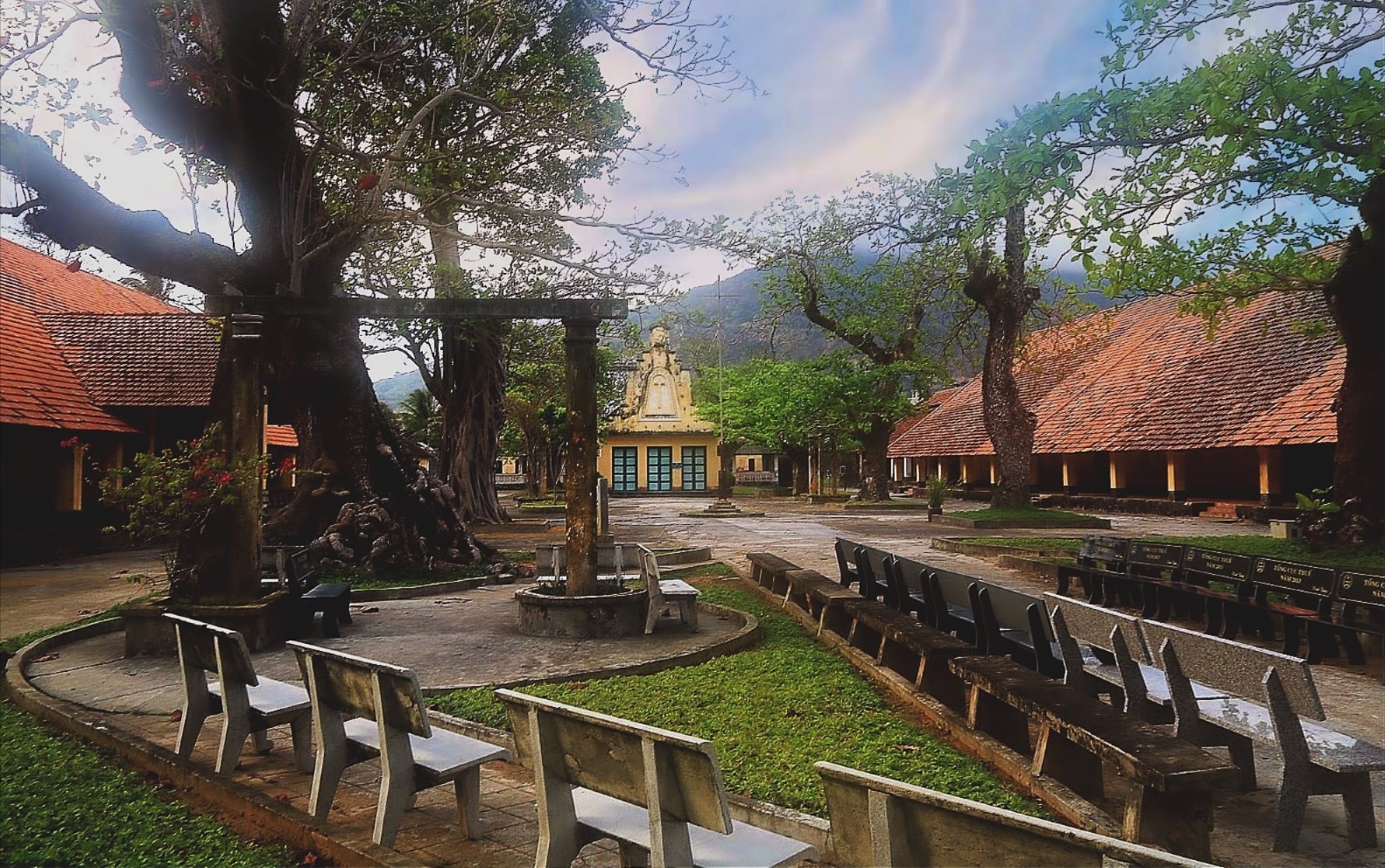
Phu Son Prison Camp, also known as Banh II, is one of the most important historical sites within the Côn Đảo prison system. It was constructed by the French colonial administration in 1908 and completed in 1916 to incarcerate Vietnamese patriotic and political prisoners.
Throughout its long history, the facility carried several names:
- During the French period: Banh II
- During the U.S.–Saigon regime: Lao 2, Camp Nhân Vị, Camp 3
- After the Paris Peace Accords (1973): Phu Son Prison Camp
- The compound covered over 13,200 m², consisting of:
- 13 large detention rooms
- 14 solitary confinement cells
Supporting facilities such as a medical room, canteen, kitchen, club area, barber room, warden’s office, and courtyards
Architectural Features and Prison Operations
Unlike Banh I, Banh II was built on a larger and more fortified scale. A notable architectural feature was an elevated inspection corridor, designed to allow guards to observe prisoners from above. However, during one nighttime uprising, prisoners overpowered and killed a guard at this walkway, causing the authorities to abandon its use out of fear.
While Banh I was known for struggles against forced labor, Banh II became the center of unity among various political groups, a place where prisoners fought to protect one another and improve their living conditions.
Many revolutionary cadres later holding vital roles in the Party and the Government studied here—through clandestine literacy classes and political theory lessons—including Nguyễn Văn Cừ, Lê Duẩn, Phạm Văn Đồng, Hoàng Quốc Việt, Lê Thanh Nghị, Hà Huy Giáp, and others.

The Solitary Confinement Block – “The Nursery of Communists”
The solitary confinement area of Phu Son was hidden behind thick walls and difficult to detect from the outside. This was where prisoners endured:
- Darkness
- Starvation
- Lack of ventilation
- Disease, skin infections, dysentery
- Severe torture and physical isolation
- Many prisoners died here under brutal conditions.
The French ironically referred to this area as “the nursery of communists,” because even under horrific repression, revolutionary prisoners stood firm. Many inmates belonging to other political factions were inspired and transformed into steadfast communists.
This block also held Lê Hồng Phong, General Secretary of the Indochinese Communist Party, and the patriot Nguyễn An Ninh.
On September 6, 1942, after months of torture and dysentery, Lê Hồng Phong sacrificed his life in solitary cell No. 05, leaving deep sorrow for the revolutionary movement.
4. Major Resistance Movements at Phu Son Camp
1951–1953: The Armed Escape Plan
Phu Son held many prisoners transported from Northern and Central Vietnam. It was here that the plan for an armed prison break was formed, culminating in the December 12, 1952 uprising at Bến Đầm with 198 prisoners participating.
1964–1970: The “Autumn Uprising” Movement
The camp became a center for major resistance movements on the island, including the historic struggle of over 4,000 political prisoners protesting forced labor and mandatory flag-salute rituals imposed by the U.S.–Saigon regime.
Cultural Life and Revolutionary Spirit
Despite harsh imprisonment, Phu Son remained a cradle of cultural and intellectual activism.
In spring 1935, at the Banh II courtyard, political prisoners such as Phạm Văn Đồng, Nguyễn Văn Linh, and Nguyễn Kim Cương staged the play “Napoleon”—a performance that astonished even the French guards.
The prisoners’ talent and knowledge earned respect from the warden, resulting in fewer acts of brutality and slightly improved treatment.
Historical Value and Recognition
Phu Son Prison Camp is considered the second most important historical site of the Côn Đảo prison system, after Banh I, symbolizing the indomitable spirit and sacrifice of Vietnamese revolutionaries.
- April 29, 1979: The Ministry of Culture and Information issued Decision 54-VHQĐ, designating Phu Son Camp as a Nationally Important Historic Site.
- May 10, 2012: The Prime Minister issued Decision 548/QĐ-TTg, officially listing the entire Côn Đảo Prison System—including Phu Son—as a National Special Historic Site.
Phu Son Prison Camp Today
Today, Phu Son stands as:
- A stark reminder of colonial oppression
- A symbol of the Vietnamese people’s resilience
- A memorial to generations of revolutionaries who sacrificed their youth and lives
Every step within its walls reminds visitors of the immeasurable price paid for freedom, and why Côn Đảo remains a sacred symbol of faith, courage, and national pride.



)