


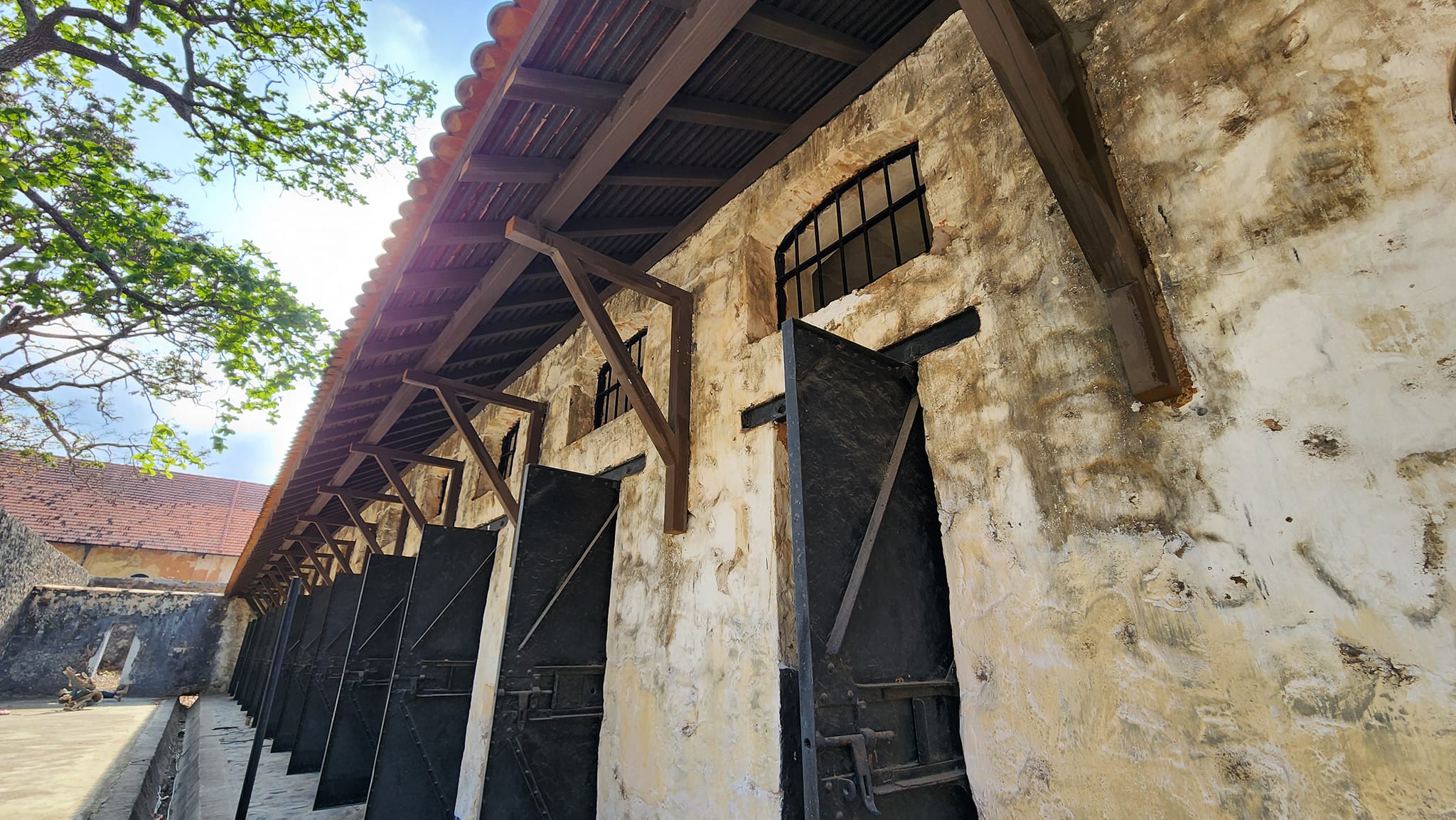
In 1928, the French colonial administration expanded the Côn Đảo prison system by constructing Banh III, covering an area of more than 12,700 m². Over time, this facility was known by several names: Banh III, Lao 3, Camp Bác Ái, Camp 1, and later Phu Tho Prison Camp.
Originally, the camp included:
- Two rows of collective detention rooms
- One row of solitary confinement cells
- A kitchen area and a small infirmary
After the August Revolution of 1945, the layout was adjusted to two rows, each with four detention rooms.
Expansion Under the U.S.–Saigon Regime
During the U.S.–Saigon period, two additional cells (Rooms 9 and 10) were built behind the infirmary.
Room 10 was transformed into a harsh isolation block that supplemented the infamous Tiger Cages. It was subdivided into 15 tiny solitary cells, whose ceilings were not made of iron bars like the French Tiger Cages but instead woven with layers of razor-sharp barbed wire.
Because of the cramped, stifling, and dehumanizing conditions, prisoners called this area by a bitter nickname: “The Chicken Coop Isolation Block.”
The camp also included auxiliary buildings such as a mess hall, storerooms, the kitchen, the warden’s office, and garden space.
Role of Phu Tho Prison Camp in the Colonial System
The French initially used Banh III to quarantine newly arrived prisoners before transferring them to other camps, preventing information from the mainland from spreading to long-term detainees.
Later, it became the facility where the French held prisoners classified as:
- “Extremely dangerous,”
- “Uncontrollable,”
- Repeat escapees,
- Or those accused of sabotage and disrupting public order.
A Site of Severe Repression (1939–1945)
During the period of harsh repression following the Southern Uprising (1940), Banh III held many prominent revolutionaries, including Lê Duẩn, Lê Hồng Phong, Dương Bạch Mai and others.
In the summer of 1944, groups of prisoners transferred from Sơn La and Hỏa Lò—many of them high-ranking Party and Xứ ủy leaders—were also confined here.
Banh III became one of the most brutal detention sites, where thousands of political prisoners were beaten, tortured, and starved to death under French “white terror” policies.

The Story of Revolutionary Martyr Vũ Văn Hiếu
One of the most moving stories from Phu Tho Camp is that of Vũ Văn Hiếu, the first Secretary of the Hòn Gai Special Zone. He drew his last breath inside a solitary cell here.
Moments before his death, he took off his shirt and handed it to fellow revolutionary Lê Duẩn, saying:
“Live on… and continue the struggle for the revolution.”
His sacrifice became a powerful symbol of communist loyalty —
“Live for the Party, die without leaving the Party.”
This moment later inspired writers and sculptors to create the famous monument based on the poetic line:
“Even in death, we give our last shirt to one another.”
Recognition as a National Special Historic Site
The historical significance of Phu Tho Prison Camp has been officially acknowledged:
- April 29, 1979: The Ministry of Culture and Information issued Decision 54-VHQĐ, designating Phu Tho Camp as a Nationally Important Historic Site.
- May 10, 2012: The Prime Minister issued Decision 548/QĐ-TTg, recognizing the entire Côn Đảo Prison System—including Phu Tho Camp—as a National Special Historic Site.
Phu Tho Camp Today
Today, Phu Tho Prison Camp is a must-visit historical site for travelers exploring Côn Đảo. It stands as:
- A stark reminder of colonial brutality
- A memorial to the unbreakable will of revolutionary fighters
- A symbol of sacrifice, loyalty, and resilience
Every wall and every cell here preserves the memory of those who endured suffering for the nation’s independence and freedom.



)