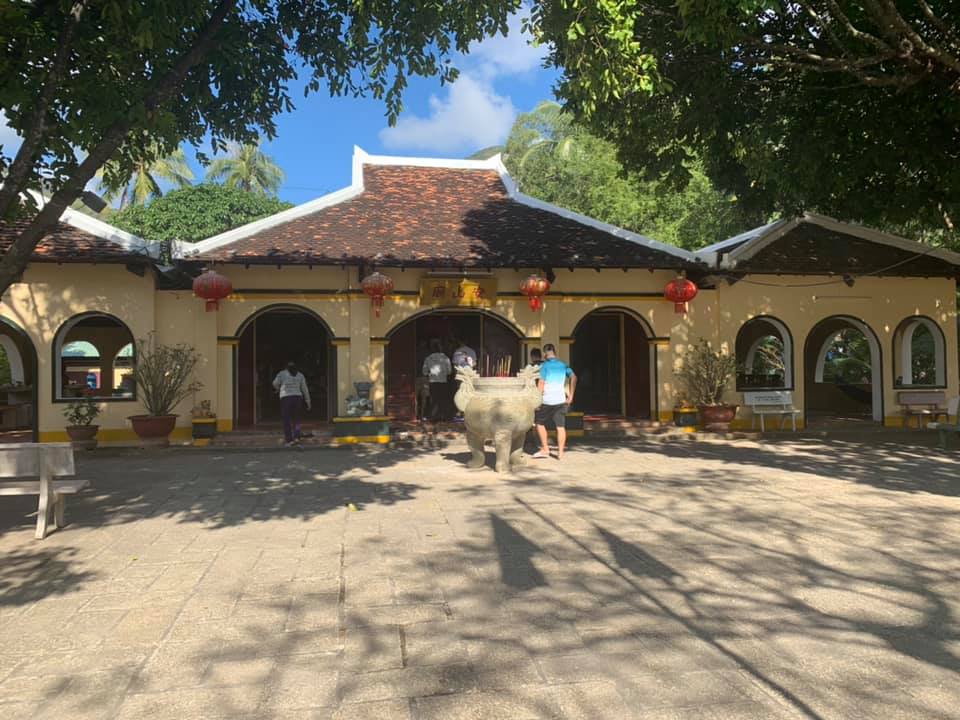
An Son Shrine—commonly known by local residents as the Shrine of Lady Phi Yen—is located in An Hai Village, at the foot of Thanh Gia Mountain, approximately 2.5 km southeast of Con Dao Town center, along the Nguyen Hue – Ton Duc Thang – Mieu Ba axis. The shrine is dedicated to Lady Hoang Phi Yen, the second consort of Lord Nguyen Phuc Anh.
Historical Background and Legend of Lady Phi Yen
According to local legend, Lady Phi Yen passed away in An Hai Village in 1785. The shrine stands on her original burial site, on flat terrain shaded by ancient forest sapodilla trees. The harmonious combination of architecture and natural surroundings lends the shrine a serene and sacred atmosphere.
The present structure was rebuilt in 1958 during the U.S.–backed South Vietnamese administration, honoring Lady Phi Yen, her son Prince Cai, and Admiral Ngoc Lan, a loyal official who protected the mother and child.
The legend recounts that in 1783, while fleeing the Tay Son forces, Lord Nguyen Phuc Anh sought refuge in Con Dao, accompanied by Lady Phi Yen. When she tried to dissuade him from seeking French military assistance, she was confined to a remote cave. Her young son, Prince Cai, cried for his mother and was accused of complicity, resulting in his being thrown into the sea. His body drifted ashore at Co Ong Village, where it was recovered and given burial rites; a shrine dedicated to him still exists there today.
It is said that during her confinement, Lady Phi Yen survived through the aid of a White Gibbon, and later was rescued by this gibbon along with a Black Tiger, a companion of Prince Cai, who brought her back to Co Ong.
In 1785, during the annual festival held on the 18th day of the tenth lunar month, Lady Phi Yen was invited back to An Hai Village to attend the ceremony. Here, she was assaulted by a butcher named Bien Thi and chose to take her own life to preserve her honor. The villagers, mourning her tragic fate and admiring her virtue, erected a shrine in her memory.
Reconstruction and Architectural Characteristics
After the French occupied Con Dao in 1861, all inhabitants were forced inland, leaving the shrine abandoned and eventually destroyed.
In 1958, when Con Dao became Con Son Province, Nguyen Kim Sau—Head of the Treasury Office—reviewed historical records and, recognizing the noble sacrifice of Lady Phi Yen, proposed the reconstruction of An Son Shrine on its original foundations. The project was funded by the provincial welfare budget and built using forced labor from prisoners.
Material Cultural Value
The shrine is laid out in the traditional horizontal “Nhat”-style (一), enclosed by perimeter walls.
- Total site area: approx. 4,200 m²
- Built area: approx. 1,100 m² (21.5 m × 50 m)
Key architectural features include:
- A southwest-facing entrance gate with the inscription “An Son Mieu” in raised red lettering.
- A 2 m–wide stone walkway leading to the forecourt, which contains a Heaven Altar and a circular pond with a miniature rock grotto symbolizing the cave where Lady Phi Yen was once confined.
- Two ancient sapodilla trees, considered important heritage elements.
- An Eastern-facing Tam Quan gate, behind which lies the main sanctuary.
- Inside the sanctuary are four altars:
- Avalokiteshvara Bodhisattva
- Lady Hoang Phi Yen
- Admiral Ngoc Lan
- Prince Cai
Intangible Cultural Value
Since 1975, Con Dao has had no formal religious institutions, yet it represents a “microcosm of Vietnamese culture,” as its residents originate from many regions across the country, bringing diverse cultural traditions that blend organically into a distinctive local identity.
To meet spiritual needs, residents enshrined a statue of Guanyin within An Son Shrine. On the first and fifteenth lunar days, locals—particularly fishermen—visit the shrine to offer prayers, leading to the additional name “Chua Ba” (Lady’s Pagoda).
While her memorial rites were once conducted informally by villagers, since 1987, the annual Memorial Festival of Lady Phi Yen (18th day of the 10th lunar month) has been formally co-organized by the Con Dao Fatherland Front and later the Con Dao Historic Sites Management Board.
Current Condition and Preservation Challenges
Despite periodic repairs funded by local authorities and community donations, An Son Shrine is deteriorating severely. Several structural components are unstable, posing safety risks to worshippers and visitors.
The shrine is currently managed by the Con Dao Revolutionary Historic Sites Management Board. To ensure proper preservation and sustainable use, several immediate and long-term measures are required.
Priority Solutions
- Authentic Restoration:
Conduct restoration using conservation principles that maintain the original structure; avoid inappropriate modernization. - Removal of Incongruent Additions:
Eliminate ad hoc architectural elements that undermine the historical integrity of the shrine. - Comprehensive Condition Assessment:
Prepare detailed architectural and structural documentation to guide restoration planning.
Funding Concerns
As state funding remains unavailable, community-based financial contribution—from organizations, local enterprises, and individuals nationwide—is vital. Public participation is essential for both funding and stewardship.
Community-Based Preservation Approach
- Enhance public awareness and cultural pride.
- Strengthen community responsibility in safeguarding the shrine.
- Integrate preservation efforts with sustainable tourism and cultural education.
THIEN ANH
(Adapted from materials of the Ba Ria – Vung Tau Museum)