Around this time in 2019, a delegation of officials and journalists from Bạc Liêu Newspaper visited the historical site of Côn Đảo (Bà Rịa–Vũng Tàu Province). After paying respects at the grave of the heroine Võ Thị Sáu and the martyrs’ graves at Hàng Dương Cemetery, our delegation continued to the Côn Đảo National Museum.
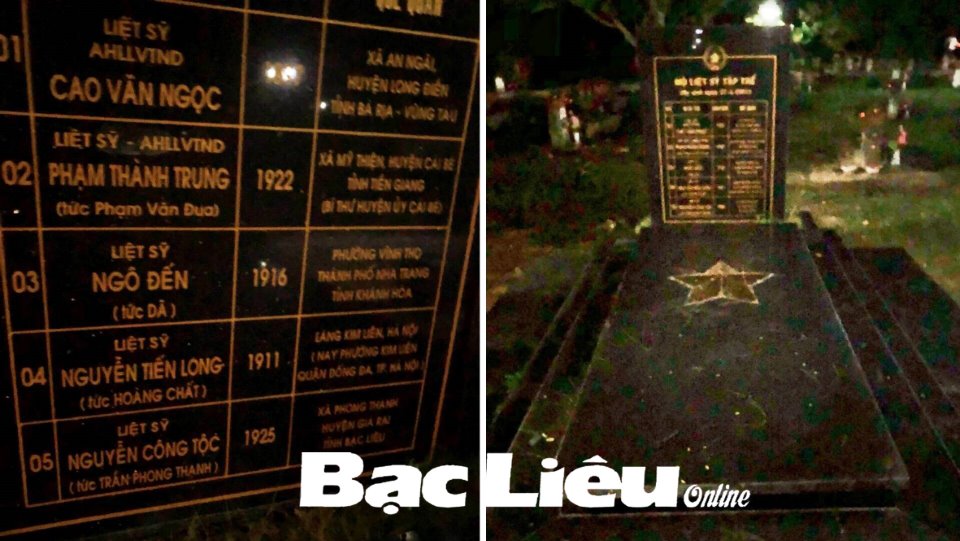
Among the golden names engraved on the crimson memorial board, I found his—Martyr Nguyễn Công Tộc. He was one of the “Bronze Pillars of Côn Đảo” from Bạc Liêu, who heroically sacrificed his life and is solemnly commemorated on the roll of honor of martyrs in this extraordinary museum on the sacred island.
Nguyễn Công Tộc’s real name was Cao Văn Ba, alias Trần Phong Thạnh. He was born on May 17, 1925, in Phong Thạnh village, Giá Rai District. Coming from a family with a strong revolutionary tradition, most of his siblings took part in the resistance wars against French colonialism and later against imperialist forces. In 1938, after passing his primary studies in his home province, he left for Saigon to continue his education at Pétrus Trương Vĩnh Ký High School. Even as a student, he actively participated in progressive, patriotic student movements in Cần Thơ, Thủ Dầu Một, and other localities.
Over more than a decade of revolutionary engagement (1945–1955), he held numerous positions: representative of the Democratic Party in the Việt Minh City Committee; Secretary of the Democratic Party City Committee; member of the Saigon–Chợ Lớn Administrative Committee; special envoy of the Saigon–Chợ Lớn Information Department; and staff member of the Southern Information Office. During this period, he was repeatedly imprisoned. After 1955, he continued his political-intellectual activities in Saigon–Chợ Lớn until August 1957, when he was arrested at the intersection of Yên Đỗ and Công Lý streets (now Lý Chính Thắng). After resisting the puppet police, he was captured and exiled to Côn Đảo, where he was held in solitary confinement in the notorious Tiger Cages.
Mentioning Côn Đảo and the Tiger Cages evokes the grim reality that, from 1945 onward, the Côn Đảo prison system became a ruthless instrument—a living hell—used to implement policies of anti-communist repression. Prisoners endured brutal torture intended to destroy their political resolve, exhaust them physically, and crush their will. Yet these inhumane methods failed to break the spirit of communist prisoners. The struggles of political inmates at Côn Đảo became a focal point of confrontation between steadfast revolutionaries and the most extreme, violent anti-communist forces. Notably, collective movements opposing forced renunciation of the Communist Party and refusing compulsory flag salutes emerged as powerful symbols of resistance. More than 1,000 political detainees resolutely resisted forced dissociation from the Party and slogans insulting President Hồ Chí Minh for seven consecutive years (1957–1963); over 500 sacrificed their lives heroically. By April 1960, only 59 resisters remained; they were transferred to the Tiger Cages and subjected to intensified terror.
By March 1961, only 17 prisoners remained in the anti-renunciation movement in the Tiger Cages of Côn Đảo—among them Nguyễn Công Tộc. Each wrote a declaration affirming their stance: to die rather than renounce the Communist Party, never denounce President Hồ Chí Minh, never abandon the revolutionary path, and continue fighting for national reunification. Nguyễn Công Tộc’s declaration is preserved at the Côn Đảo National Museum. It reads, in part:
“Côn Sơn, March 27, 1961… I, Nguyễn Công Tộc, hereby affirm that I will not renounce the Communist Party.”
This document stands as a testament to the unyielding will of a man worthy of the title “Bronze Pillar of Côn Đảo.” He sacrificed his life that very night.
More recently, I met and spoke with Trương Minh Chiến, former Standing Deputy Secretary of the Bạc Liêu Provincial Party Committee and former Head of the Bạc Liêu National Assembly Delegation. Recalling his visit to Côn Đảo Prison in 2018, he told me how he stopped at the collective grave of five martyrs—those who died defending revolutionary integrity by refusing to step over President Hồ Chí Minh’s portrait, tear the Party flag, or renounce their beliefs. Among them was Nguyễn Công Tộc. At this point in the story, his eyes reddened, and he could no longer continue.
The road leading to my home also bears the name Nguyễn Công Tộc. It feels like fate: after visiting the sacred historical site of Côn Đảo, I came to cherish even more the familiar street I pass each day. I will forever remember a steadfast son of heroic Bạc Liêu—a “Bronze Pillar of Côn Đảo” of whom we are profoundly proud.