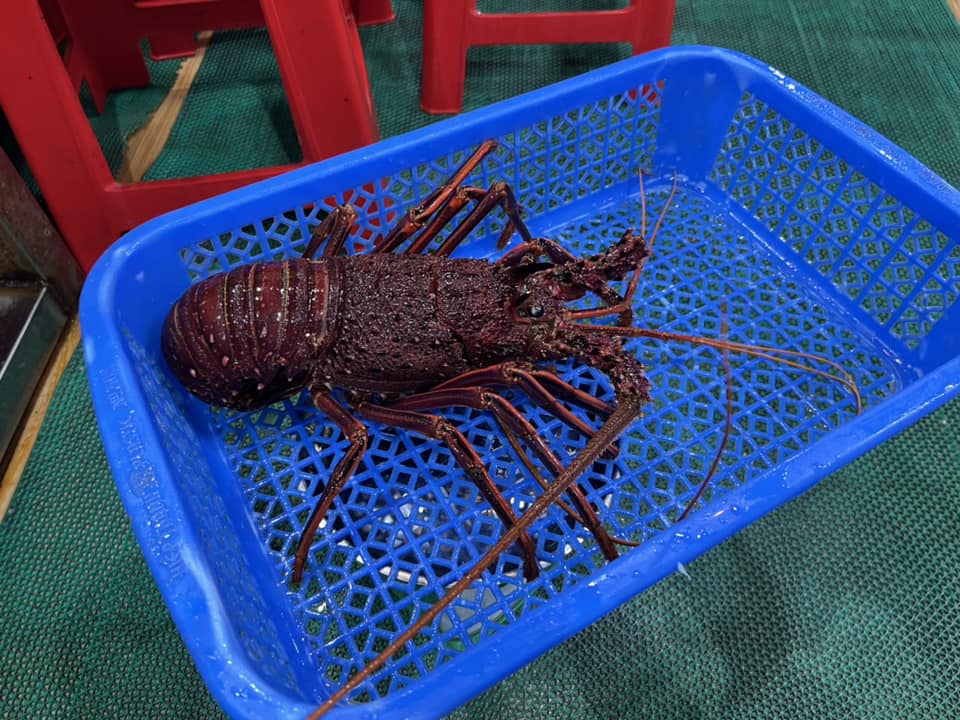
The red spiny lobster, also known as the fire lobster (scientific name: Panulirus longipes), is a rare, highly nutritious seafood delicacy, often hailed as the “king” of seafood in Côn Đảo.
Red spiny lobsters have a smooth, glossy shell in shades of reddish-brown to purplish red, marked with small round spots or white to orange-red speckles. They have long legs and belong to the decapod (ten-legged) crustaceans. Adult lobsters typically measure 20–25 cm in length, with some reaching up to 30 cm, and can weigh close to 1 kg. Scientific literature notes that this species inhabits rocky seabeds and coral reefs in tropical and subtropical waters of the Pacific and Indian Oceans.
In Vietnam, the red spiny lobster is listed in the Red Data Book and falls under the category of aquatic species permitted for regulated harvest and trade. Its distribution ranges from Quảng Bình southward through Khánh Hòa, Ninh Thuận, Bình Thuận, to Bà Rịa–Vũng Tàu.
Red spiny lobsters in Côn Đảo grow slowly and are generally smaller than other lobster species. Notably, they cannot be farmed in cages and must be wild-caught, which contributes to their firm, resilient flesh and a naturally sweet flavor with a hint of ocean salinity. Research shows that red spiny lobster meat is high in protein while low in fat, carbohydrates, calories, and cholesterol, making it beneficial for health. It is also rich in omega-3 fatty acids, which help protect cardiovascular health—suitable for people managing heart disease or diabetes.
The most prized and nutritious part is the roe (coral) that runs along the spine toward the head. During winter, the roe develops further, forming a golden-yellow layer along the back and a larger mass in the head. Red spiny lobster roe is considered exceptionally delicious and nourishing, offering rich flavor without concerns about weight gain.
This lobster can be prepared in many exquisite dishes, such as cheese-grilled red spiny lobster, garlic-butter grilled lobster, lobster porridge, tamarind-sauce lobster, beer-steamed lobster, and mayonnaise lobster with fruit.
To prepare the lobster properly, some technique is required. For frozen lobster, thaw first, scrub clean with a brush, then firmly separate the head and tail by pulling them apart. Place on a cutting board and use appropriate knives and tools to portion the meat as desired. For live lobster, preparation is more challenging due to movement; it is common to place the lobster on ice to stun it before separating the head and tail.
After removing the meat, the shells and antennae can be chopped and simmered in boiling water or coconut water to create a flavorful broth or porridge base, seasoned to taste.
Red spiny lobster is a rare, premium delicacy in Côn Đảo and not easy to find. The island’s residents primarily rely on fishing, so travelers hoping to taste this specialty should visit local fishing villages—peaceful, picturesque communities known for their warm hospitality. There, visitors may purchase red spiny lobster and other renowned Côn Đảo seafood. Another option is the seafood market on Trần Huy Liệu Street, which operates in both daytime and evening sessions, bustling with activity until late at night. The market offers a wide array of fresh local seafood, including red spiny lobster, giant limpets, moon crabs, blue crabs, oysters, Spanish mackerel, sardines, and squid.
When buying red spiny lobster, pay attention to color and body shape, and look for individuals with thick, golden roe running along the spine. If possible, purchase during winter, when the roe is at its richest and most developed.