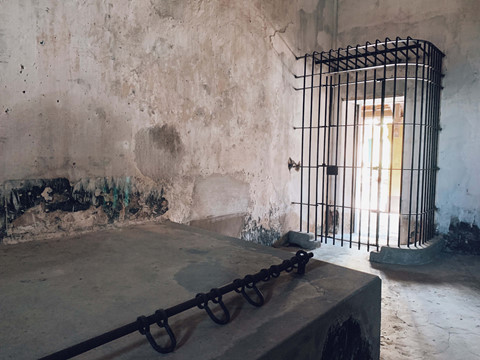
Revolutionary journalism within the Con Dao prison system emerged when large numbers of communist prisoners were exiled to the island, particularly after the 1930–1931 revolutionary uprisings. Waves of Party members and patriotic citizens were arrested and deported during the French colonial “White Terror,” turning Con Dao into a horrifying prison complex under the brutal control of the infamous warden Bouver.
Each year, between 10% and 15% of the prisoners died. Faced with this terrifying reality, communist inmates were confronted with a stark choice: slowly perish on this remote island, or unite and fight to reclaim their basic rights, their dignity, and ultimately, their chance to survive. To resist, they needed solidarity, leadership, and an organized core.
After many discussions, the first Communist Party cell inside Con Dao Prison was established in early 1932. It became the nucleus that unified leadership and coordinated collective struggle, compelling the prison authorities to respect certain regulations: fairer distribution of food and supplies, the right to study, the right to read newspapers and books sent by families (even in foreign languages), and protection against torture and mistreatment. Following waves of strikes and protests, prison guards were forced to concede several demands, reducing forced labor and allowing time for study and reading.
The First Prison Newspapers (1934–1935)
In 1934, the first underground political newspaper produced by the communist prisoners appeared, titled “Bàn Góp” (Contribution). It was hand-copied in multiple versions and circulated secretly.
By late 1935, another paper called “Ý Kiến Chung” (Common Opinion) was created in Cell Block 3 of Banh I. Written on small 13 × 19 cm school notebook paper, it served as an ideological forum for discussions arising from study sessions of Marxism–Leninism. Each issue included news, commentary, editorials, and theoretical essays. The paper circulated covertly as disguised letters passed between inmates.
Historian Trần Văn Giàu later noted that Ý Kiến Chung functioned as a genuine theoretical journal, addressing major questions of the Indochinese Revolution: issues concerning Laos, Cambodia, ethnic minorities, and clarifying concepts only briefly outlined in the 1930 Political Thesis.
Around the same time, prisoners in Cell Block 5 published “Người Tù Đỏ” (The Red Prisoner), a smaller 9 × 13 cm weekly paper. It provided news on ongoing struggles and offered Marxist–Leninist education in a question–answer format.
Nguyễn Văn Cừ, who later became General Secretary of the Communist Party of Vietnam, served as its editor-in-chief and primary writer. Many inmates across Banh I and II actively contributed articles.
Later, Người Tù Đỏ was moved to Cell Blocks 6 and 7 and renamed “Tiến Lên” (Advance), becoming the official organ of the prison Party cell. Editors included Hồ Văn Long, Phạm Hùng, and Nguyễn Công Khương (Lê Văn Lương).
The 1945 Moment: The Birth of “Độc Lập”
By late August 1945, after the Japanese surrender, the last Japanese troops and their collaborators left Con Dao. The island remained with nearly 3,000 prisoners supervised by a few local overseers. A security detachment from Saigon soon arrived to restore order.
The prison Party Committee decided to form an armed force and immediately launched a new public newspaper to explain the Việt Minh program and revolutionary line.
This paper, titled “Độc Lập” (Independence), was edited by Nguyễn Công Khương (Lê Văn Lương), with contributors including Nguyễn Xuân Hoàng, Trịnh Đình Trọng, Nguyễn Văn Vịnh, Nguyễn Mạnh Hoan, and the monk Thiện Chiếu.
Printed using spirit duplicators on small 16 × 20 cm notebook sheets, about 20 copies per issue, Độc Lập was a milestone: the first openly published revolutionary paper in a place long known as “hell on earth.”
The Emergence of the Prisoners’ Union and New Publications (1950s)
In November 1950, the prison warden reluctantly allowed the formation of the Prisoners’ Union, a rare exception in the 88-year history of Con Dao Prison. The Union’s executive committee was publicly listed.
The Union published a journal titled “Côn Đảo Mới” (New Con Dao), serving as the collective voice of prisoners. Other cell blocks also produced newspapers such as:
- Đời Sống Mới (New Life)
- Văn Nghệ (Arts)
Wall newspapers appeared across many prison workshops:
- Bạn Tù (Cellmate) – Death row block
- Đoàn Kết (Solidarity) – An Hải farming unit
- Thợ Hồ (Bricklayer) – Construction unit
- Thắng Lợi (Victory) – Firewood unit
- Tiền Phong (Vanguard) – Chỉ Tồn workshop
- Lao Động, Công Nhân – Other prison sectors
Though their quality varied, these publications fostered intellectual life, education, and unity among prisoners.
The Struggle Years: 1945–1973
Two important documentary volumes were produced during this period:
- “Địa Ngục Trần Gian” (Hell on Earth) – exposing French atrocities.
- “Bản Án Xâm Lược Pháp” (Indictment of French Aggression) – published by the Con Dao Propaganda Office.
A notable publication was “Sinh Hoạt” (Activities), first released after a victorious 19-day hunger strike at Camp 6B. The 40-page issue included prose, poems, stories, songs, and began with Tố Hữu’s “October Song.” Ho Chi Minh’s poem “Thân thể ở trong lao…” was placed prominently as a guiding motto.
The second special New Year issue (1973), released after the Paris Peace Accords, reflected cautious optimism, self-reliance, and vigilance against enemy deception.
From 1972 to late 1973, nearly 50 issues were published in Camp 6B alone, including:
- Xây Dựng (Construction) – 10 issues, the most influential
- Rèn Luyện (Self-Discipline)
- Đoàn Kết (Unity)
- Niềm Tin (Faith)
- Tiến Lên (Forward)
- Vươn Lên (Rise Up) – Youth unit
Producing Newspapers in Prison: A Heroic Effort
Creating a single issue required extraordinary effort:
- Paper was scarce; prisoners used school notebooks, or repurposed cigarette packs, parcel wrapping, envelope backs, even layers peeled from soaked cardboard.
- Pen refills were smuggled in; ink was homemade from improvised pigments such as turmeric, antiseptic solutions, or herbal powders.
- Manuscripts were written in secret corners under dim light, with lookouts guarding against sudden raids.
- If discovered, material had to be destroyed instantly to protect the organization.
Completed issues were copied and circulated room to room. During lockdown hours, prisoners gathered around a single reader. These newspapers were treated like precious treasures — symbols of intellect, resistance, and unity behind bars.
A Legacy of Courage and Intellectual Resistance
The prison newspapers of Con Dao were not merely handwritten sheets. They were:
- Weapons of ideological struggle
- Records of collective resilience
- The spiritual lifeline of incarcerated revolutionaries
They preserved stories of sacrifice, unity, and indomitable will — the same spirit that helped prisoners endure decades of brutality in what was once the most feared prison of Indochina.
Nguyễn Thị Thiện
Bà Rịa – Vũng Tàu Museum