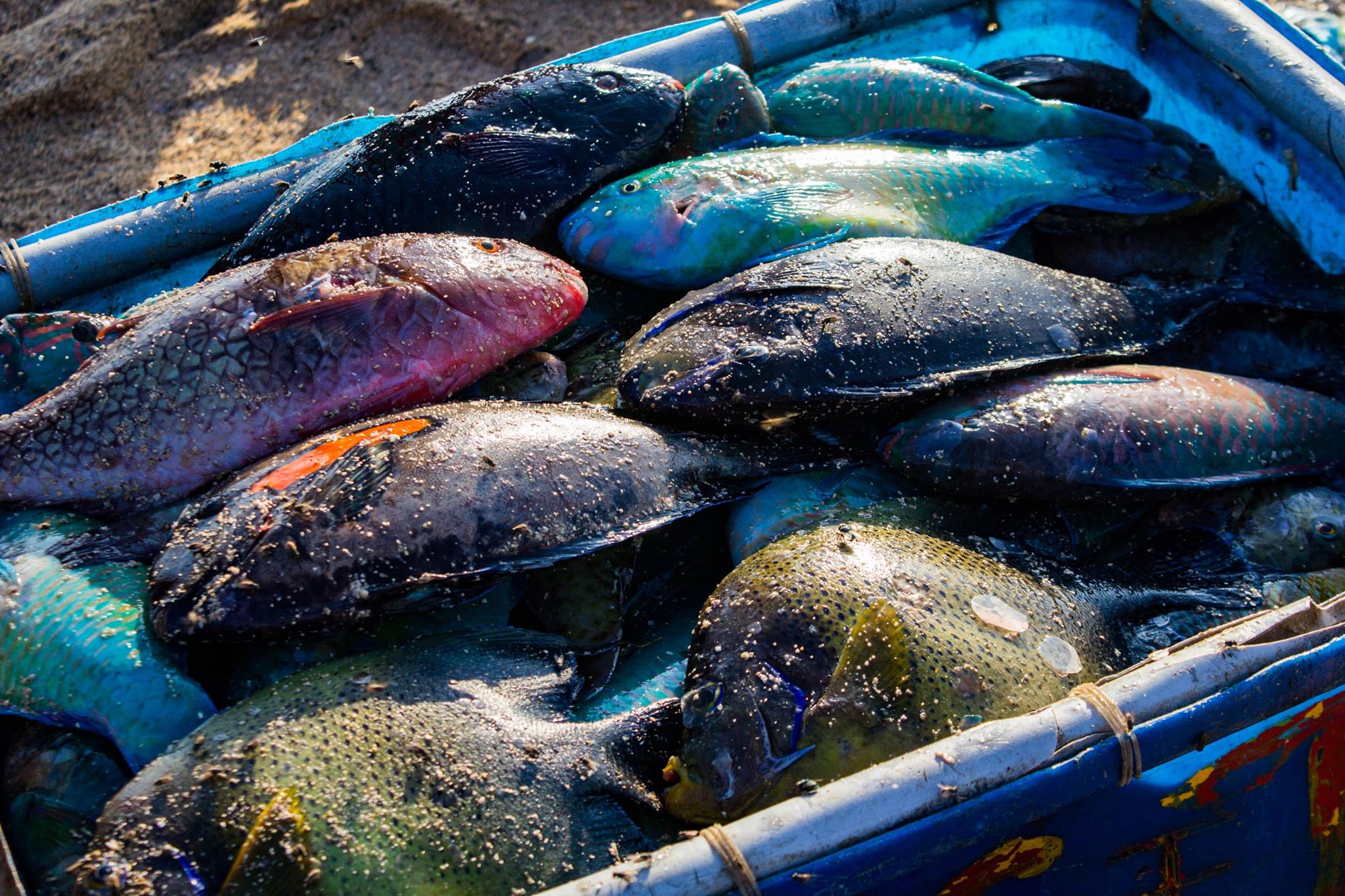
According to marine surveys, Phu Quy Island hosts an impressive biodiversity with around 152 fish species living in coral reef ecosystems and 50 additional species inhabiting seagrass beds. Many of these fish have high economic value—such as grouper, parrotfish, rabbitfish and snapper. Several species were once abundant around Phu Quy (and still exist today, though in smaller numbers). Among the most notable are:
Mackerel Scad (Cá Nục Sỏi)
This species belongs to the bigscale scad family and is commonly found in the East Sea, especially in rocky, reef-filled areas. In Phu Quy, locals also call it “flag-tail mackerel.” The peak season runs from September to November.
To catch mackerel scad, fishermen typically set up “chà” (artificial fish shelters), then cast two to three surrounding nets to encircle the fish. In the past, one good “chà” could yield 300–500 kg of fish in a single catch. Another traditional method is tube-line fishing, using a 30 m line with hooks placed 1 m apart, each decorated with shimmering white fibers. As the line moves with currents, the fibers flutter like bait, attracting schools of mackerel scad to strike. Skilled fishermen can haul in large numbers in one lift.
Red Snapper (Cá Hồng)
Once extremely common in Phu Quy waters, red snapper is a predatory species that thrives in tropical seas and lives near the seabed. A mature fish can reach 50 cm in length and weigh up to 5–6 kg. Spawning season lasts from March to July, peaking in May. Before liberation, local fishermen often rowed just 200 m offshore and used seine nets to catch red snapper and juvenile grouper.
Yellowtail Scad (Cá Dảnh)
Phu Quy has two types: yellowtail scad “dảnh bông” and “dảnh vẩy.” The largest individuals grow up to 25 cm. When fermented, yellowtail scad produces a fish sauce with exceptionally high protein content and remarkable flavor. Locals also sun-dry the fish as provisions during stormy seasons.
Boneless Fish (Cá Không Xương / Cá Lưỡi Dong)
This unique species—known locally as “paper fish” or “flatmouth fish”—has a soft, noodle-like texture. Round and about the size of a small bowl, the fish has rough yellow skin with black stripes and wing-like fins resembling frog legs. It swims extremely fast. When caught, fishermen often keep them in tanks as ornamental fish.
Electric Ray (Cá Chào Dao)
A member of the stingray family, the electric ray appears year-round in Phu Quy. It has a flat, square body; large individuals can be as big as a wooden bed plank. Its skin is smooth and dark brown on top, with a white underside. The ray prefers warm currents and buries itself in sandy seabeds, leaving only its eyes and breathing holes exposed.
Traditionally, fishermen caught electric rays using large purse-seine nets up to 10 km in circumference. Occasionally, they encountered the phenomenon known locally as “chào dao đóng mẻ”—when a disturbed school of rays stacks tightly together, motionless, making them easier to harvest by diving down and lifting each one individually. The fish is usually filleted and sun-dried.
Triggerfish (Cá Bò)
There are five triggerfish species commonly found in Phu Quy’s waters: bò ngừ, bò dẹp, bò hòm, bò gai and bò hút. Triggerfish swim in schools in mid-water zones while searching for food. Their spawning season lasts from February to May. They have rough backs and sharp dorsal spines. Fishermen catch them using handlines or small trawl nets.