
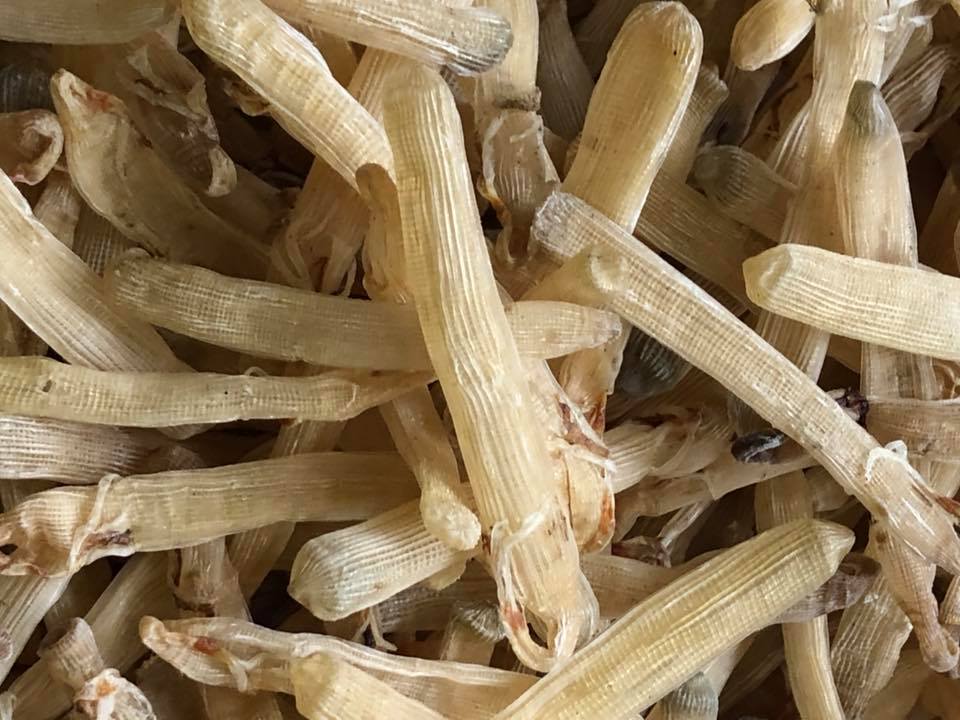
Sá sùng—scientifically known as Sipunculus nudus—is one of Vietnam’s rarest and most precious seafoods, historically presented as a tribute to the kings. In Vietnam, sá sùng is harvested mainly along the northeastern coast and in a few southern regions, including the waters of Con Dao.
Locally, sá sùng is known by many names such as địa sâm, cạp đất, and bi bi. In Van Don (Quang Ninh), where it is most abundant, residents simply call it con mồi. Sá sùng belongs to the phylum of segmented marine worms. Fresh specimens generally measure from 5–10 cm, with some growing as long as 15–20 cm. They live only in sandy coastal areas where the tide rises and falls, and their appearance resembles a plump, colorful marine worm.
A Seasonal Delicacy of Con Dao
In Con Dao, sá sùng appears only from March to July, emerging on sandy beaches during low tide. Harvesters follow winding trails on the sand, then dig deeply using specialized tools to extract the worms.

After a long day of labor, sá sùng is brought home for a meticulous cleaning process. The worms are washed in seawater, their insides removed, then rinsed thoroughly with salt to eliminate odor. They are lightly boiled before being dried for preservation. Fresh sá sùng can be cooked into porridge, soup, grilled dishes, sweet-and-sour stir-fries, crispy fry, salads, and more. However, the most beloved preparation is simply grilled sá sùng—dipped in chili sauce, salt-pepper-lime, yielding a flavor that is fragrant, crunchy, sweet, and uniquely rich.
Fresh Sá Sùng Porridge – A Local Favorite
Con Dao residents often prepare fresh sá sùng porridge. The worms are scrubbed with salt, boiled with slices of ginger, and set aside. The flavorful cooking broth is then used to simmer rice into a smooth, aromatic porridge. Once done, the boiled sá sùng is added, topped with scallions and pepper. After a long day of work, a bowl of fresh sá sùng porridge brings remarkable comfort and revitalization.
The High Value of Dried Sá Sùng
Dried sá sùng is considered the most valuable form. The simplest preparation is pan-roasting, eaten as is or soaked in fish sauce with pepper. This dish is gentle on the stomach and often recommended for postpartum women. Wealthier families traditionally use sá sùng to enhance broth, especially for soups. Many famous pho restaurants in Hanoi and Nam Dinh add sá sùng to their stock to achieve a naturally sweet, irresistible aroma.
Nutritional and Medicinal Benefits
Scientific studies show that sá sùng contains essential amino acids such as glycine, alanine, glutamine, taurine, and succinic acid, along with various minerals beneficial to human health.
In traditional Eastern medicine, sá sùng is considered a nourishing tonic—salty in flavor, cooling in nature, effective in strengthening the body, clearing heat, improving lung function, calming cough, supporting digestion, and revitalizing those with weakened health. It can be cooked with herbal medicines or steamed inside a black chicken to enhance vitality.
A Precious Species in Decline
Due to overharvesting, sá sùng populations in Con Dao—and across Vietnam—have sharply decreased. Today, fresh sá sùng in Con Dao costs around 500,000 VND/kg, while dried sá sùng ranges from 1.8–2.4 million VND/kg. Visitors can purchase genuine sá sùng at Con Dao Market, local specialty shops, or major seafood suppliers on the island.