


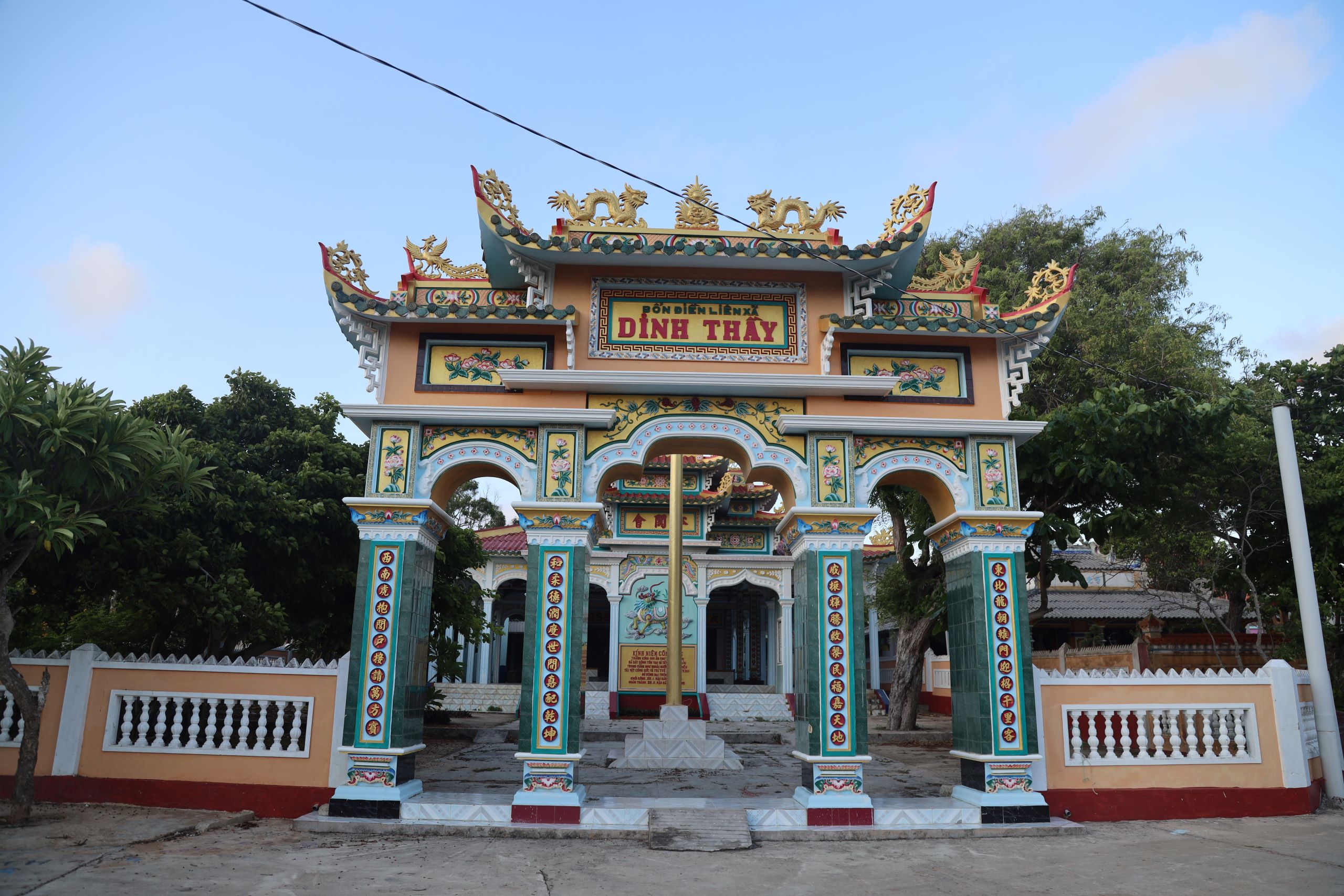
To make worship more convenient for islanders, Vietnamese settlers on Phu Quy built the Thầy Sài Nại Temple (Dinh Thầy) in the 16th century, on a hill in Ngũ Phụng, northeast of An Hòa village. For centuries, it has been one of the island’s most important spiritual sites dedicated to Thầy Sài Nại, a revered protective deity.
Architecture of the Temple
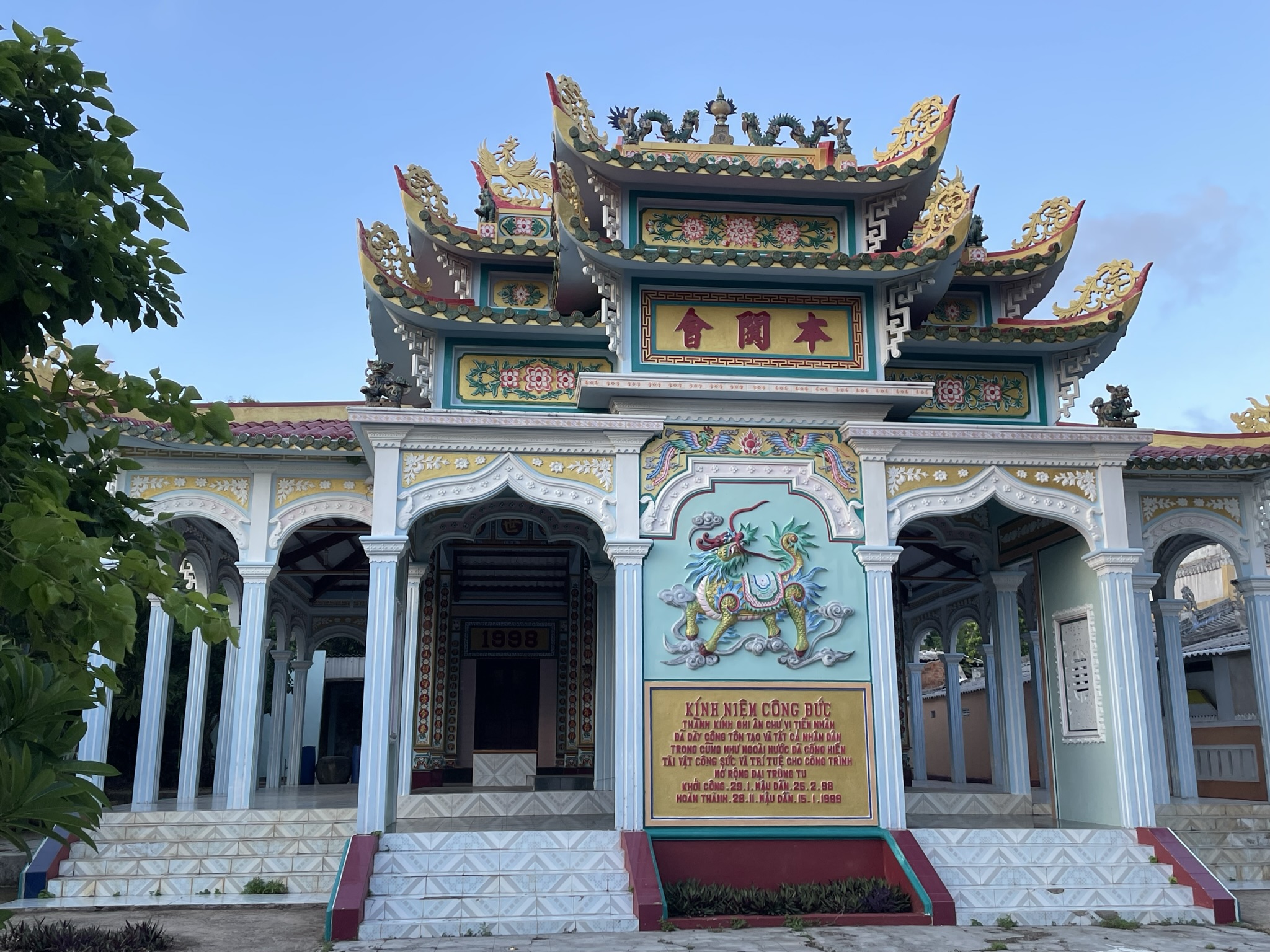
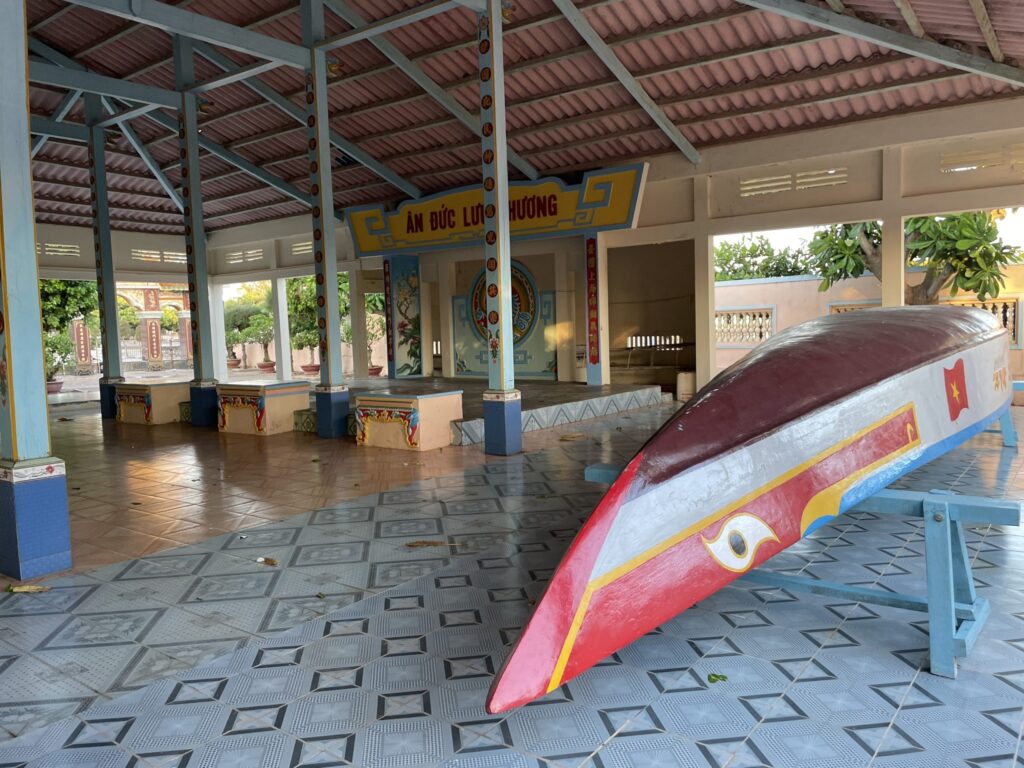
The architectural complex of Dinh Thầy includes the main gate, flagpole, screen wall (bình phong), ceremonial hall (võ ca), and the main sanctuary. Its façade faces the southwest.
The main gate, ceremonial hall, and sanctuary adopt traditional Vietnamese–Chinese temple architecture:
- a three-entrance ceremonial gate,
- a square main hall with a four-sloped roof,
- roof decorations featuring dragons, phoenixes, flowers, clouds, and other sacred motifs.
Inside the main sanctuary are three altars:
- the central altar dedicated to Thầy Sài Nại, crafted from lacquered wood and adorned with the character “Thần” (Spirit);
- the left altar honoring the Tiền Hiền (Founding Elders);
- the right altar dedicated to the Hậu Hiền (Later Elders).
The altars are decorated with carvings of dragons chasing a pearl, mythical animals, plum blossoms, orchids, chrysanthemums, bamboo, and traditional Sino-Vietnamese parallel verses.
Thầy Sài Nại was honored with eight royal decrees (sắc phong) by Nguyen Dynasty emperors, which are carefully preserved and rotated annually among the nine villages of the island.
Every year, on the 4th day of the 4th lunar month, island communities hold a solemn procession to bring the royal decrees from the village responsible for safeguarding them to the temple for ceremonial worship. This festival follows long-standing rituals transmitted through generations.
The Origin Story: How Dinh Thầy Was Founded
According to oral tradition, one morning in the past, a group of children playing near Bàu Bưng suddenly witnessed one boy falling into a trance and proclaiming himself to be Thầy Nại. Confused, the children brought him back to the village.
At the village gate, the spirit revealed that his burial site lay on a cape jutting into the sea (present-day Long Hải). Seeing the villagers’ devotion, he wished to “borrow a child’s body” to deliver a message:
“If the people build a temple for me, I shall protect the village and bless the nation with peace and prosperity.”
The villagers gladly asked the spirit to choose a site for the temple. The possessed boy led them to the current location of Dinh Thầy. But at the center of the chosen land stood a colossal duối tree, so large that four adults could not wrap their arms around it. Because the tree stood exactly at the “heart” of the future temple, it had to be removed.
Men from all 12 villages were mobilized to clear the area, yet the enormous tree remained immovable. Suddenly, the boy again entered a trance, proclaimed himself Thầy Nại, and asked villagers to prepare offerings—porridge, sugarcane, incense—so he could summon spirit soldiers (âm binh) to help.
After the ritual, the boy approached the tree, lifted it from the ground, and carried it away. The people built a simple shrine of bamboo and clay on the cleared land. Through many renovations over centuries, the shrine evolved into the temple seen today.
Recognizing its cultural and spiritual importance, the People’s Committee of Bình Thuận Province designated Thầy Sài Nại Temple a Provincial Historical–Cultural Relic on September 7, 2010 (Decision No. 1993/QĐ-UBND).
The Miracles of Thầy Sài Nại
Islanders believe that Thầy Sài Nại is highly responsive and spiritually powerful. They often recite his sacred invocation when seeking blessings:
“Thầy Sài Nại Thông linh Chiêu ứng… Trung đẳng thần phù hộ…”
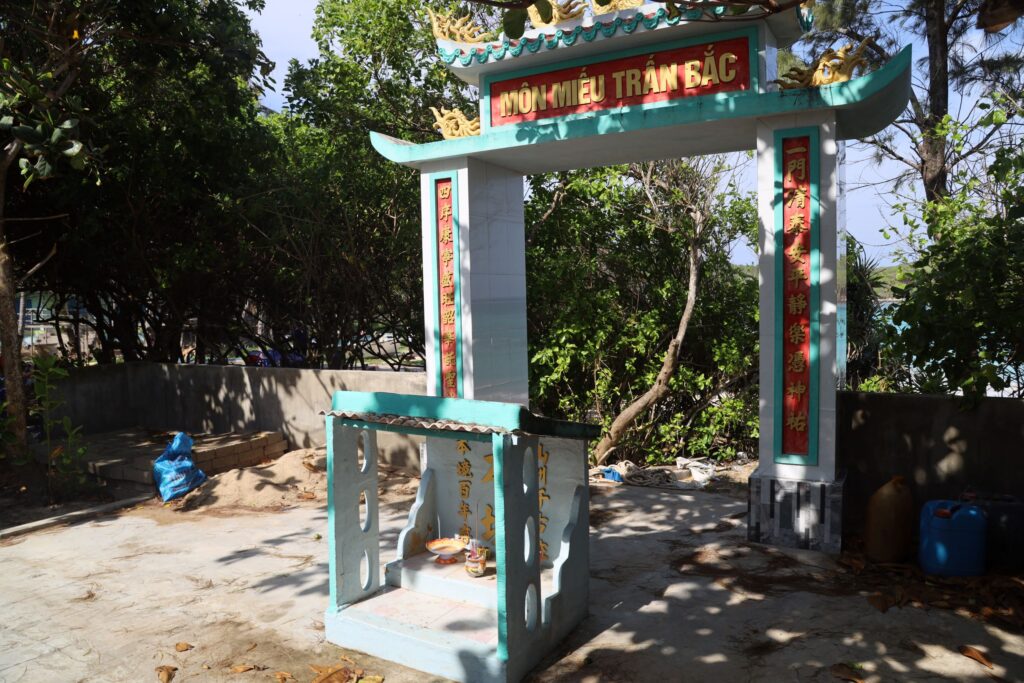
Fishermen recount many occasions when boats were trapped on coral reefs. Even large vessels could not pull them free—until the families made offerings at Thầy’s tomb. After the prayers, the boats miraculously lifted away from the rocks.
The Nguyen kings’ eight royal decrees further affirm his status as a protective deity. Each year, villagers reenact the solemn procession of the decrees, maintaining rituals passed down over centuries.
Cultural Significance
Dinh Thầy is more than a religious site—it is a repository of Vietnamese–Chinese cultural exchange, illustrating how communities adapted and blended spiritual traditions while inhabiting a remote island environment.
For over 300 years, successive generations—first Cham, then Vietnamese settlers—have cared for the temple, preserved its rituals, and maintained worship practices that remain largely intact today.
With its enduring tangible and intangible heritage, the temple stands as a symbol of:
- spiritual protection,
- community identity,
- cultural continuity,
- and the harmonious coexistence of diverse cultural roots on Phu Quy Island.

:+A+Sacred+Cultural+Landmark+of+Phu+Quy+Island)