
This was Phú An Camp (also known as Camp VI). Most notably, it was here that the Party Committee named after the steadfast revolutionary and Hero of the People’s Armed Forces, Lưu Chí Hiếu, was established—marking a major, comprehensive leap in political consciousness, organizational capacity, and struggle of the detained political prisoners at Côn Đảo.
Following the tour guide, we left Phú Bình Camp and proceeded along Lưu Chí Hiếu Road toward Phú An Camp. Along the way, the guide explained that among the four clusters of sites included in the heritage tour organized by the Côn Đảo National Historic Site Conservation Center—the Governor’s Residence, Phú Hải Camp, Phú Tường Camp, Phú Bình Camp, and Phú An Camp—Phú An is the farthest, located on the road toward Cỏ Ống, while the other three lie within the town center.
“Farthest” is relative on the small island of Côn Đảo; for us, it still felt very close. Before the story of Côn Đảo’s prisoners had gone far, we heard the guide announce, “We’ve arrived—please get off the bus.”
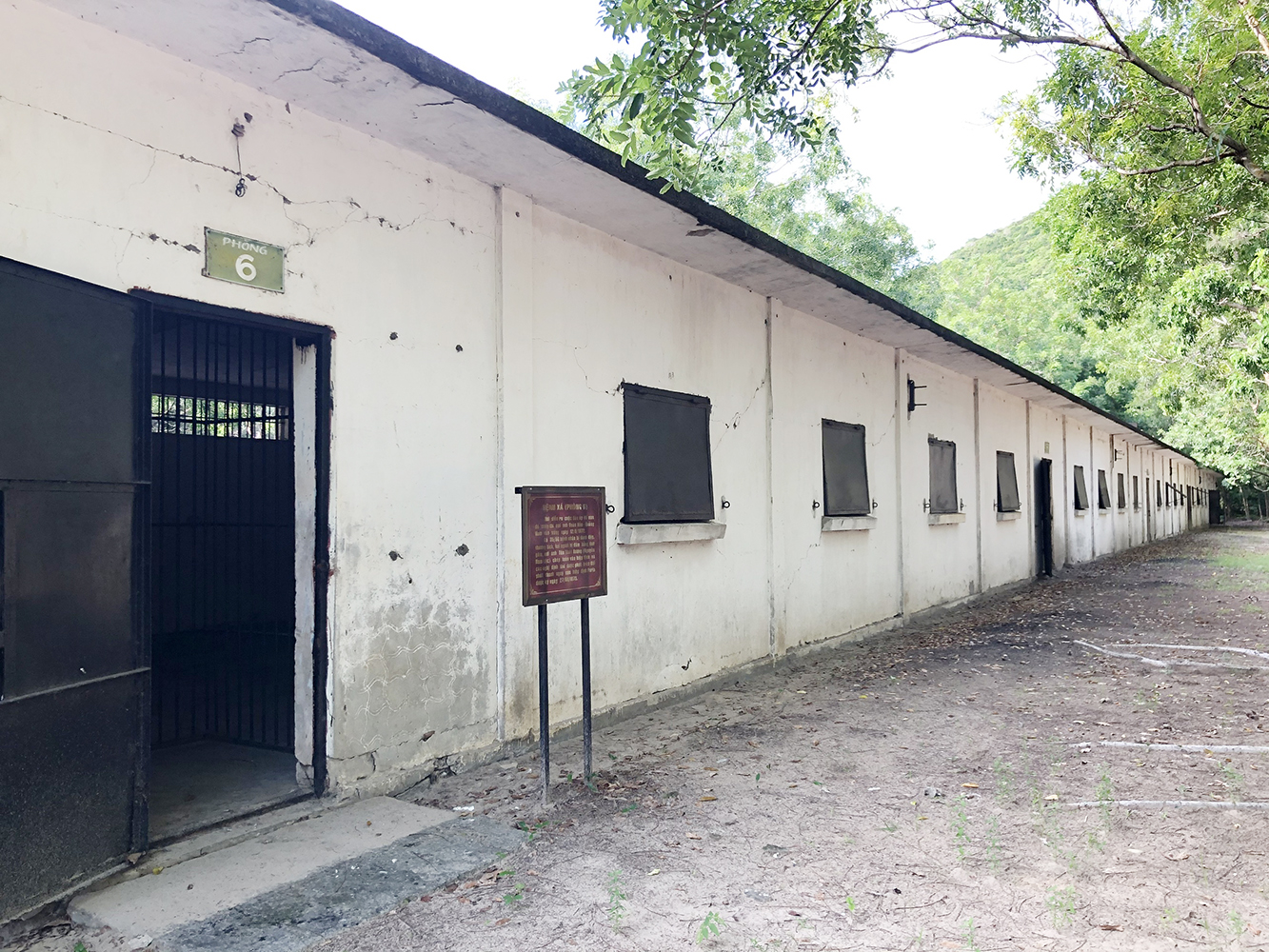
At first glance, Phú An Camp’s architecture closely resembles that of Phú Bình Camp: twin iron gates with diamond-patterned bars, weathered concrete gate pillars, and a steel nameplate painted blue with lettering identical in style and color. From outside, one can see nearly all structures within the camp. Yet, as with Phú Bình, another form of punishment employed by the U.S.–Saigon regime here was the harsh climate of Côn Đảo itself.
“This area lies on sandy ground near a mountain hollow,” the guide explained. “During the day it is scorching; at midday it is impossible to cross between cell blocks barefoot. At night, temperatures drop sharply, and wind swirling back from the mountain hollow creates a ‘toxic wind’ that severely affects prisoners’ health. The low-roofed, tin-covered cells absorb searing heat by day and turn cold quickly at night. Even healthy people could hardly endure it—let alone prisoners already weakened by beatings, torture, and hunger after transfers from other camps.”
According to the guide, Phú An Camp covers 29,394 m², divided into Zones A and B. Each zone has two blocks with ten rooms; each room measures over 100 m². Zone A was put into use in 1970. In August 1970, the U.S.–Saigon authorities established a pilot Psychological Warfare Battalion at this camp, directly supervised by American and Taiwanese advisers. Zone B initially held resistant political prisoners screened from the first cohort of that pilot unit. However, from December 1971, when detained political prisoners were transferred from Phú Thọ Camp (Camp I)—a battle-hardened collective forged through hundreds of struggles against denunciation campaigns and forced renunciations of the Communist Party dating back to the U.S.–Diệm era—the prisoners’ movement entered a new phase: organized, disciplined struggle under Party leadership, embodied by the Lưu Chí Hiếu Party Committee.
The guide then invited us to stop before Room No. 3, where the Lưu Chí Hiếu Party Committee was founded on February 3, 1972. The committee comprised 62 Party members, organized into 10 cells across the rooms, with an executive structure from camp-wide leadership down to each room to sustain activities in line with Party directives. The committee also published an internal bulletin titled “Xây dựng” (Construction), featuring news, current affairs, commentary, reportage, poetry, and essays exposing enemy schemes and highlighting the unity and struggle of political prisoners. Major holidays and historical anniversaries were observed solemnly—flags and revolutionary slogans displayed openly, cultural activities held, traditional stories told, and political education conducted—like a liberated zone within the prison.
With a strong Party organization, tight coordination, collective solidarity, and high fighting spirit, detained political prisoners achieved notable victories, gaining significant political leverage. By late 1974, after learning the contents of the Paris Peace Accords agreed between the Government of the Democratic Republic of Vietnam and the United States, the Lưu Chí Hiếu Party Committee established Military and Security Committees to prepare for seizing the moment and self-liberation.
The birth of the Lưu Chí Hiếu Party Committee marked a decisive maturation of the political prisoners. It truly became the combat headquarters leading all activities and struggles at Phú An Camp, contributing decisively to directing the uprising that liberated Côn Đảo on the night of April 30 and the early morning of May 1, 1975.