The Côn Đảo long-tailed macaque (scientific name: Macaca fascicularis condorensis), known in English as the Côn Sơn long-tailed macaque, is a subspecies of the long-tailed macaque found in Vietnam, with populations concentrated in Côn Đảo and Phú Quốc. This subspecies is considered endemic to Vietnam.
Origins and Formation
According to evolutionary explanations of distribution and subspecies formation, around 18,000 years ago sea levels were much lower than they are today. At that time, the landmass from the Indochinese Peninsula to Bali (Indonesia) formed a broad connected region where long-tailed macaques could spread widely. As sea levels rose to modern levels, islands were formed and macaque populations became geographically isolated. Over time, this isolation contributed to the formation of several subspecies—including the Côn Đảo long-tailed macaque.
Physical Characteristics
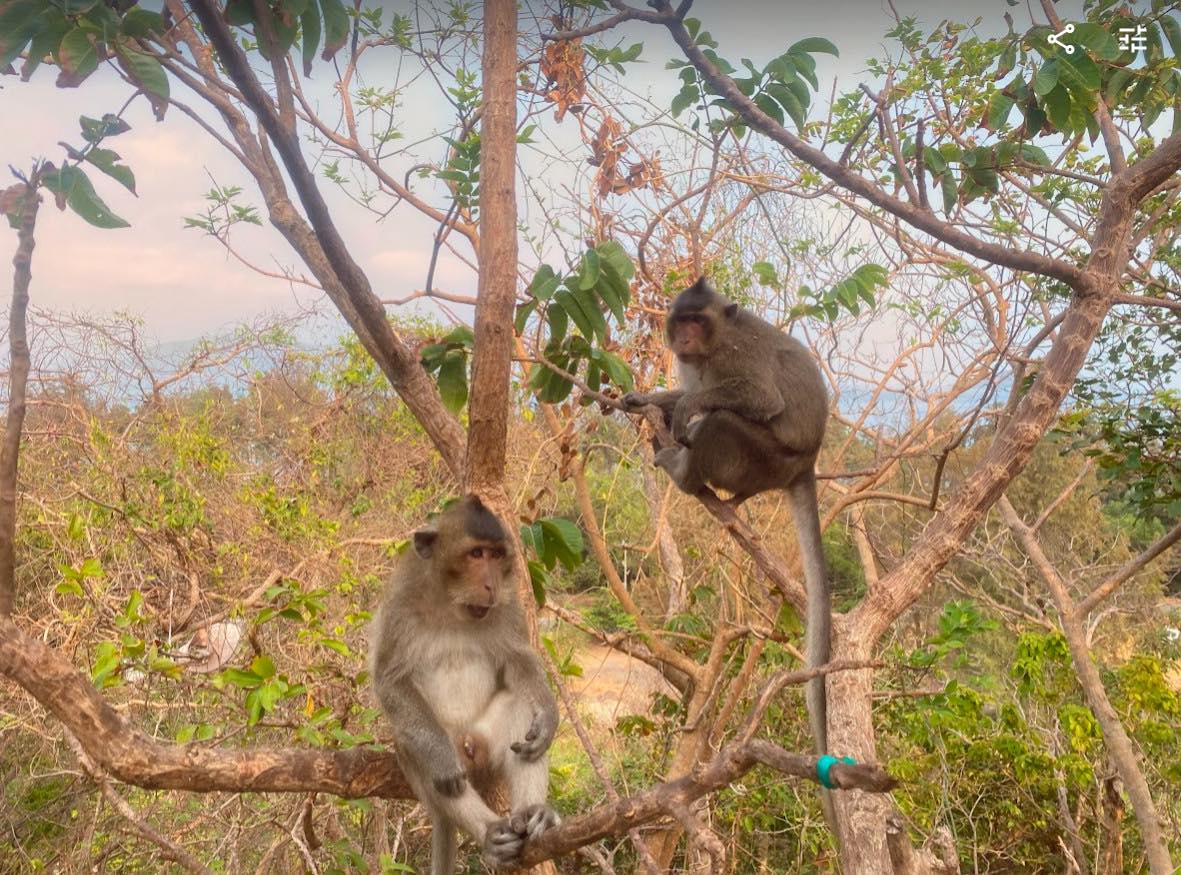
Their coat color typically ranges from gray to reddish-brown, with the rear part of the body usually lighter. Hair on the head grows backward and often forms a small crest. The face is generally pink. Large adult males may have two white tufts on either side of the upper mouth, resembling a moustache. Females tend to have sparser hair around the mouth.
Compared with long-tailed macaques living in mangrove forests such as Cần Giờ and Cà Mau (whose crown hair appears darker), the Côn Đảo subspecies often shows a lighter crown coloration. Newborns are black. The tail is long and well-furred, usually reaching three-quarters or more of the body length. Adult males may have a slightly shorter tail compared with some mainland populations.
Key life-history traits include:
- Sexual maturity: around 50–51 months
- Gestation period: 160–170 days
- Interval between births: about 13 months (ranging 12–24 months)
- Lifespan: approximately 37–38 years
Habitat and Distribution
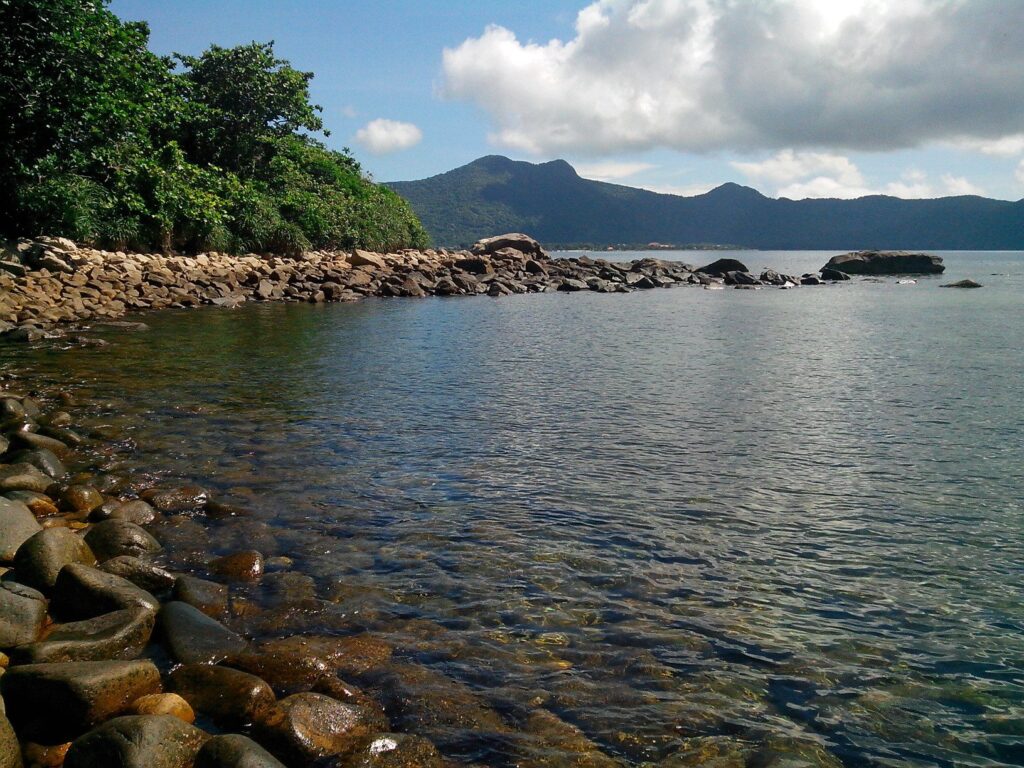
This macaque inhabits a wide range of environments: primary and secondary forests, bamboo forests, evergreen forests, open woodland, riverbanks, coastal areas, mangroves, and along river systems—up to elevations of 2,000 meters. In Côn Đảo National Park, the species is commonly recorded at at least 10 sites across three islands: Côn Sơn, Hòn Bà, and Hòn Bảy Cạnh.
Population Trends and Threats
Before 1975, long-tailed macaques were widely encountered in southern Vietnam, from Thừa Thiên–Huế to Kiên Giang, across an estimated area exceeding 5,000 km². Since 1975, their situation has changed significantly, with populations declining sharply. The number of subpopulations is currently estimated at around 30.
Key drivers of decline include habitat loss and degradation (forest clearing and shrinking natural forest cover), as well as hunting for meat, traditional medicinal products, trade, and export.
Diet, Behavior, and Social Structure
Their diet consists mainly of fruit (about 64%), along with seeds, shoots, leaves, other plant parts, and various animals such as insects, frogs, crabs, and more. They are diurnal (active during the day) and spend much of their time in trees. They are also excellent swimmers and may jump into water from branches.
They are often seen sitting in groups along roads and may show little fear when vehicles pass by.
Côn Đảo long-tailed macaques typically live in troops, rarely appearing alone. Troops have a multi-male, multi-female structure, averaging around 2.5 females per male, and can range from 10 to 100 individuals. Unlike some other macaque species, dominant males may mark territory less frequently. Juveniles spend much of their early years playing, often forming same-sex play groups (males with males, females with females), particularly during the first two years.
The Red-Faced Macaque in Côn Đảo
The red-faced macaque in Côn Đảo is described as having a coat ranging from dark brown to shades shifting between black and red. The underside is always lighter than the upper body. The back is reddish-brown to dark brown, and the face is largely red. Hair on the crown radiates outward, while cheek hair sweeps backward.
This macaque has a thick, short tail, typically no more than one-third the length of the hind foot. Adult males have an unusually long penis, and one of the most notable features is a large, hairless ischial callosity (sitting pad).