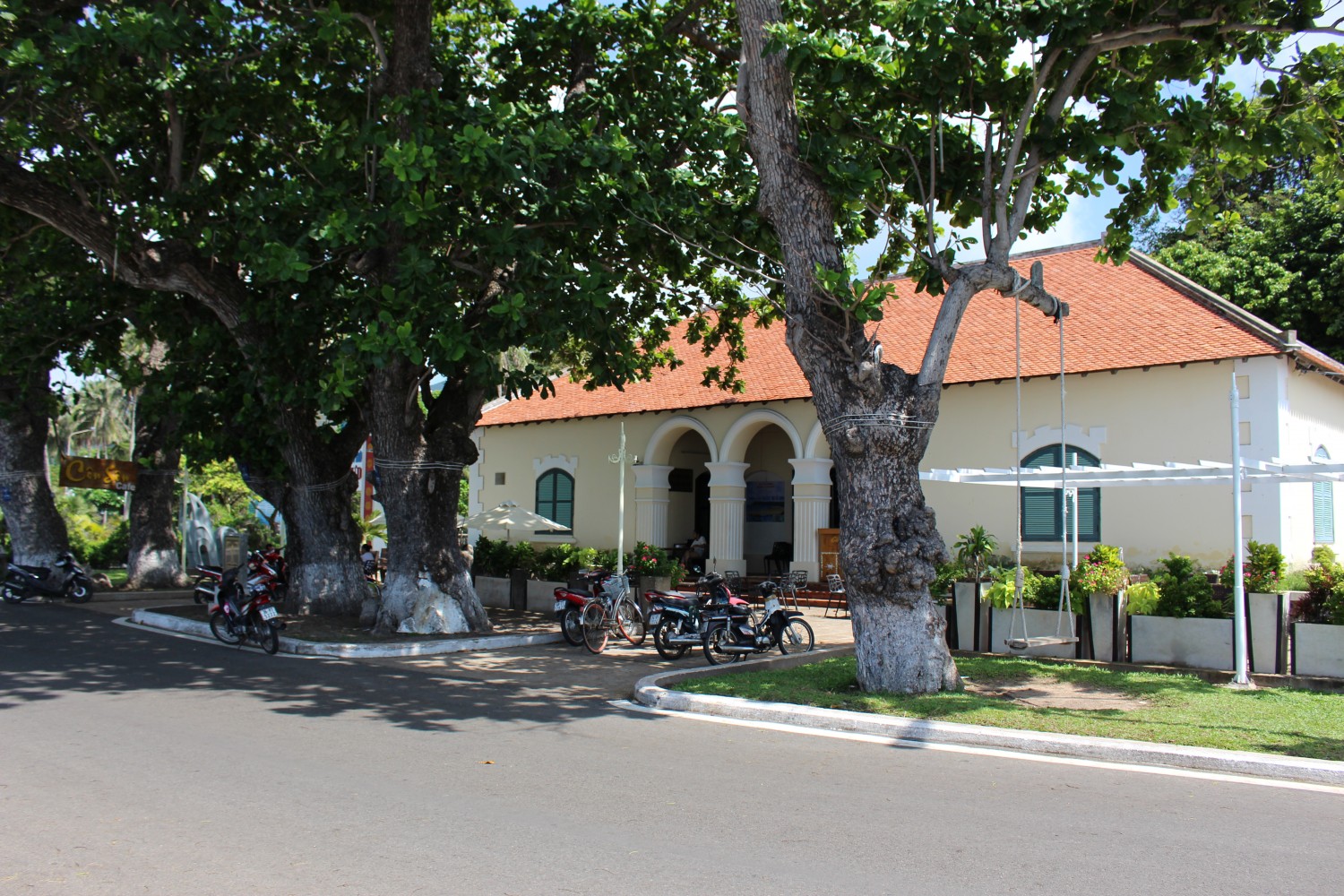
Next to the path leading to Pier 914, in front of the former Island Governor’s Residence, stands a modest Western-style villa nestled beneath the broad canopy of ancient tropical almond trees. This is the Cong Quan House, built by the French in the late 19th century as part of the Governor’s Residence complex. Covering an area of about 150 m², it once served as accommodation for colonial officials.
During the American–Saigon administration, the building was known as the Public House or the Clubhouse, continuing its role as a resting place for government visitors arriving on the island.
Where Composer Camille Saint-Saëns Once Stayed
In 1895, the renowned French composer Camille Saint-Saëns spent a full month here (from March 20 to April 19) at the invitation of his longtime friend Roussrau and Governor Jacke. Welcomed with great hospitality, he lived on the island as an honored guest, wandering the coastal roads, venturing into the lush forest, and absorbing the pristine beauty of Con Dao.
Yet he also witnessed the haunting reality of colonial prisons:
- prisoners forced to stand for hours in seawater collecting coral for lime production,
- breaking rocks under the blazing sun,
- dragging heavy timber through the forest.
On his final night, Saint-Saëns followed the footsteps of inmates to Prison Block I, where he heard a faint two-string fiddle echoing from the cells. The contrast between brutal torture and the prisoners’ unbroken spirit deeply moved him.
That night, inspired by the sound of the ocean, the voice of the violin, and the island’s natural beauty, he stayed awake to complete the final chapter of his opera “Brunechilda.”
In a letter sent to Governor Jacke, he wrote:
“The landscape of Con Dao is magnificent. Of all the places I have seen, none compares. As an artist, I believe where beauty is honored, darkness recedes—and the law becomes almost unnecessary.”
A Lasting French Footprint on the ‘Island of Prisons’
Today, the Cong Quan House has been restored as part of the Dinh Chúa Đảo complex. It remains one of the most refined symbols of French architectural heritage still preserved on an island once known as the “hell on earth.”
Heritage Status
April 29, 1979: Recognized as a Special National Historic Site under Decision No. 54-VHQĐ by the Ministry of Culture and Information.
May 10, 2012: Officially listed as a National Special Relic under Decision No. 548/QĐ-TTg by the Prime Minister.