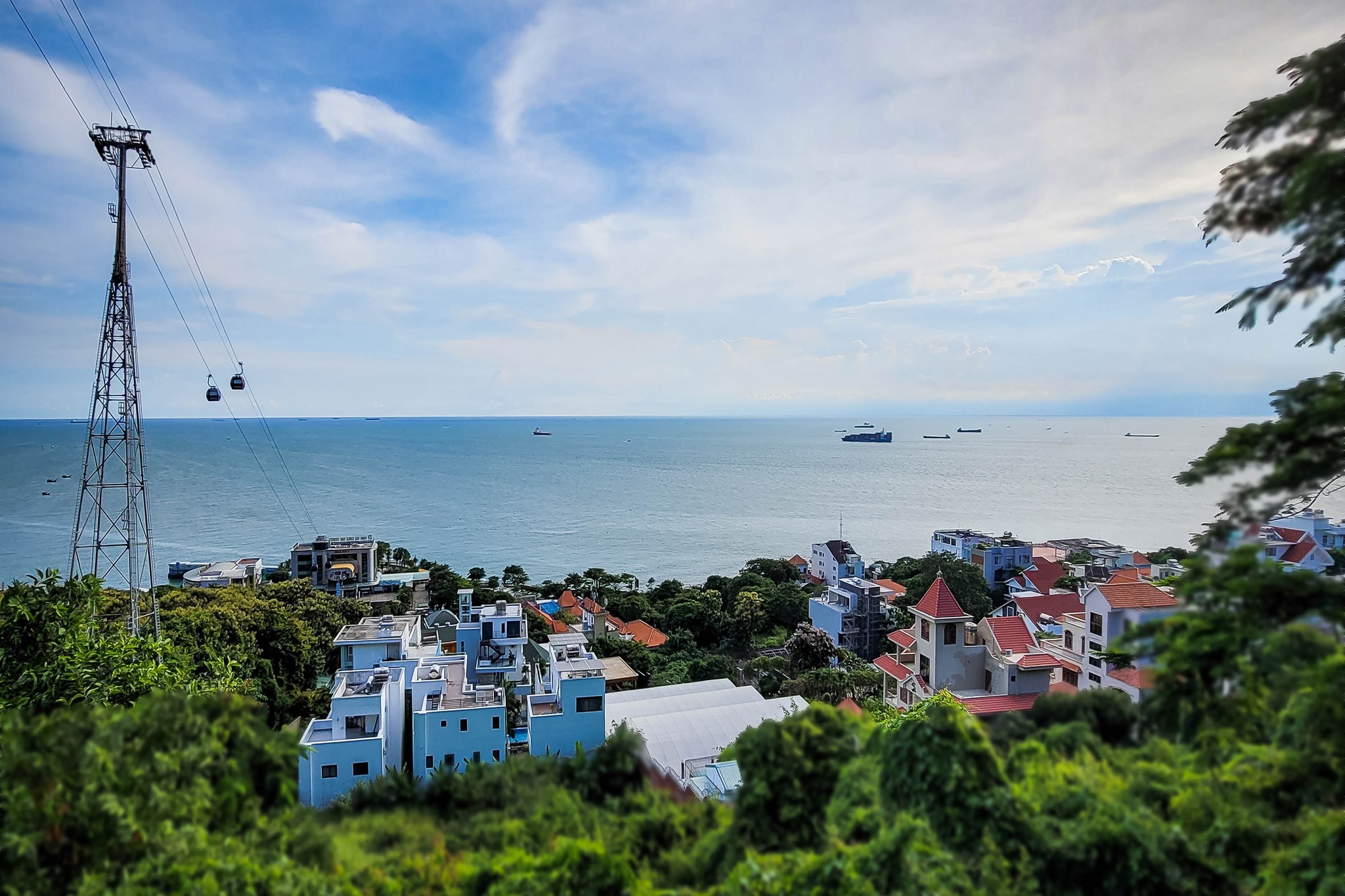
Standing side by side like two inseparable brothers, Big Mountain (Núi Lớn) and Small Mountain (Núi Nhỏ) create the iconic mountain-and-sea landscape that defines the coastal city of Vung Tau. Also known as Tuong Ky and Tao Phung, these two mountains are not only natural landmarks but also the heart of many fascinating local legends.
Big Mountain (Tuong Ky) – The Green Dragon by the Sea
Big Mountain, also called Tuong Ky, covers an area of about 400 hectares and rises to 254 meters at its highest point. In the early 19th century, historical records referred to it as Thac Co Mountain, comparing its shape to a green dragon bathing in the sea, standing proudly between sky and ocean, guiding ships sailing along Vietnam’s coastline. Because otters were often seen on its rocky slopes, locals also called it Ghenh Rai Mountain. Mid-19th century chronicles even described Big Mountain as a natural shield protecting the Can Gio estuary.
According to legend, the name Tuong Ky came from a romantic tale. Long ago, when the area was still wild and filled with tigers, Scholar Hieu and his granddaughter Mai were among the first people to settle here. Scholar Hieu was the teacher of the three Tay Son brothers—Nguyen Nhac, Nguyen Hue, and Nguyen Lu.
One day, Mai was gathering mushrooms in the forest when she was attacked by a tiger. Just as danger struck, a brave warrior appeared and defeated the beast, saving her life. The hero was Le Tuan, a general of Nguyen Hue. Grateful for his courage, Scholar Hieu allowed Le Tuan to marry his granddaughter. Pointing to the mountain, he declared that this place had witnessed their fateful meeting and named it Tuong Ky, meaning “a destined encounter.”
Small Mountain (Tao Phung) – The Golden Fish and the Sea Princess
Small Mountain, also known as Tao Phung, covers about 120 hectares and reaches 170 meters in height. If Big Mountain is the body of a green dragon, Small Mountain is said to be its tail.
The name Tao Phung comes from a magical legend. Long ago, the daughter of the Sea King transformed into a golden fish and swam ashore, where she was caught by a fisherman. Enchanted by its beauty, he brought it to the mountain and kept it in a small stone pool. One day, instead of a fish, a beautiful woman emerged and revealed she was a sea princess. They fell in love and lived happily together.
However, one day a mysterious figure captured her and sealed her inside a shining jade box, turning her back into a golden fish. From then on, the princess could only return to meet her husband once every five years, giving rise to the name Tao Phung, meaning “reunion.”
Landmarks and History on the Two Mountains
In 1862, the French built Vietnam’s first lighthouse on Small Mountain at an altitude of 149 meters. At the southern tip lies Nghinh Phong Cape, once known as O Quan, stretching out like an arm into the sea, embracing Vong Nguyet Beach to the east and Bai Dua to the west. Nearby stands Hon Ba Islet, home to a small temple, adding a mystical touch to the scenery.
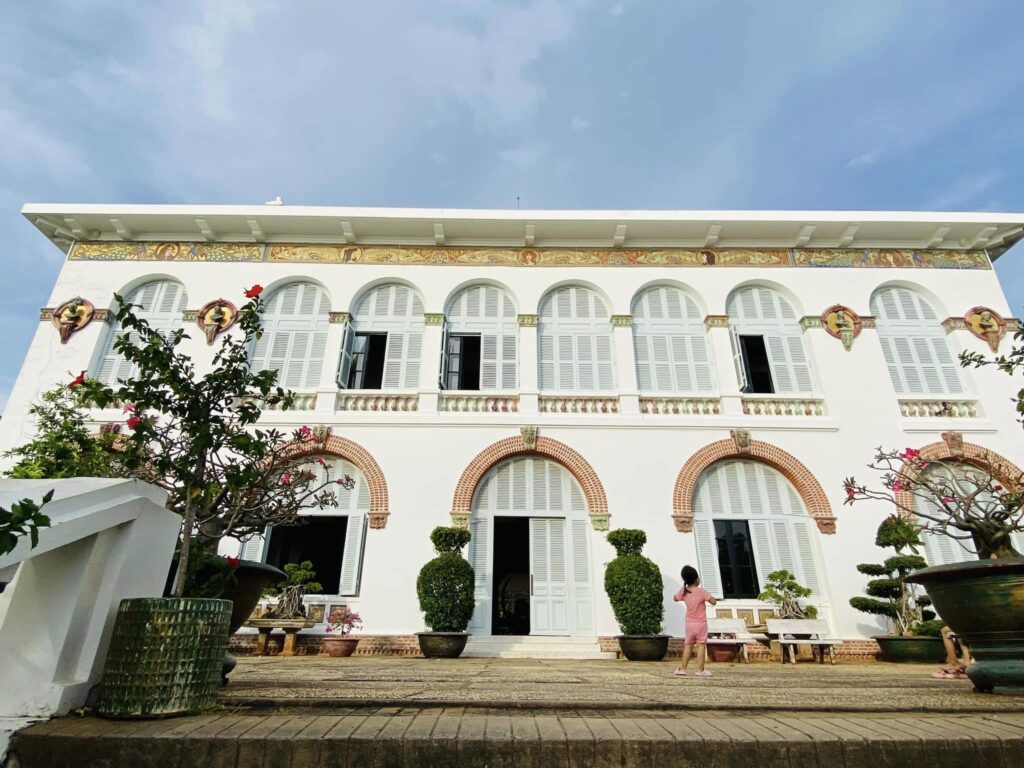
On the slopes of Big Mountain, the elegant White Palace (Bach Dinh), built in 1898, still preserves its late-19th-century European architecture. Nearby, the Thich Ca Phat Dai pagoda—one of Vung Tau’s most important Buddhist sites—has been a national heritage monument since 1989.
Together, Big Mountain and Small Mountain are also home to numerous historical relics: French coastal artillery, the Vung Tau Lighthouse, Japanese naval mine tunnels from World War II, American radar installations, the Christ the King statue, and many temples and shrines.
Rising between the mountains and the sea, these two legendary peaks continue to shape the soul of Vung Tau, blending nature, history, and folklore into one unforgettable landscape.