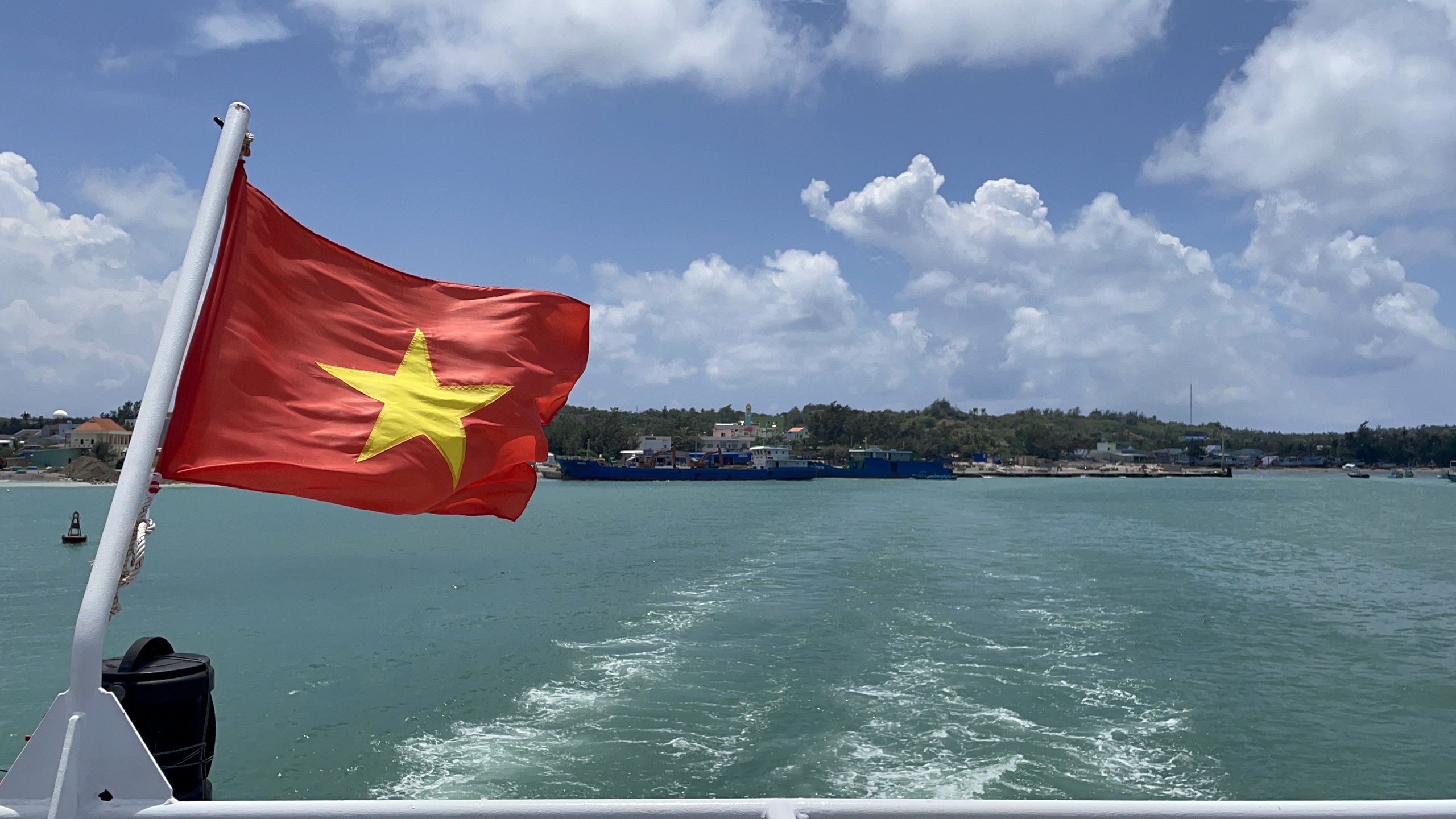
In commemoration of the 50th anniversary of the Liberation of the South and National Reunification (April 30, 1975 – April 30, 2025), Travelin.vn presents a detailed chronicle of the liberation of the Phu Quy Archipelago. For the younger generation today, these historical records serve as invaluable testimony—preserving memory, nurturing patriotism, and strengthening pride in our homeland.
On March 10, 1975, liberation forces launched the key strategic breakthrough at Buon Ma Thuot, triggering a rapid chain of victories that liberated the Central Highlands, the coastal regions, and the south-central provinces. On April 16, 1975, units of Military Region 6 defeated the outer defensive shield of the Saigon regime at Phan Rang, freeing Ninh Thuan Province. Soon after, the liberation forces swept forward: Binh Thuan was freed on April 19, and Binh Tuy on April 23. News of these victories quickly reached Phu Quy Island. Amid the intense and fast-changing situation on the mainland, on April 22, 1975, Mr. Trần Nghĩa and a group of young men in Long Hai spontaneously rose up, seizing weapons from local militia and civil defense forces. But due to severe disparity in strength, the uprising was crushed, and the youths were brutally killed. Though outraged by the enemy’s cruelty, the people of the island restrained themselves and waited for coordinated support from the mainland to ensure a successful liberation.
During this time, the Binh Thuan Provincial Party Committee urgently prepared for the liberation of the Phu Quy Archipelago. On the afternoon of April 24, 1975, the committee established a “Civil-Military Delegation” to participate in the liberation campaign, led by Nguyen Thanh Tam—Provincial Party Committee member and Secretary of Tuy Phong District. To assess the situation on the island, the delegation met with Tuy Phong District authorities. Intelligence reports indicated that enemy forces were heavily fortified, especially on the eastern side. Additional information from a militia member who had escaped the island revealed that enemy troops consisted of one militia battalion, one police platoon, nearly 4,000 “self-defense volunteers,” and about 800 soldiers who had fled from Ham Tan after its fall. From April 22, the Saigon navy had also deployed two additional vessels (HQ11 and WPB) offshore. Thus, by late April 1975, enemy troop strength on Phu Quy Island was nearly half of the island’s population—making the upcoming operation extremely difficult.
Given this situation, on April 23, 1975, Lieutenant General Lê Trọng Tấn—Commander of the Eastern Front—assigned the Navy High Command, in coordination with Military Region 6 and Binh Thuan Provincial Forces, to liberate the Phu Quy Archipelago as a strategic step toward freeing islands in Southern Vietnam. The Navy prepared Ship 643 of Group 125 along with fishing vessels from Nha Trang to transport troops. Military Region 6 contributed a water-commando unit (Battalion 407) and an infantry company from Regiment 95. Commanders included Mai Năng (Navy), Nguyen Thanh Tam (Political Commissar), and Officer Toàn (Deputy Commander). Binh Thuan Provincial Forces, led by Officer Huy of Military Region 6, consisted of 30 soldiers cooperating with the main forces.
The plan divided the attacking forces into three key directions targeting the administrative offices in Ngu Phung, Long Hai, Tam Thanh, and the Phu Quy Administrative Office. Local guides were assigned to each unit. The time for the offensive was precisely set: D-Day: April 27, 1975 – H-Hour: 3:00 AM, with landing scheduled at 5:00 AM and simultaneous assaults thereafter.
According to plan, on the morning of April 26, 1975, naval forces departed Cam Ranh Port and reached the staging area by nightfall. At 1:50 AM, fishing boats T2 and T3 approached the island to land the first assault teams. At the same time, the Binh Thuan “Civil-Military Delegation” sailed toward the island amid large waves; many soldiers became seasick, but morale remained high. At midnight, enemy patrol boats attempted to intercept them, but the formation broke through and pressed onward.
At 5:15 AM on April 27, 1975, all four assault units launched the attack.
Taken by surprise, enemy soldiers fled in panic—some abandoning uniforms and blending into the population. The attack groups in Ngu Phung and Tam Thanh encountered no resistance and quickly secured control. The Long Hai direction also succeeded after short engagement. At the Phu Quy Administrative Office, however, entrenched enemy forces resisted fiercely. Liberation troops deployed a 75mm recoilless gun, destroying bunkers, killing one enemy and capturing eleven others; but the administrative chief Phan Văn Hựu escaped.
By 6:30 AM, liberation forces had completely secured the island.
At sea, meanwhile, Ship 643 engaged two Saigon patrol vessels. Enemy forces fired mortars heavily, but the Vietnam Navy counterattacked with B40, B41, and 12.7mm anti-aircraft weapons, damaging one enemy ship and forcing the other to retreat. Around 9:00 AM, the enemy attempted to shell the island from afar but did not dare approach because of the strong defense. By 4:00 PM, with no reinforcements, the enemy vessels withdrew.
The liberation operation demonstrated perfect coordination between provincial forces and naval units. Most enemy troops surrendered; those who resisted were eliminated. Key enemy leaders, including Vo Gia Vi and Phan Văn Hựu, were captured while attempting to hide. In total, liberation forces killed or captured 382 enemy soldiers, damaged one patrol vessel, seized 1,840 weapons, communications equipment, and other military supplies.
Reinforcement units from Tuy Phong District and Battalion 482 arrived on the morning of April 28 to secure positions in Tam Thanh, Long Hai, and Ngu Phung, collect weapons, and maintain order. Hundreds of former regime soldiers and officials surrendered peacefully and were treated humanely.
April 27, 1975 thus became a historic milestone for Phu Quy—the final territory of Binh Thuan Province (under Military Region 6) to be completely liberated. At the request of the people and armed forces, this date is now observed as the Traditional Day of the Phu Quy District Armed Forces.
Excerpt from: History of the Armed Forces of Phu Quy District (1975–2010)