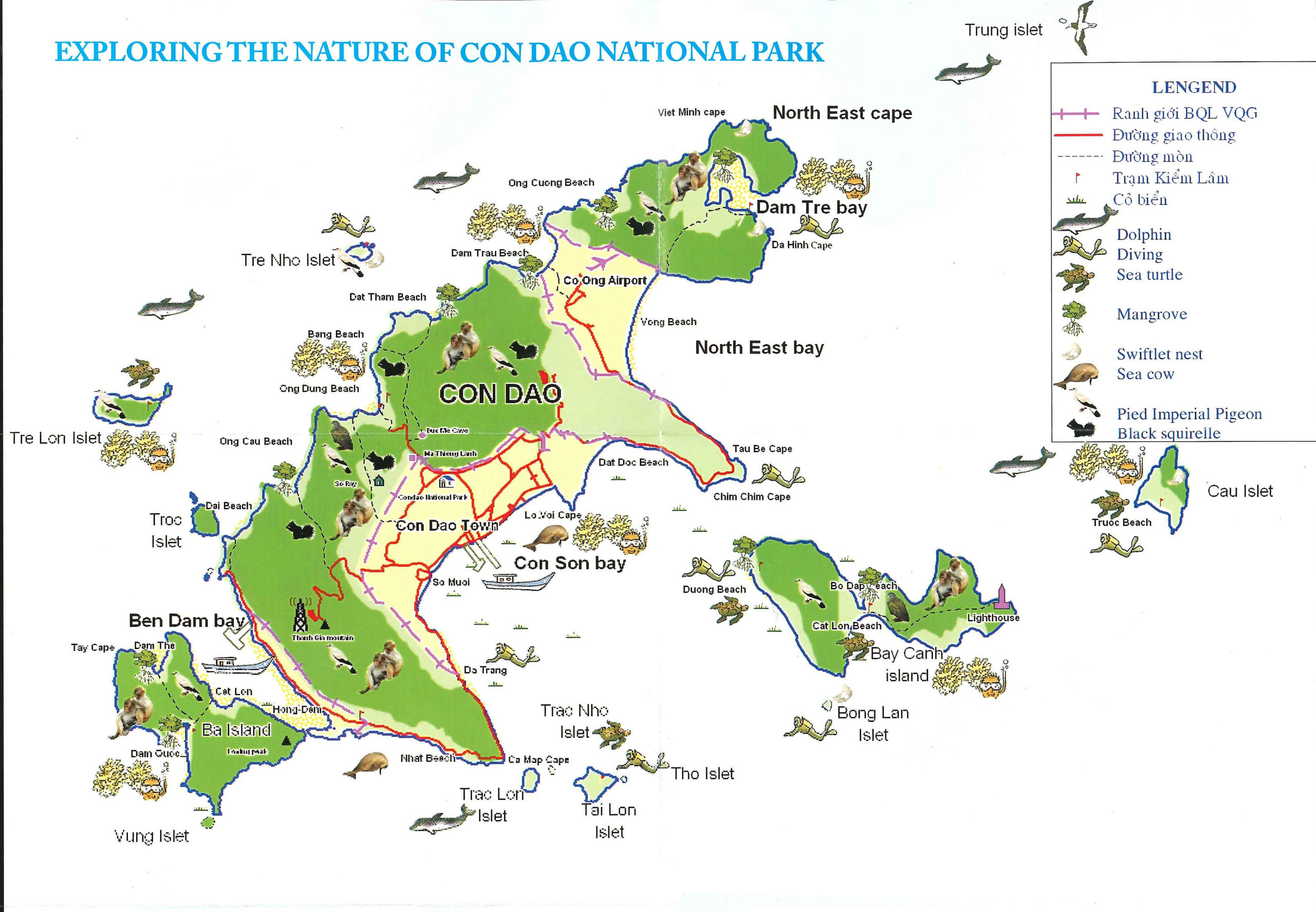
Con Dao is one of Vietnam’s southeastern offshore archipelagos, located 97 nautical miles from Vung Tau City and 45 nautical miles from the Hau River estuary. The archipelago consists of 16 islands: Con Son, Con Lon Nho (Hon Ba), Hon Bay Canh, Hon Cau (Phu Le), Hon Bong Lan (Phu Phong), Hon Vung (Phu Vinh), Hon Troc (Hon Trai, Phu Nghia), Hon Trung (Phu Tho), Hon Tai Lon (Phu Binh), Hon Tai Nho (Hon Tho, Phu An), Hon Trac Lon (Phu Hung), Hon Trac Nho (Phu Thinh), Hon Tre Lon (Phu Hoa), Hon Tre Nho (Phu Hoi), Hon Anh (Hon Trung Lon) and Hon Em (Hon Trung Nho).
The total land area is 76 km², of which Con Son Island is the largest at 51.52 km². Today, Con Dao is recognized as one of Vietnam’s 46 national tourist destinations and has repeatedly been described by international media as “one of the most enchanting islands on the planet.”
Early Appearances of the Name “Con Dao”
The place name Con Dao has appeared in international maritime history for centuries under various forms such as Poulo Condore, Con Lon, Con Non, Con Son, and others. Historical documents help trace the origins of these ancient names.
One key question is: When did “Poulo Condore” or “Paulau Kundur” first appear?
The earliest Vietnamese reference to Con Lon appears in the Dai Viet Su Ky Toan Thu (Outer Annals, Book V, page 4b):
“Year Dinh Mui (767), Tang Dynasty – Second year of the Dai Lich era: People of Con Lon and Java came to raid Chau Thanh.”
Footnotes in the same document indicate that the term “Con Lon” appears in Chinese texts as early as the 4th century, referring to groups inhabiting the South Seas—essentially the region of today’s Southeast Asia.
European and Asian names for the archipelago include:
- German: Poulo Condore or “Con Non”
- Chinese (transliterations): K’ouen L’ouen (Côn Lôn), K’ouen T’ouen (Côn Đồn)
- Malay: Paulau Kundur or Poulo Condore, meaning “gourd island”
- An Nam–Latin Dictionary (1772–1773): Con Non, Pulo Condor
- In Phu Bien Tap Luc, scholar Le Quy Don wrote:
“Beyond the Gia Dinh prefecture lies a mountain called Con Lon.”
Professor Tran Quoc Vuong further explained:
- Pulo (or Polo in Malay) means island
- Condore in English/French refers to eagles or large raptors
→ Therefore, Poulo Condore may be interpreted as “Island of Eagles.”
Over time, Chinese sailors transcribed Paulau Kundur or Poulo Condore into K’ouen Louen, which Vietnamese later pronounced as Con Lon or Con Non.
Con Lon / Con Non → The Modern Name “Con Dao”
Thus, the modern Vietnamese name Côn Đảo derives from:
- Malay Paulau Kundur / Poulo Condore,
- Chinese phonetic renderings K’ouen Louen,
- and finally localized Vietnamese forms Côn Lôn, Côn Nôn, and Côn Sơn.
Con Dao in Vietnamese Imperial Records
In the Dai Nam Thuc Luc (Nguyen Dynasty Chronicles), two historical events mention Con Lon:
- English pirates anchored eight ships at Con Lon.
Commander Truong Phuc Phan reported the event and was ordered to eliminate them. - Malay (“Cha Va”) raiders attacked local populations.
The island authorities requested permission to arm civilian and government vessels. The emperor approved.
From this point, Con Lon referred both to the archipelago and to its inhabitants, the precursors of the modern term Con Dao.
Poulo Condore in Western Exploration
Associate Professor Dr. Dao Ngoc Chuong notes that one of the earliest detailed Western accounts comes from William Dampier, who visited Poulo Condore in 1687. He stayed for over a month (14 April – 24 April 1687) to repair his ship and documented extensively the island’s:
- inhabitants
- customs
- natural resources
- landscape
Prior to this, Portuguese traders and Catholic missionaries had already known the archipelago.
Administrative History of Con Dao
- Gia Long era (1802–1820): Con Dao was under the jurisdiction of Can Gio, Phiên An, within Gia Dinh Citadel.
- Minh Mang era (1839): Transferred to Vinh Long Province, part of the “Six Provinces of Southern Vietnam.”
- French Colonial Period:
Con Lon became a district governed by an administrative officer or military official. - Republic of Vietnam:
The island became Con Son Province (Decree 143.NV, 22 Jan 1956).
In 1965, the province was abolished and reorganized as a central administrative zone headed by a military officer who also supervised the Con Son Prison Complex. - After 1975:
- May 1975: renamed Con Dao Province
- Sept 1976: reorganized as Con Dao District under Ho Chi Minh City
- Oct 1976: transferred to Hau Giang Province
- May 1979: designated as a district of the Vung Tau – Con Dao Special Zone
- Aug 1991: Con Dao became a district of the newly established Ba Ria – Vung Tau Province
Cultural Interpretation of the Name “Con Dao”
The transition from Côn Lôn → Côn Đảo reflects:
- a cultural response to distancing from Sinicized nomenclature
- the deep maritime connections between Vietnam and the wider South China Sea region
- linguistic layers involving Malay (pulo, kundur), Chinese phonetic forms (K’ouen Louen), and Vietnamese adaptations (cù lao, đảo)
Some scholars suggest kundur (“gourd”) may have metaphorically evolved into condore, referring to a raptor species in Western languages—possibly inspired by the island’s silhouette.
The long evolutionary chain—Sender → Foular → Cundur → Fulát → Sondur → Condur → Côn Lôn → Poulo Condore → Côn Đảo—reflects centuries of maritime trade, cultural exchange, conflict, and state formation.
As Associate Professor Dr. Dao Ngoc Chuong emphasizes,
the history of the name Con Dao is inseparable from the broader historical narrative of Vietnam, shaped by encounters on the seas and movements across the region.