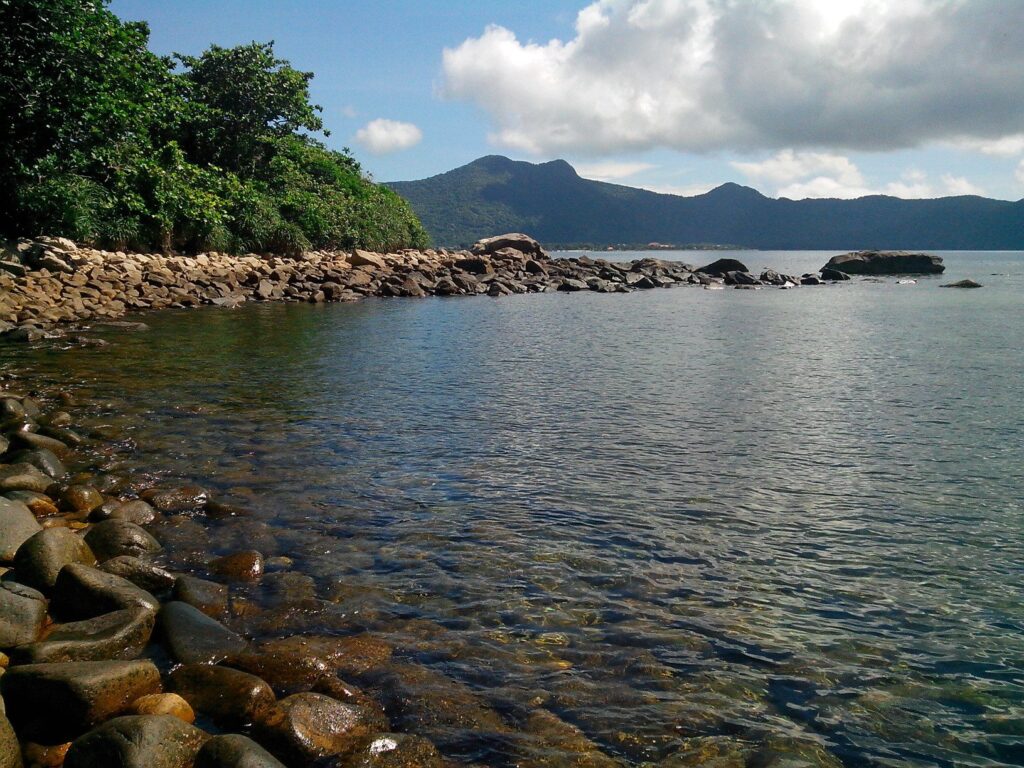
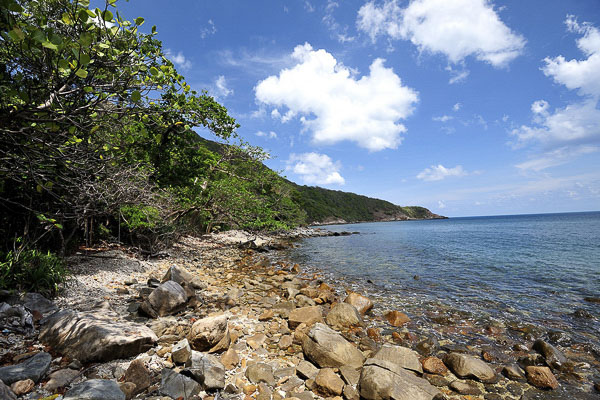
Many visitors to Côn Đảo make a stop at Ông Đụng Beach—a destination known for its open landscape, pristine shoreline, fine white sand, and fresh, unpolluted air. Located on the western side of Côn Đảo District and within Côn Đảo National Park, Ông Đụng Beach is associated with a tragic yet fascinating legend that has been passed down through generations.
From the center of Côn Đảo District, after reaching Ma Thiên Lãnh Bridge, visitors descend a slope and walk for about 45 minutes to arrive at Ông Đụng Beach. On one side lies a rocky hillside covered with large, lush trees such as oak, ironwood, sea almond, and teak. From time to time, rare black squirrels, a species characteristic of Côn Đảo, can be seen chasing one another through the dense branches. On the other side stretches a beach dotted with rocky outcrops extending into the sea, creating a habitat where various marine species gather.
Why is it called Ông Đụng Beach? Elderly residents of Côn Đảo recount the following story:
Long ago, in Giồng Nâu hamlet, Hòa Nghị village, Gò Công (present-day Tiền Giang Province), there lived a martial arts master. He had two children: an elder daughter named Hương, commonly called Nàng Hai, and a younger son named Ba Thọ. Though a woman, Nàng Hai possessed extraordinary strength. Any young man who flirted or harassed her would quickly receive a lesson he would never forget. As a result, no one in the village dared to propose marriage to her.
At that time, in neighboring Tân Duân Đông village, there lived the wealthy landowners Mr. and Mrs. Sương, who had a son named Hai Đụng. Spoiled by his parents’ wealth, Hai Đụng squandered money freely, indulging in pleasure without regard for the hard work that built his family’s fortune. Concerned about their wayward son and the future of their estate, the Sương couple sought a capable and strong-willed daughter-in-law to rein him in. Among all the nearby villages, only Nàng Hai met their expectations, so they arranged her marriage to Hai Đụng.
Not long after the wedding, Mr. and Mrs. Sương passed away. Hai Đụng soon returned to his wasteful ways and was repeatedly disciplined by Nàng Hai—sometimes with force. Outwardly, he pretended to live happily with his wife to maintain appearances, but deep down he plotted to kill her if the chance arose. One day, he picked a fresh coconut and hung it on a palm tree by a pond. When Nàng Hai came out to prepare vegetables and fish, he pulled the rope, causing the coconut to fall and strike her on the head, killing her instantly. Neighbors rushed over to find Hai Đụng crying bitterly beside his wife’s body, and no one suspected foul play.
Believing her death to be a tragic accident, Hai Đụng felt free of obligation and soon resumed his reckless lifestyle. Before long, the vast family fortune was gone. Former drinking companions abandoned him, and Hai Đụng was left penniless—begging by day and sleeping on the streets at night. Haunted by guilt and regret, especially for murdering Nàng Hai, a woman who had been strict yet devoted to her family, he was tormented by remorse.
Unable to bear his conscience, Hai Đụng eventually surrendered himself to the authorities and confessed to killing his wife. With sufficient evidence, the court sentenced him to 10 years in prison for spousal murder and exiled him to Côn Đảo. There, consumed by regret and memories of Nàng Hai, he lived in sorrow and soon died by the seashore. From that time on, islanders called the place Ông Đụng Beach.
At Ông Đụng Beach, there is a species of sea snail that clings to rocks, slightly larger than a tropical almond fruit, round and domed in shape, resembling a woman’s breast. Locals call it “vú nàng” snail, a famous delicacy of Côn Đảo. A folk verse still circulates on the island:
“Whoever passes Đất Thắm, Bãi Bàng,
Ask if Ông Đụng’s ‘vú nàng’ has grown large yet?”
In addition to vú nàng snails, Côn Đảo is also home to cone snails, named for their spiraled, conical shells resembling traditional hats. Each can be as large as an adult’s fist. These snails cling to white rocky shores and cliffs throughout Côn Đảo, but are especially abundant at Ông Đụng Beach—hence they are also called “ốc đụng.” They are another local seafood delicacy prepared in many tasty dishes for visitors.
Today, Ông Đụng Beach is part of an attractive ecotourism route within Côn Đảo National Park, drawing travelers interested not only in natural beauty, but also in the legends and folklore that enrich this unique island landscape.