The Con Dao Prison system stands as a stark testament to the brutality inflicted on the Vietnamese people by French colonialists and American imperialists. Here, the U.S.–Saigon regime implemented an exceptionally harsh prison policy aimed at breaking the spirit of revolutionary prisoners.
The Situation Before and After the Paris Agreement
In late December 1972, when the U.S. and the Saigon administration reversed the terms already agreed upon at the Paris Peace Talks, the world reacted with strong condemnation after the delegation of the Provisional Revolutionary Government of South Vietnam exposed their duplicity. In a final, desperate attempt, the United States launched the B-52 bombing campaign against Hanoi and Hai Phong for 12 consecutive days and nights, only to suffer a decisive defeat. News of this resounding victory eventually reached political prisoners on Con Dao despite the enemy’s strict censorship.
By March 1973, when the Paris Agreement came into effect, Con Dao held 9,892 prisoners, including:
- 274 common-law offenders
- 940 military offenders (common crimes)
- 636 military offenders (political)
- 4,020 “special detainees” (sentenced political prisoners)
- 3,498 “special administrative detainees” (unsentenced political prisoners)
- 37 suspects
- 487 unclassified detainees
Yet the Saigon regime only announced 5,081 political detainees nationwide to be exchanged, including 4,075 on Con Dao.
Through a secretly hidden radio, prisoners clandestinely followed the developments of the Paris Conference, transcribed the full text of the Agreement and its Protocols, and received outside information through underground networks.
Escalating Resistance in 1974
From late 1974, political prisoners launched continuous, persistent, and widespread resistance movements inside the prison camps. They understood that the great general offensive of the Vietnamese revolution was approaching and prepared themselves accordingly.
Prisoners fought simultaneously on two fronts:
- Demanding rights: proper food rations, enforcement of political prisoner status, and immediate release in accordance with the Paris Agreement.
- Building internal strength: maintaining cultural and political activities such as literature, music, newspapers (notably the Xây Dựng newspaper), political education, and collective discipline.
Trại 6B (Camp 6B) became a beacon of resistance. Weekly cultural performances were maintained; newspapers were produced monthly; political education was conducted regularly using both secret radio transmissions and smuggled materials.
Even under strict surveillance, revolutionary prisoners used coded chanting, collective shouting, and improvised broadcasting to denounce the Saigon regime’s war-mongering attitude and call upon enemy soldiers, guards, and civil servants to support peace and national independence. Inside the prison walls, a “liberated zone” of the spirit was formed.
The Final Days Before Liberation (Early 1975)
By early 1975, the imminent collapse of the U.S.–Saigon regime became evident. Throughout the Lunar New Year period, when night fell, prisoners’ singing echoed through the darkness—an act of defiance and a powerful source of hope. Despite hunger and exhaustion, they sang to assert revolutionary resilience and strengthen collective belief in final victory.
By April 1975, Con Dao Prison still held:
- 7,448 prisoners, including
- 4,234 political prisoners (494 women).
Of these, 2,488 were in solitary confinement for refusing to salute the Saigon flag, refusing to confess, or resisting coercion. The remaining 1,746 were forced to do hard labor alongside common criminals.
April 29–30, 1975: The Turning Point
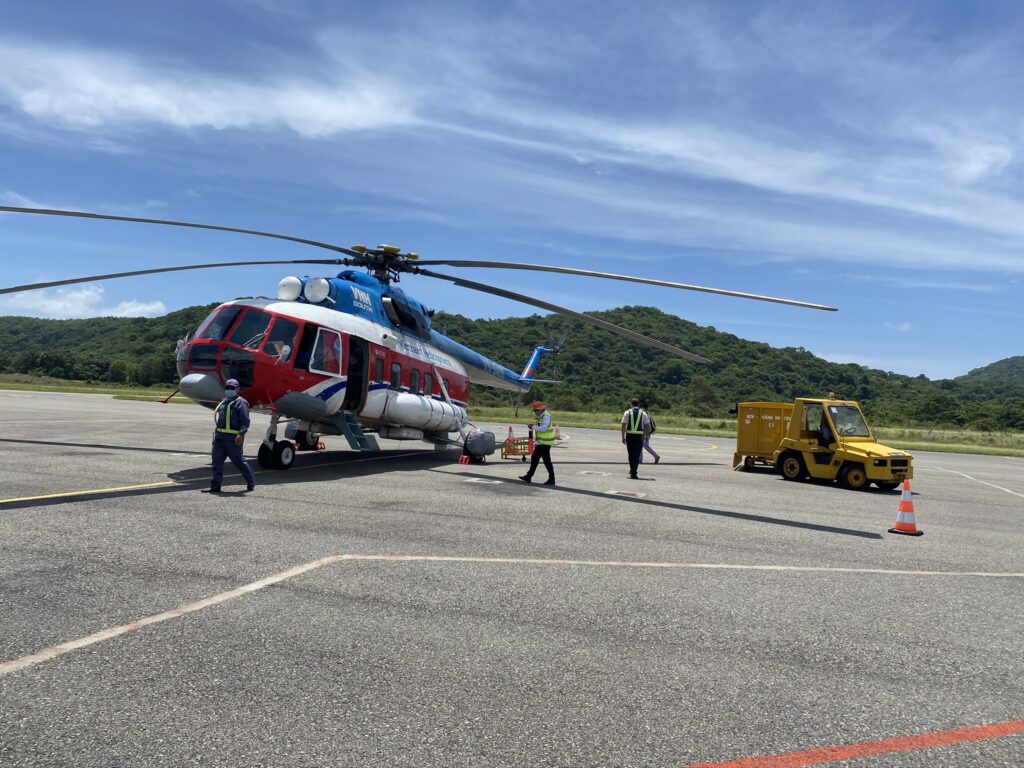
As liberation forces approached Saigon, Con Dao entered a tense and chaotic state. Military aircraft repeatedly landed at Co Ong Airfield; evacuation boats carried U.S. advisers and Saigon officers away; by 16:30 on April 29, all remaining American personnel fled the island.
At around 10 AM on April 30, kitchen workers were suddenly thrown into solitary confinement. Guards, panicked and confused, began cooking for the inmates themselves, cursing and shouting.
The last information smuggled in was:
“Tran Van Huong is replaced by Duong Van Minh. Negotiations with the Provisional Revolutionary Government are underway.”
A confiscated radio belonging to the prison warden was retrieved and turned on. Prisoners held their breath as the Voice of Vietnam broadcast the historic announcement:
General Duong Van Minh had surrendered; Saigon was liberated; the Military Administration Committee had been formed.
The prisoners were overwhelmed with joy. They immediately decided to act.
The Self-Liberation of Con Dao (Night of April 30 – Dawn of May 1, 1975)
Late at night on April 30, leaders from Camp 7’s H Block—including Kieu Van Dau, Nguyen Van Dong, and Nguyen Van Son—contacted intelligence officers imprisoned in Cell No. 24 (such as Le Cau and Tran Quang Tin). After confirming the liberation of Saigon, they convened a leadership meeting and concluded:
“All prisoners must be freed immediately.”
Within minutes:
- Keys were seized
- Doors were smashed open
- Walls were kicked down
- Messages were broadcast by makeshift loudspeakers
By 1:00 AM on May 1, 1975, thousands of prisoners poured out of their cells—a historic moment of self-liberation after 113 years of oppression.
By the afternoon of May 1, all prison camps and enemy military facilities were under the control of the prisoners. Weapons, documents, and infrastructure were preserved intact.
Their next mission was to contact the mainland. On May 3, 1975, comrade Tran Trong Tan successfully radioed the Saigon City Party Committee, reporting:
“Con Dao has been liberated.”
On May 4, a ceremony was held at the historic Pier to send 549 sick and weak prisoners home.
At 7:00 AM on May 5, 1975, the first unified national flag-raising ceremony took place across the entire island.
By May 24, 1975, the final evacuation ship departed, carrying 976 prisoners back to the mainland. Over 150 volunteered to stay and help stabilize Con Dao.
A Legacy of Courage and Revolutionary Faith
The struggle of Con Dao’s political prisoners exemplifies extraordinary ideological determination and revolutionary integrity. Despite brutal torture and inhumane conditions, they upheld communist ideals, resisted coercion, maintained discipline, and seized the historic moment to liberate themselves—turning Con Dao from a “hell on earth” into a symbol of resilience and freedom.
These political prisoners were not merely victims of a cruel prison system—they became active agents of history, ending the 113-year existence of Con Dao Prison and contributing to the final victory on April 30, 1975.