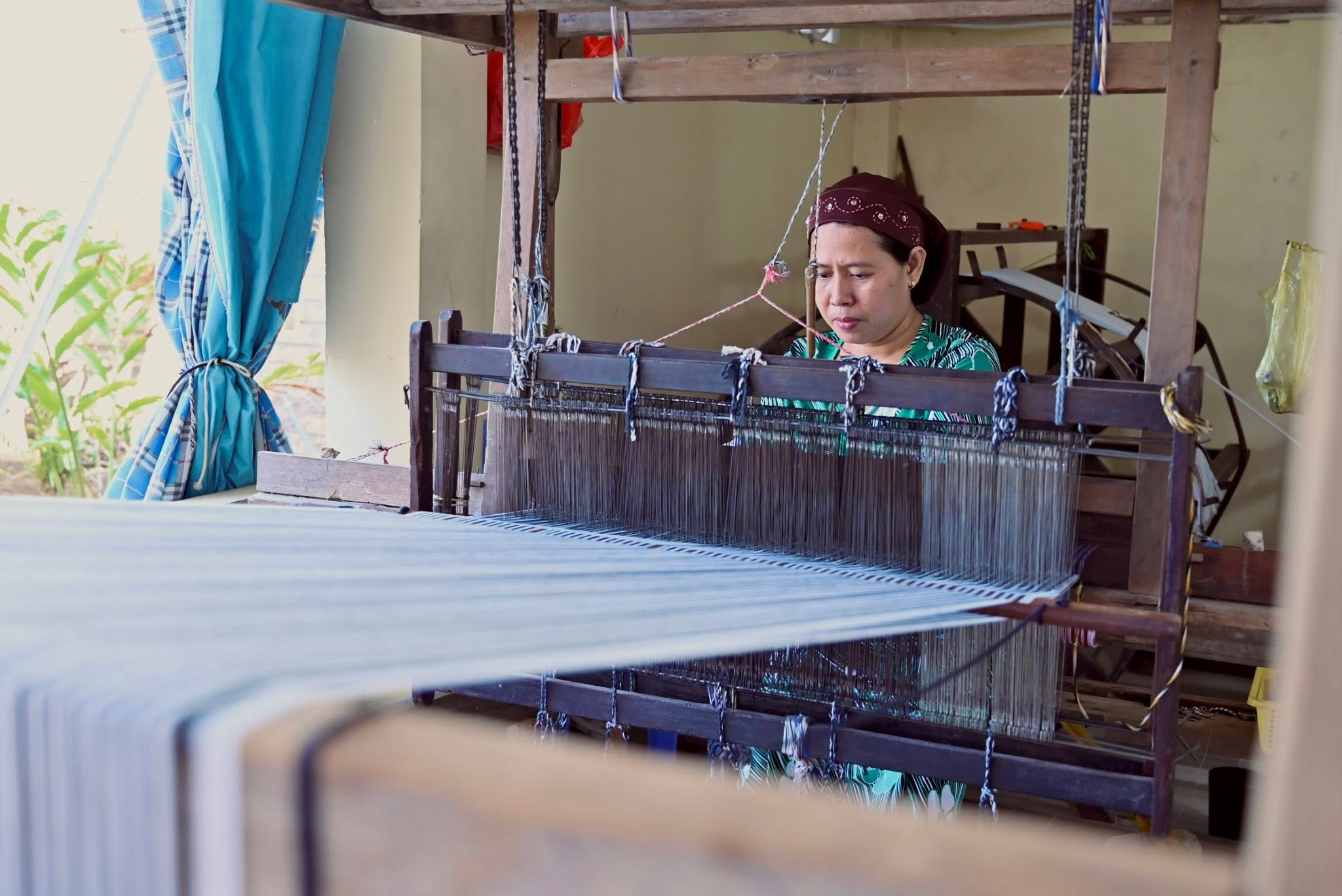
The traditional brocade weaving of the Cham people in An Giang is a long-established craft closely associated with the cultural life, beliefs, and daily traditions of the Cham Muslim community. Through the hands of skilled weavers, cotton threads are dyed, arranged on wooden looms, and woven into fabrics featuring distinctive colors and patterns that reflect Cham cultural identity.
More than products for everyday use, Cham brocade textiles preserve traditional knowledge, weaving techniques, and decorative art passed down through generations. The patterns found on the fabrics reflect the community’s relationship with nature, daily life, and spiritual traditions, forming a distinctive cultural feature of An Giang.
The Traditional Brocade Weaving of the Cham People was included in Vietnam’s National Intangible Cultural Heritage List under Decision No. 480/QĐ-BVHTTDL dated March 6, 2023, classified as a Traditional Craft, in An Giang Province.
Basic Information
- Heritage: Traditional Brocade Weaving of the Cham People
- Heritage category: Traditional Craft
- Location: An Giang Province
- Cultural community: Cham people
- History: According to the available source, the craft dates back to the early 19th century
- Characteristics: Hand weaving on wooden looms, with patterns created directly during the weaving process
- Recognition: National Intangible Cultural Heritage
- Recognition decision: Decision No. 480/QĐ-BVHTTDL, March 6, 2023
History of Cham Brocade Weaving in An Giang
The traditional brocade weaving of the Cham people in An Giang developed alongside the long-standing settlement of the Cham community in the region. According to the source material, the craft emerged in the early 19th century and once played an important role in the economic life of many Cham families.
In the past, weaving was a familiar occupation among Cham women. Many households owned several looms, producing fabrics not only for clothing and household use but also for exchange and trade.
Over time, Cham weaving developed through cultural and economic interaction with other communities in southern Vietnam. Traditional weaving techniques and looms were adapted and improved through these exchanges, contributing to the diversification of Cham textile production.
At certain periods, Cham woven products were traded beyond Vietnam, including in Cambodia, Thailand, and Malaysia. Weaving therefore developed beyond a household activity and became an important source of livelihood and commercial exchange within the community.
Today, under the influence of modern lifestyles and competition from industrially manufactured textiles, traditional weaving is no longer as widespread as it once was. Nevertheless, families, artisans, and weaving establishments that remain committed to the craft continue to preserve traditional techniques while developing products suited to contemporary markets.
Weaving Techniques and Pattern-Making
One of the defining characteristics of Cham brocade is its traditional hand-weaving technique and the creation of patterns directly on the loom.
The production process involves several stages, beginning with preparing and soaking the threads, dyeing and drying them, winding them onto bobbins, preparing the warp, and finally weaving the finished textile.
Preparing the warp is one of the most technically demanding stages. The weaver must carefully calculate the number of threads, colors, width, and length of the fabric before placing them on the loom. Setting up the heddles for a loom can take several days.
During weaving, the weaver combines the ground weave with patterned sections to create the intended designs. The process requires considerable precision, patience, and knowledge of traditional techniques.
This form of hand weaving gives each textile a distinctive character. The finished fabric carries the imprint of the individual weaver through the arrangement of colors, patterns, and weaving techniques.
Colors and Patterns of Cham Brocade
Cham brocade is distinguished by its vivid colors and diverse decorative patterns.
According to traditional techniques described in the source material, the Cham people used plant-based and mineral materials to produce dyes for the threads. Traditional colors included blue from indigo, black from muong fruit, yellow from the jưng plant, and red from the inner wood of the pan tree.
These colors could be combined to create a wide range of shades and give the textiles their distinctive appearance.
Cham textile patterns are diverse and include motifs representing animals, plants, objects, and other decorative forms. Interlocking diamonds, repeated geometric blocks, flowers, leaves, waves, squares, stripes, and stylized forms contribute to the characteristic composition of the fabric.
Motifs such as clouds, waves, mulberry flowers, and geometric patterns are not merely decorative. They reflect aspects of nature, everyday life, and the cultural world of the Cham Muslim community in An Giang.
Cham Brocade in Daily Life and Tourism
In the past, traditionally woven textiles were primarily used for clothing and community life. Today, Cham brocade products have become more diverse, including scarves, handbags, clothing, accessories, and souvenirs.
The growth of cultural tourism has created additional opportunities for traditional handicrafts. Visitors can not only purchase products but also learn about the looms, dyeing techniques, weaving methods, patterns, and cultural stories behind the textiles.
According to the source material, Cham communities in An Giang welcomed tens of thousands of domestic and international visitors in 2022 and 2023, many of whom came to explore the communities and purchase local products. Some textiles are sold locally, while others reach markets outside the province and overseas.
Brocade has therefore become a bridge between cultural heritage preservation and community-based tourism. A scarf, bag, or piece of woven fabric is not simply a souvenir. It can also carry the story of the traditional techniques and cultural identity of the community that produced it.
Cultural Values and Community Livelihoods
Traditional brocade weaving is both an economic activity and a means of preserving cultural knowledge.
Through the weaving process, artisans pass knowledge of materials, colors, thread arrangement, pattern-making, and loom operation from one generation to the next. Maintaining a traditional loom therefore also means maintaining a body of knowledge and craftsmanship.
The craft also provides employment for local people, particularly women. According to the source material, workers can earn approximately VND 150,000 to 200,000 per day, while another source cited in the material records an average income of approximately VND 7.5 to 8 million per person per month.
Beyond its economic value, Cham brocade carries aesthetic and cultural significance. The patterns woven into the fabric preserve traces of nature, everyday life, beliefs, and the cultural identity of the Cham people, transforming textiles into a form of cultural memory expressed through material and craftsmanship.
Preserving and Promoting Cham Brocade Weaving
As industrially manufactured textiles become increasingly common, preserving traditional weaving requires more than simply keeping old fabrics or looms. The most important task is to maintain the knowledge, techniques, and community of practitioners that sustain the craft.
Passing weaving skills to younger generations, supporting artisans, developing products suited to contemporary markets, and incorporating weaving into cultural tourism are potential ways to help the craft remain part of modern community life.
When visitors can learn about the weaving process, observe artisans at work, and purchase products made using traditional techniques, heritage becomes something experienced directly rather than simply described.
For An Giang, connecting traditional weaving with tourism can therefore create a link between cultural preservation, community livelihoods, and the promotion of Cham cultural heritage.
Heritage Recognition
The Traditional Brocade Weaving of the Cham People was included in Vietnam’s National Intangible Cultural Heritage List under:
Decision No. 480/QĐ-BVHTTDL dated March 6, 2023
- Heritage category: Traditional Craft
- Province: An Giang
- Cultural community: Cham people
The recognition provides an important foundation for continuing to preserve, transmit, and promote the values of Cham brocade weaving, while creating opportunities to connect the traditional craft with cultural tourism and community development in An Giang.