Discover the extraordinary life, courage, and legacy of Võ Thị Sáu – the young revolutionary heroine whose story continues to inspire generations across Vietnam.
Part 1: Childhood and the Path to Revolution
Võ Thị Sáu was born in 1933 in Phước Lợi Hamlet, Long Mỹ Commune, Đất Đỏ District, Bà Rịa Province (now Phước Hội Commune, Đất Đỏ District, Bà Rịa–Vũng Tàu Province). She was the fifth of six children in a hardworking family. Her father, Võ Văn Hợi, earned a living driving a horse cart between Đất Đỏ, Long Điền, and Phước Hải, while her mother, Nguyễn Thị Đậu, sold bún bì and spring rolls at the local market.
When Sáu was six, the family moved to a rented house in the Đất Đỏ market area. Like many rural homes of the early 20th century, it was constructed of wooden planks, roofed with yin-yang tiles, and divided into two modest rooms. This small house witnessed Sáu’s childhood and the earliest signs of her revolutionary awakening.
Life in Đất Đỏ changed drastically after the French re-occupied Bà Rịa on November 23, 1945. Checkpoints, raids, and terror spread across liberated areas. Villagers lived under constant threat from colonial troops, local collaborators, and brutal informants. Even as a young girl, Võ Thị Sáu was outraged by the injustices around her.
Around 1946, accompanied by her father on a supply trip to the Long Mỹ resistance base—where her brothers were serving in the revolution—Sáu first encountered the spirit of revolutionary struggle. The courage and camaraderie she witnessed left a deep impression on her. Determined to follow the same path, she joined the resistance at the age of 13.
In 1947, at just 14 years old, Võ Thị Sáu officially became a member of the Đất Đỏ District’s Vanguard Security Force. Despite being the youngest in the unit, she quickly earned the admiration of comrades for her bravery, sharp instincts, and deep understanding of the area.
From that moment on, Sáu soared like a bird finally freed—immersed in the revolutionary cause, dedicating her youth to the liberation of her homeland.
Part 2: Courageous Deeds Before the Fateful Day
As a member of the Vanguard Security Force, Sáu was entrusted with reconnaissance missions to gather intelligence on enemy activity. Her first major operation came on July 14, 1948, when the French organized a rally to celebrate Bastille Day. Moving unnoticed through layers of guards, Sáu lay in wait near Đất Đỏ Market. At the moment the provincial chief arrived, she threw a grenade at his vehicle, helping disperse the gathering in a powerful show of Việt Minh resistance.

Her next mission was to eliminate the notorious village chief, Tổng Tòng—feared for his cruelty toward the local people. Disguised among villagers lining up for identification papers, Sáu hid a grenade in a betel-leaf box and hurled it directly at him when the crowd thinned.
She later participated in another ambush, targeting two brutal henchmen known as Cả Đay and Cả Suốt. Disguised in black bà ba clothing, she followed them through a crowded pre-Tết market. Once they stepped outside, she threw her grenade. The explosion killed both men instantly. As she fled, Sáu attempted to use a second grenade, but it failed to detonate. She was captured, tortured, and transferred through multiple prisons—from Đất Đỏ to Bà Rịa and finally to Chí Hòa Prison.
Even behind bars, Sáu remained steadfast. Fellow female prisoners taught her literacy and encouraged her unwavering spirit. During her military trial in April 1951, Sáu fearlessly declared:
“I am not guilty. Loving my country and resisting invaders is not a crime.”
The French sentenced her to death but, facing widespread public pressure, secretly transported her to Côn Đảo on January 21, 1952.
Part 3: Defiant in the Face of Death
On January 22, 1952, 17-year-old Võ Thị Sáu arrived in Côn Đảo under heavy guard. She was imprisoned in solitary confinement at Sở Cò, the island’s brutal political police headquarters.
Despite being isolated, she managed to connect with the underground prisoner network. They smuggled her messages of encouragement—affirming her strength, honoring her sacrifice. Sáu responded with quiet determination:
“I chose the path of struggle, and I will face death with dignity. Tell the comrades not to worry about me.”
Before dawn on January 23, the French brought Sáu from her cell. She refused last rites, refused their wine, and calmly requested only that her hair and belongings be sent home to her family.
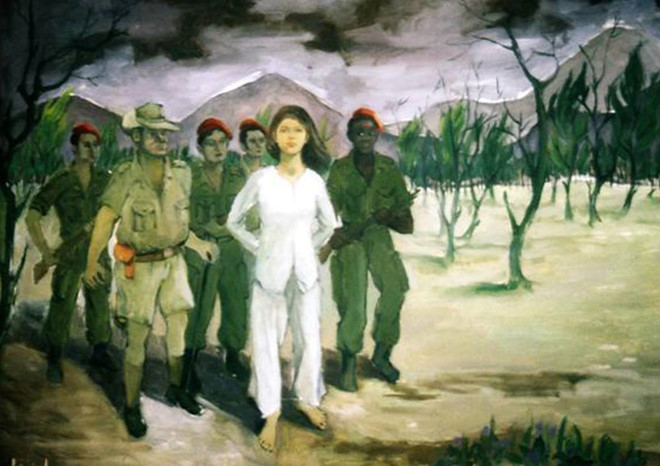
At the execution ground behind today’s Prison No. 4, she declined a blindfold. She began singing the revolutionary song Tuốt gươm thiêng before shouting:
“Long live President Hồ Chí Minh!”
Moments later, the firing squad opened fire.
Her courage—unyielding even at the final moment—forever immortalized her as a symbol of revolutionary heroism.
Part 4: The Legend Spreads Like Waves
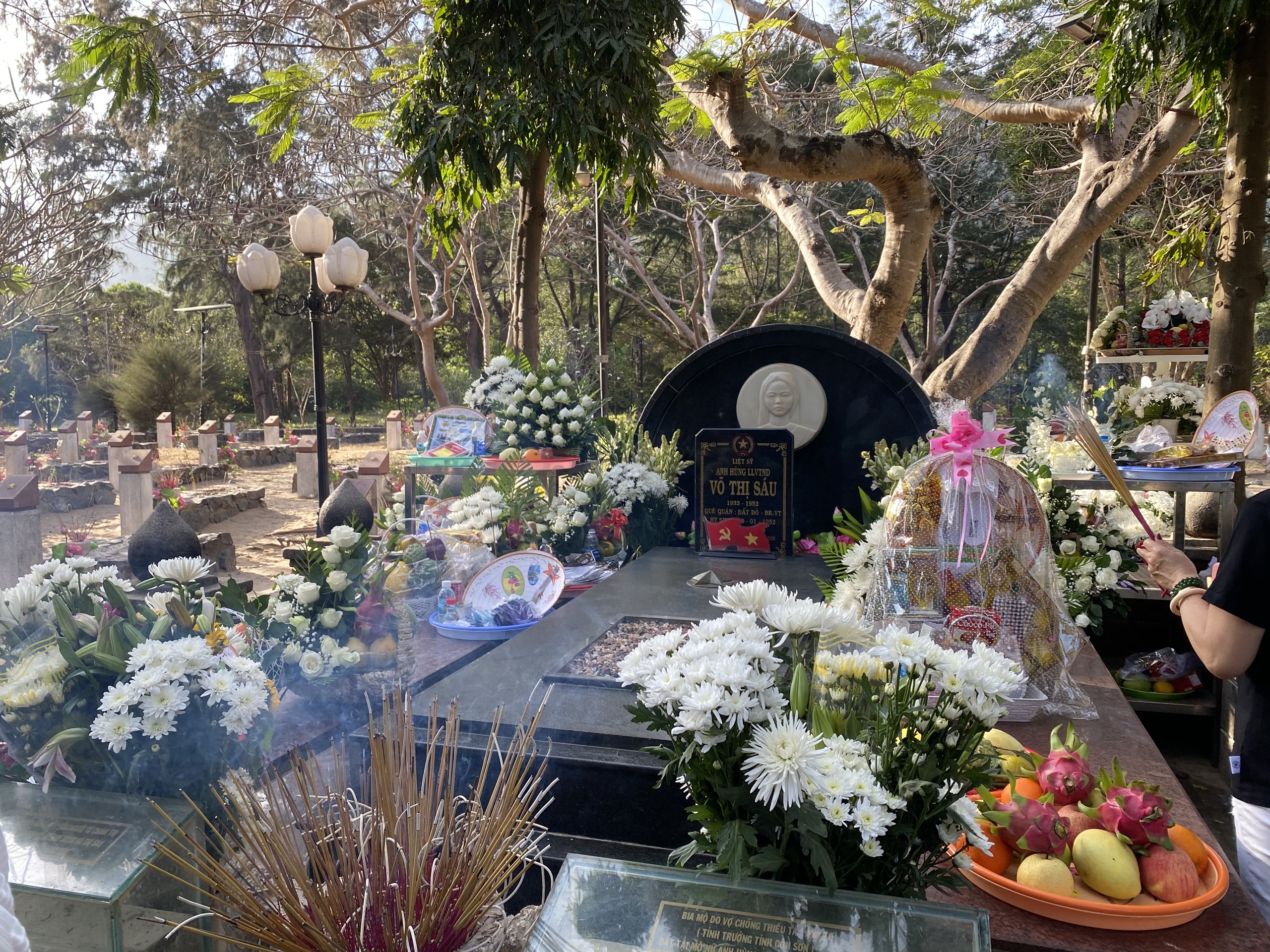
Today, at Hàng Dương Cemetery on Côn Đảo, the grave of Võ Thị Sáu stands among countless revolutionary martyrs. Every visitor pauses here, honoring the young heroine who became a legend.
Poet Phan Thị Thanh Nhàn captured Sáu’s final moments in four unforgettable lines:
Walking between two enemy lines
Still smiling peacefully
Plucking a fresh flower
And placing it in her hair.
Countless stories—half history, half legend—continue to circulate. Prisoners secretly rebuilt her grave each time guards destroyed it. Some believed that anyone who disrespected her tomb would meet misfortune. Others recalled how a lone surviving branch of a dying casuarina tree above her grave continued to reach northward—symbolically toward President Hồ Chí Minh.
Her grave was later tended by island residents, government officials, and even former regime officers. Over the decades, new stones, flowers, and sacred objects were added. In 1995, a lê-ki-ma (egg-fruit) tree from her hometown Đất Đỏ was planted near her tomb—echoing the flowers she loved as a child and forever tied to the famous song written in her honor.
Part 5: An Enduring Inspiration for Generations
Across Việt Nam, schools, streets, parks, youth organizations, and scholarships bear the name Võ Thị Sáu. Her life continues to inspire generations of young people.
In Đất Đỏ Town today, the monument, memorial house, and museum dedicated to her form an important site for patriotic education. The bronze statue—seven meters tall—depicts Sáu in her final walk to the execution ground.
Students across Đất Đỏ District reenact scenes from her life during Monday ceremonies. At Võ Thị Sáu High School, teachers incorporate her story into lessons on national pride, perseverance, and civic responsibility. Each year, graduating students hold their commencement ceremony at her monument, pledging to carry forward the spirit she embodied.
Her story remains a guiding light: the courage of youth, the strength of conviction, and the profound love for one’s homeland.
Final Part: “The Villages Still Whisper Her Name”
“When the lê-ki-ma flowers bloom
In our homeland of Đất Đỏ
The villages still whisper the name
Of the young heroine
Who died for the blossoms to bloom…”
These are the opening lines of Biết ơn chị Võ Thị Sáu (“Gratitude to Sister Võ Thị Sáu”), written in 1958 by composer Nguyễn Đức Toàn. Inspired by Phùng Quán’s memoir Vượt Côn Đảo, he chose the delicate lê-ki-ma flower as a symbol of Sáu’s youth, beauty, and ultimate sacrifice.
The song avoids grandiose rhetoric. Instead, it tells her story with tenderness and clarity—honoring her bravery without losing the softness of a girl who deserved love, joy, and a full life. The contrast between her youthful innocence and her tragic fate moves generations of listeners.
The most iconic rendition is by Meritorious Artist Thanh Thúy, who won the 1994 Ho Chi Minh Television Singing Contest with this song and later portrayed Võ Thị Sáu in the 1995 film Người con gái Đất Đỏ.
More than sixty years later, the song remains a cultural treasure—reminding all who hear it of the brilliant youth, indomitable will, and enduring legacy of the young heroine from Đất Đỏ.
“From our homeland of Đất Đỏ
The villages still whisper her name
She died so the lê-ki-ma flowers could bloom
And the mountains and rivers will forever remember
The heroine who gave her life
For future generations.”
Compiled and adapted from the six-part series by Báo Bà Rịa – Vũng Tàu.