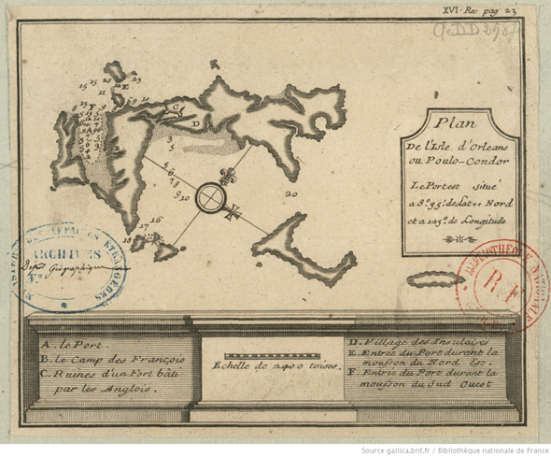
At the beginning of the 18th century, the English East India Company attempted to establish a trading post on Pulo Condore (Côn Đảo). They built a fort and warehouse after withdrawing from Chusan (Zhoushan, China). However, their presence ended violently only a few years later. While this episode is widely referenced, Vietnamese, French, and English sources provide conflicting details about when the English arrived, how long they stayed, and what caused the uprising that ultimately destroyed the settlement.
Most popular materials simplify the story: “In 1702, the English landed on Côn Đảo and built a fortress. On 3 February 1705, a revolt by Macassar soldiers forced them to flee.” Meanwhile, the Đại Nam Thực Lục offers a completely different picture, describing “sea raiders from An Liệt” landing in the eighth lunar month of 1702 and Nguyễn forces eliminating them in late 1703. These discrepancies prompted historians to examine primary English sources, eyewitness accounts and official East India Company documents.
English records show the expedition left Batavia on 16 June 1702, but this was merely the departure date, not the landing date. The initiative came from Allen Catchpoole, head of the Chusan factory, who had long advocated turning Côn Đảo into a transit station between Surat and China. Company correspondence from late 1701 confirms plans to set up a fortified trading post. Thus, the English presence on the island likely began in mid–1702.
The real confusion lies in determining when the English abandoned Côn Đảo. While Vietnamese chronicles imply they were expelled by late 1703, French writings suggest 1704, and other Western works propose even later dates—1707, 1708, 1709 or 1717. Yet ship logs from the East India Company contradict these claims. Multiple Company vessels visited Côn Đảo throughout 1704, proving the factory was still operating. Detailed accounts by Charles Lockyer, who visited in 1704, also confirm a functioning settlement with European officers, African soldiers and Bugis mercenaries.
The most credible evidence comes from those who survived the uprising. Captain William Funnell recorded that English sailors approaching the island in 1705 learned that the entire garrison had been massacred by Macassar troops on the night of 2–3 March 1705. East India Company annals describe the same event: the mutineers set fire to the warehouse, killed President Catchpoole and most of the English, with only a handful escaping by boat.
Based on these primary sources, historians agree that the English settlement on Côn Đảo fell on 3 March 1705, not 1703 or 1704 as some earlier materials claimed. The collapse of the outpost was so devastating that, as French scholar A. Faure noted, the British chose to remain silent about it for decades.