The Bay Nui Ox Racing Festival is a distinctive traditional festival of the Khmer people in southern Vietnam, closely associated with the Bay Nui (Seven Mountains) region of An Giang Province, particularly the areas of Tri Ton and Tinh Bien. Rooted in Khmer agricultural life and traditionally held around the Sene Dolta festival, ox racing combines folk culture, farming traditions, physical skill, and community celebration in a unique form of cultural heritage.
The festival is distinguished by the transformation of ordinary rice fields into racing grounds. Oxen normally used for plowing become the central participants, while farmers who are familiar with working with them take on the role of riders, guiding pairs of oxen through muddy tracks in front of enthusiastic crowds.
More than a sporting competition, the Bay Nui Ox Racing Festival reflects the close relationship between the Khmer community, agricultural land, livestock, seasonal cycles, and ancestral traditions. On 19 January 2016, the Ministry of Culture, Sports and Tourism officially included the Bay Nui Ox Racing Festival in Vietnam’s National Intangible Cultural Heritage List as a traditional festival.
Basic Information
- Name: Bay Nui Ox Racing Festival
- Vietnamese name: Lễ hội Đua bò Bảy Núi
- Type: Traditional festival
- Cultural community: Khmer people of southern Vietnam and communities in the Bay Nui region
- Cultural area: Bay Nui (Seven Mountains), An Giang Province
- Traditional locations: Tri Ton, Tinh Bien and surrounding areas
- Festival period: Usually held around the Sene Dolta festival, generally from the 29th day of the eighth lunar month to the first day of the ninth lunar month
- Participants: Pairs of specially selected and trained oxen
- National Intangible Cultural Heritage: 19 January 2016
- Decision: No. 246/QD-BVHTTDL
- Heritage category: Traditional festival
From Khmer Rice Fields to a Bay Nui Festival
Ox racing did not originate as a sport created specifically for a festival. Its roots lie in the agricultural life of the Khmer communities of Bay Nui, where oxen traditionally played an important role in plowing fields, preparing soil, and supporting rice cultivation.
After the main farming activities of the season had eased, Khmer communities traditionally celebrated Sene Dolta, an important festival dedicated to remembering ancestors and expressing gratitude to previous generations. Within this cultural setting, oxen that were normally used for agricultural work became participants in friendly competitions.
Over time, these competitions developed into a distinctive community tradition. Ox racing provided an opportunity for people from different phum and sóc communities to meet, celebrate, and demonstrate their skills in raising, training, and controlling oxen.
The distinctive character of Bay Nui ox racing lies in the way sport emerged from agricultural labor. Farmers did not become spectators separated from the competition. Their knowledge of farming, their understanding of oxen, and their ability to handle the plow became essential skills on the racing ground.
There is no single historical record establishing the exact date when the first ox race was held. Nevertheless, the practice was passed down within Khmer communities in southern Vietnam and gradually developed beyond a post-harvest pastime into an important cultural symbol of the Bay Nui region.
In 2004, the An Giang provincial authorities elevated ox racing into a provincial traditional cultural festival, expanding its scale and participation. In 2009, the 18th Bay Nui Ox Racing Festival was organized with sponsorship from An Giang Radio and Television and became known as the Bay Nui Ox Racing Festival for the An Giang Television Cup.
The inclusion of the festival in the National Intangible Cultural Heritage List on 19 January 2016 marked an important stage in recognizing, safeguarding, and promoting its cultural values.
The Racing Ground, Oxen and Riders
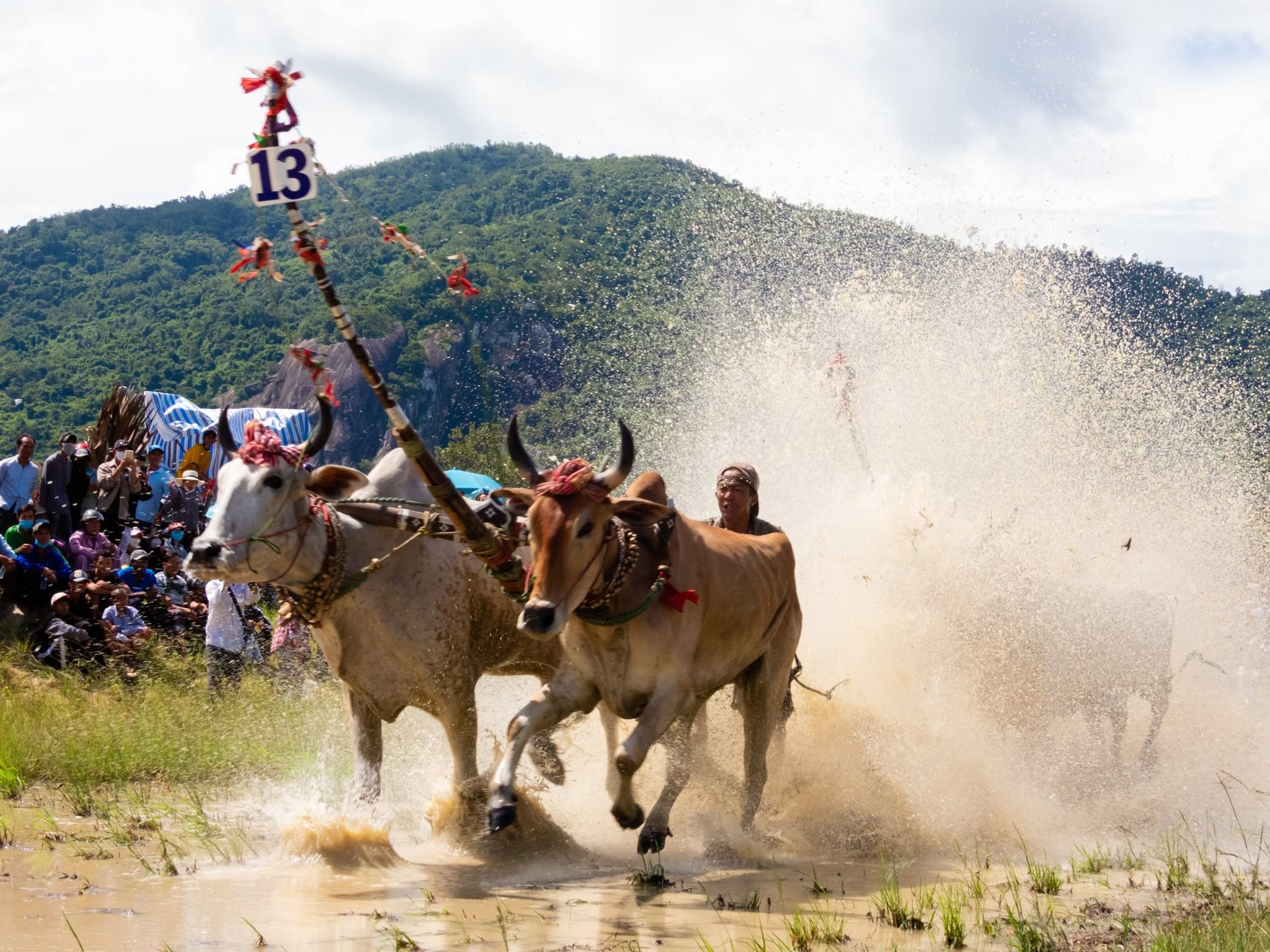
Traditional ox-racing grounds are usually rectangular rice fields. The racing track is lowered by approximately 10 centimeters and filled with water, creating a muddy and slippery surface. This distinctive terrain is one of the defining characteristics of Bay Nui ox racing and requires considerable skill from the riders.
The racing oxen are carefully selected. They must possess good physical condition, endurance, and, most importantly, the ability to work in coordination with their partner. The two oxen in a pair must maintain a relatively synchronized rhythm and balanced pulling force. If one ox runs faster or moves in a different direction, the plow can be pulled off course.
Training therefore involves more than simply making the oxen run faster. Owners must understand the characteristics of each animal, accustom them to water and mud, and train them to move together as a pair. Practice sessions on muddy fields are an essential part of preparing for competition.
The rider is commonly known as a “nai bo”, or ox rider. Standing on the plow behind the pair, the rider uses traditional tools, including a stick known as a xalul, to encourage and control the oxen.
This position requires considerable experience. The rider must maintain balance on a narrow plow while the oxen accelerate, change direction, and slide across the muddy field. At the same time, the rider must control their direction, maintain coordination between the two animals, and determine the right moment to accelerate.
The competition generally follows a knockout format, with pairs advancing through successive rounds. Under traditional racing rules, if a pair leaves the designated track or the rider falls from the plow onto the ground, the pair is considered defeated, even if the oxen cross the finish line first.
The result therefore depends on more than speed. The strength of the oxen, the rider’s technique, the coordination between the two animals, and the ability to control the muddy track all play an important role.
The Cultural Space of Sene Dolta
Bay Nui ox racing is closely associated with Sene Dolta, an important traditional festival of the Khmer people. Sene Dolta is a time for remembering ancestors and expressing gratitude to those who came before.
In traditional agricultural life, Sene Dolta also strengthens relationships between families, communities, and the agricultural cycle. Ox racing takes place within this cultural environment and therefore carries a meaning that extends beyond competition.
Before race day, the oxen receive special care. Owners pay particular attention to their physical condition, diet, and training. Some owners traditionally provide fresh coconut water, egg yolks, or nutritional drinks before the competition, while giving the oxen only a light meal on the morning of the race.
When the festival begins, the oxen are decorated with bells and colorful nose ropes. Animals that normally spend their days working in the fields become the center of a community celebration and a competition eagerly awaited by thousands of spectators.
When the starting flag falls, the oxen surge forward, pulling their small plow across the muddy track. The rider bends low to maintain balance and continuously adjusts the direction of the pair. Mud and water splash into the air as drums, cheers, and shouts rise from both sides of the track.
The scene creates one of the most recognizable images of Bay Nui culture: the rice field, the oxen, the farmer, the drums, and the community coming together in a single festival space.
From a Khmer Festival to a Cultural Heritage of Bay Nui
Over generations, ox racing expanded beyond the boundaries of individual Khmer phum and sóc communities. Today, the festival attracts people from across the region, including Kinh, Khmer, Hoa, and other communities living in An Giang.
Some competitions also feature ox pairs from other localities in the Mekong Delta and, on certain occasions, from Cambodia. This broader participation demonstrates how ox racing has developed into a space for cultural exchange beyond its original community.
Nevertheless, the Khmer community and the agricultural traditions of Bay Nui remain at the heart of the festival. This foundation is particularly important as the event develops as a tourism attraction.
In recent years, organizers have also introduced activities alongside the racing competition to expand the festival’s educational and community values. These have included rice-planting demonstrations, programs supporting students, photography contests, and activities promoting local culture.
One notable example is the 2026 Chua Ro Traditional Ox Racing Festival for the Ca Mau Fertilizer Cup, which entered its 12th edition with 32 pairs of oxen. Events such as this demonstrate that the traditional practice continues to be transmitted within the community while also being presented within a broader cultural and tourism setting.
Cultural Values and Preservation
The value of the Bay Nui Ox Racing Festival lies first in its close relationship with Khmer culture and wet-rice agriculture. The ox was not simply livestock but historically played an important role in plowing fields, preparing soil, and supporting the livelihood of farming communities.
The festival also preserves forms of traditional knowledge that cannot easily be separated from community practice: selecting oxen, pairing them, caring for them, training them, familiarizing them with muddy terrain, and controlling the plow.
Another important value is its contribution to community solidarity. Participants do not compete only as individuals. They often represent their families, phum, sóc, or local communities. The races create opportunities for people to meet, celebrate, exchange experiences, and strengthen social relationships throughout the Bay Nui region.
The recognition of the festival as a National Intangible Cultural Heritage under Decision No. 246/QD-BVHTTDL dated 19 January 2016 formally acknowledged the significance of a cultural practice maintained and transmitted across generations.
As the festival develops as a tourism attraction, preservation should continue to place the communities who maintain the tradition at the center. Improving racing grounds, supporting ox owners, preserving the skills of experienced riders, introducing younger generations to the tradition, and presenting Khmer cultural practices accurately are all important for ensuring that the festival remains a living heritage rather than becoming merely a staged performance.
Today, the Bay Nui Ox Racing Festival has become one of the cultural symbols of That Son, the Seven Mountains. From ordinary rice fields, Khmer communities have developed a distinctive festival in which agricultural labor becomes a form of performance, traditional knowledge becomes a competition, and collective memory continues to be passed from one generation to the next.
Frequently Asked Questions
When is the Bay Nui Ox Racing Festival held?
The festival is usually held around Sene Dolta, the traditional Khmer festival for honoring ancestors, generally from the 29th day of the eighth lunar month to the first day of the ninth lunar month.
Where does the Bay Nui Ox Racing Festival take place?
Traditional races are held in various locations across the Bay Nui region of An Giang, particularly in the areas of Tri Ton and Tinh Bien.
What is the origin of Bay Nui ox racing?
Ox racing developed from the agricultural life of Khmer communities in southern Vietnam and became associated with communal celebrations held around Sene Dolta after the farming season.
What is the person controlling the oxen called?
The person controlling the pair is commonly known as a “nai bo”, or ox rider. The rider stands on the plow behind the oxen and controls their speed and direction.
When was the Bay Nui Ox Racing Festival recognized as national intangible cultural heritage?
On 19 January 2016, the Ministry of Culture, Sports and Tourism issued Decision No. 246/QD-BVHTTDL, officially listing the Bay Nui Ox Racing Festival as a National Intangible Cultural Heritage under the category of traditional festivals.
Why is ox racing important to Khmer culture?
Ox racing is closely connected with agriculture, livestock, rice fields, and Sene Dolta. The festival provides an opportunity for communities to meet, celebrate, demonstrate traditional skills, and maintain cultural practices passed down through generations.