
Cham pottery is a distinctive traditional craft that has been preserved across generations and remains closely connected with the cultural life of the Cham community. However, the origins and historical development of Cham pottery have not yet been documented in a complete or definitive manner.
Even elderly pottery artisans and Cham religious dignitaries cannot clearly determine when the craft first emerged among their community. Existing texts written in the ancient Cham script do not provide specific information about pottery making, while no inscriptions or traditional legends explaining the origins of the craft have been preserved within the community.
According to the source material, Lam Dong Province is currently home to 26 Cham villages, but only the Cham community in Binh Duc Village, Phan Hiep Commune, Lam Dong Province continues to practice pottery using traditional handmade techniques and processes. According to local artisans, pottery making in Binh Duc has existed for a very long time and has been maintained by local Cham families through successive generations.
Traditional Clay and the Preparation of Raw Materials
Clay is the first and most important material in pottery making. According to the experience of elderly artisans, suitable pottery clay should be light yellow, moderately fine and plastic, and should not contain excessive amounts of grit or small stones.
Before 1954, the Cham people of Binh Duc collected pottery clay in Ninh Ha Village, now part of Hai Ninh Commune, Bac Binh District, approximately 4 kilometers northeast of Binh Duc Village. From 1958 onward, they began obtaining clay from a deposit in Xuan Quang Village, approximately 3 kilometers northwest of the pottery village.
Clay is traditionally collected during the dry season, generally in the agricultural off-season around the first and second lunar months. Traditional tools include hoes, shovels, pickaxes, crowbars, and woven baskets. In the past, clay was transported by buffalo cart, known as thă’ kupaw. Today, motorized vehicles are used instead.
Once the clay has been brought home, it is broken up, aged, mixed, and kneaded. Preparing the clay properly is essential to the quality and efficiency of the finished pottery. The clay is usually prepared the day before it is needed so that it reaches the appropriate consistency by the following morning.
Artisans generally prepare only the amount of clay required for production rather than leaving excess clay until the next day. Through experience passed down over generations, they learn to recognize the texture, moisture, and plasticity needed for shaping different types of pottery.
Hand-Shaping Without a Potter’s Wheel
One of the most distinctive characteristics of Binh Duc Cham pottery is that the vessels are shaped without using a potter’s wheel. The work is traditionally carried out mainly by Cham women using their hands and a small number of simple tools.
The basic shaping equipment consists of a small supporting table known as kathun or lithung giơ yơng, together with a small piece of coarse cloth. For large and cumbersome vessels, artisans work directly on a flat surface. Such work generally requires elderly and highly experienced craftswomen.
Before shaping begins, a thin layer of white sand is spread across the supporting surface to prevent the clay from sticking. The clay is then placed on top. The artisan bends slightly forward, moving her feet around the supporting table while using both hands to shape and gradually raise the vessel.
Depending on the type and size of the vessel, additional coils or lumps of clay are added and joined to build up the body. The left hand supports and shapes the inside while the right hand smooths the outside. The artisan moves around the table in a controlled sequence, changing direction as necessary. The number of movements varies according to the form being produced.
Once the basic shape has been established, a thin bamboo ring is used to smooth the wet exterior and create a more even surface. A piece of coarse cloth dipped in water is then used to shape and smooth the rim.
Both the inner and outer surfaces of the rim are treated with thổ hoàng, a traditional ochre-colored liquid. As the clay body begins to firm up, the artisan continues refining the body and base, ensuring that the bottom is rounded and reasonably even in thickness before scraping, rubbing, and polishing the surfaces.
Simple Tools and Skilled Hands
After shaping, the vessels are naturally dried in the shade. Certain products, particularly braziers and fire-related vessels, may be placed in areas exposed to stronger sunlight and wind.
The degree of dryness is important because it determines how easily the vessel can be refined during the next stage. Artisans use a collection of simple tools, each serving a particular purpose.
These include the iron ring nuh pathei, bamboo ring núh, khóh ring made from dúi wood, wooden beating board khài poh, thick iron ring nuh pathei pan, shell dúh krang, and grinding stone taw.
For large, thick-walled vessels, the nuh pathei iron ring is used to scrape and refine the inner walls and base while shaping the bottom into a rounded form. For smaller and thinner vessels, the bamboo nuh ring is used to refine the base and remove excess clay from the interior.
The khóh ring is then used to smooth the inside of the vessel. The wooden khài poh is used to gently beat the inner surface, helping create a balanced and evenly rounded form.
The exterior is polished with the nuh pathei pan iron ring. To check the regularity and balance of the vessel, the artisan uses the shell once more to scrape the interior and base before applying thổ hoàng over both the inside and outside surfaces.
This traditional coating contributes to the fresh reddish-pink color that appears after firing. The vessels are then kept in the shade and covered with plastic sheets to prevent them from drying too quickly.
Before firing, a grinding stone is rubbed over the vessel to smooth the layer of thổ hoàng on its surface.
Open-Air Firing and the Control of Heat
Binh Duc Cham pottery is fired using a traditional open-air firing technique, one of the features that gives the pottery its distinctive appearance.
A firing generally contains several hundred pieces and may reach approximately 1,500 to 2,000 vessels. Firing can take place throughout the year, with several families sometimes bringing their pottery together for a single firing.
For a batch of approximately 1,500 to 2,000 pieces, the source describes the firing process as taking about two hours. Smaller batches require less time.
Before firing, artisans carefully determine the direction of the wind and arrange the pottery and fuel accordingly. The pottery and firewood are placed in horizontal rows perpendicular to the direction of the wind so that heat can spread evenly and the risk of cracking or breakage can be reduced.
The vessels are arranged from small to large and from thick to thin. Firewood is the principal fuel, combined with straw. The straw is soaked in water and placed over the upper layer of pottery to retain heat, prevent excessive heat loss, and help the vessels fire evenly.
The firing area is traditionally located near a source of water. Water is used to wet the straw covering, helping retain heat, while also providing a means of cooling tools, extinguishing embers after firing, and reducing heat exposure for the people directly involved in the process.
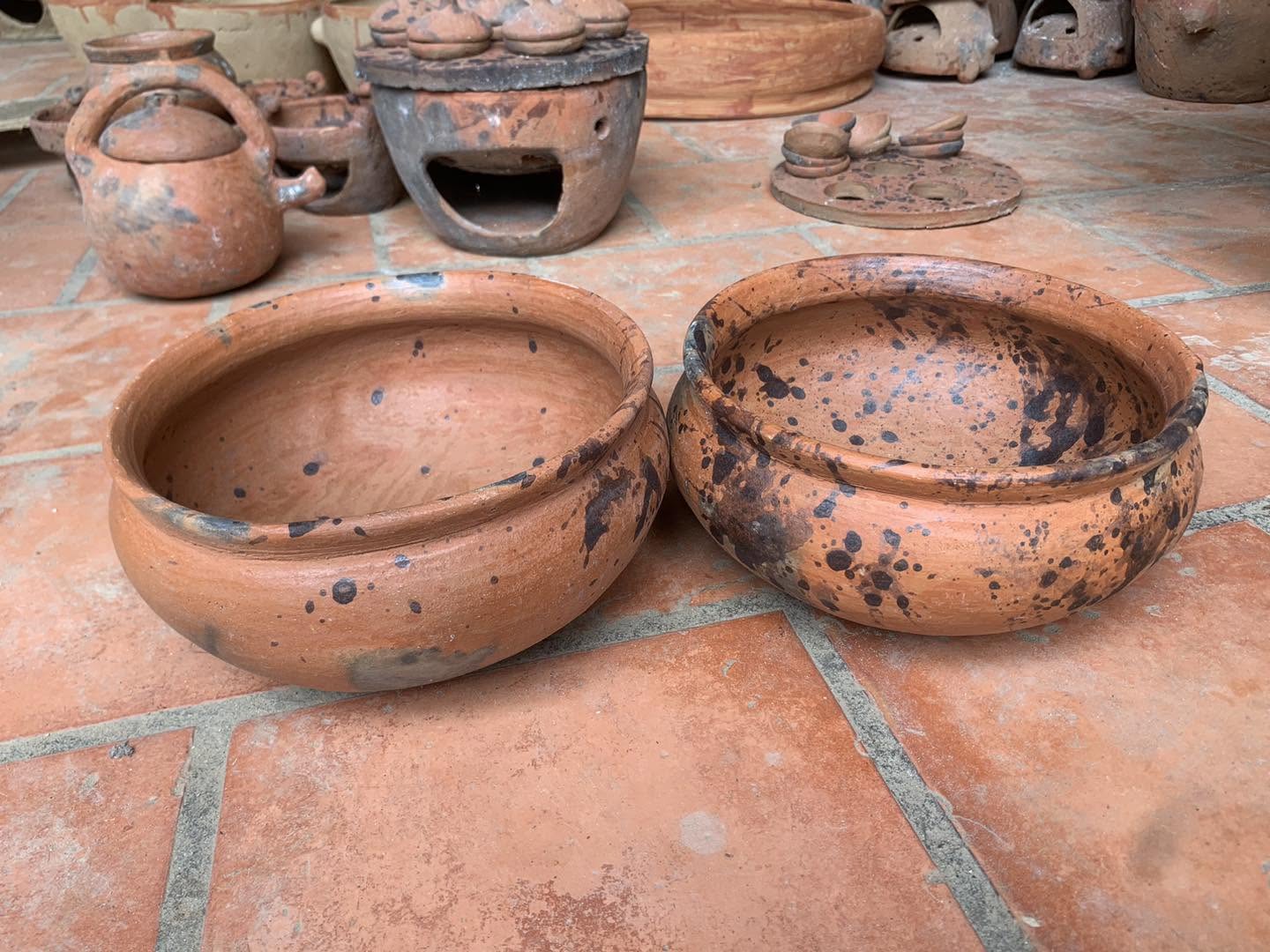
Once the pottery has been fired and removed from the firing area, artisans sprinkle the surfaces with a liquid made from the fruit of the wild persimmon tree or the bark of the chùm dụ tree to create decorative patterns.
This technique contributes to the characteristic appearance of Binh Duc Cham pottery, with a vivid reddish-pink surface marked by irregular dark brown and black streaks that resemble leopard skin.
Pottery for Everyday Life
Binh Duc pottery comes in a wide variety of forms and can generally be divided into two main groups: cooking vessels and storage vessels.
Cooking vessels include the glah roasting vessel, gok glah cooking pot, gok om kettle, glah đôi vessel, buk, gin nhjih, hawalo brazier, khung pey xèo mold for bánh xèo, khung pey kăn mold for bánh căn, and other household utensils.
Storage vessels include khơng brah rice jars, large buk praung jars, small buk ssit jars, khan basins, and ta chôrh lănk, a spittoon traditionally associated with religious dignitaries.
The products come in different sizes and forms and are relatively affordable and practical for everyday use. Binh Duc pottery is used not only by the Cham community but also by Vietnamese, Chinese, Raglai, Co Ho, and other communities in the region.
The pottery has also been sold in neighboring provinces and cities, including Ninh Thuan, Khanh Hoa, Dong Nai, Lam Dong, and Ho Chi Minh City.
Cultural Values of Binh Duc Cham Pottery
Binh Duc pottery preserves a body of traditional craft knowledge accumulated and transmitted over generations. From selecting and preparing clay to hand-shaping, refining, polishing, arranging the vessels, and controlling the fire during firing, every stage requires experience and technical skill.
The absence of a potter’s wheel and the use of open-air firing are particularly distinctive features of the craft. Rather than relying on machinery, artisans depend heavily on the sensitivity of their hands, close observation, and knowledge accumulated through years of practice.
The craft also reflects the important role of Cham women in maintaining and transmitting traditional handicraft knowledge. Through practical work within families and the wider community, pottery-making skills continue to be associated with everyday life and household needs.
The simple vessels, with their reddish-pink surfaces, characteristic dark streaks, and hand-shaped forms, are not merely functional objects. They also carry distinctive cultural marks of the Cham community.
According to the source material, in 2012, the Minister of Culture, Sports and Tourism included the Cham pottery-making craft in the National Intangible Cultural Heritage List as a traditional handicraft heritage. The source refers to the heritage at the time as the pottery-making craft of the Cham people in Binh Thuan Province.
This reflects the name and administrative context of the heritage recognition at that time. The present-day location provided for the craft in this article is Binh Duc Village, Phan Hiep Commune, Lam Dong Province.
Binh Duc Cham Pottery Today
Despite changes in contemporary life, Binh Duc pottery continues to preserve important traditional techniques, from clay preparation and hand-shaping to open-air firing.
The value of the craft lies not only in the pots, jars, braziers, and household vessels it produces, but also in the indigenous knowledge accumulated over generations. Each object is the result of an interaction between clay, the artisan’s hands, experience in controlling the material, and knowledge of fire.
Binh Duc Cham pottery can therefore be understood as a living cultural practice in which traditional craftsmanship, community life, and Cham cultural identity continue to meet through a distinctive and enduring craft tradition.
Basic Information
| Information | Details |
|---|---|
| Heritage | Cham Pottery Making |
| Community | Cham people |
| Present location | Binh Duc Village, Phan Hiep Commune, Lam Dong Province |
| Distinctive technique | Hand-shaping without a potter’s wheel |
| Firing method | Open-air firing |
| Main materials | Clay, firewood, straw |
| Finishing techniques | Shaping, scraping, polishing, and application of thổ hoàng |
| Products | Cooking vessels, storage vessels, and household utensils |
| Cultural value | Traditional craft knowledge and Cham cultural identity |
| Heritage category | Traditional craftsmanship |
| Recognition | Listed as National Intangible Cultural Heritage in 2012, according to the source material |