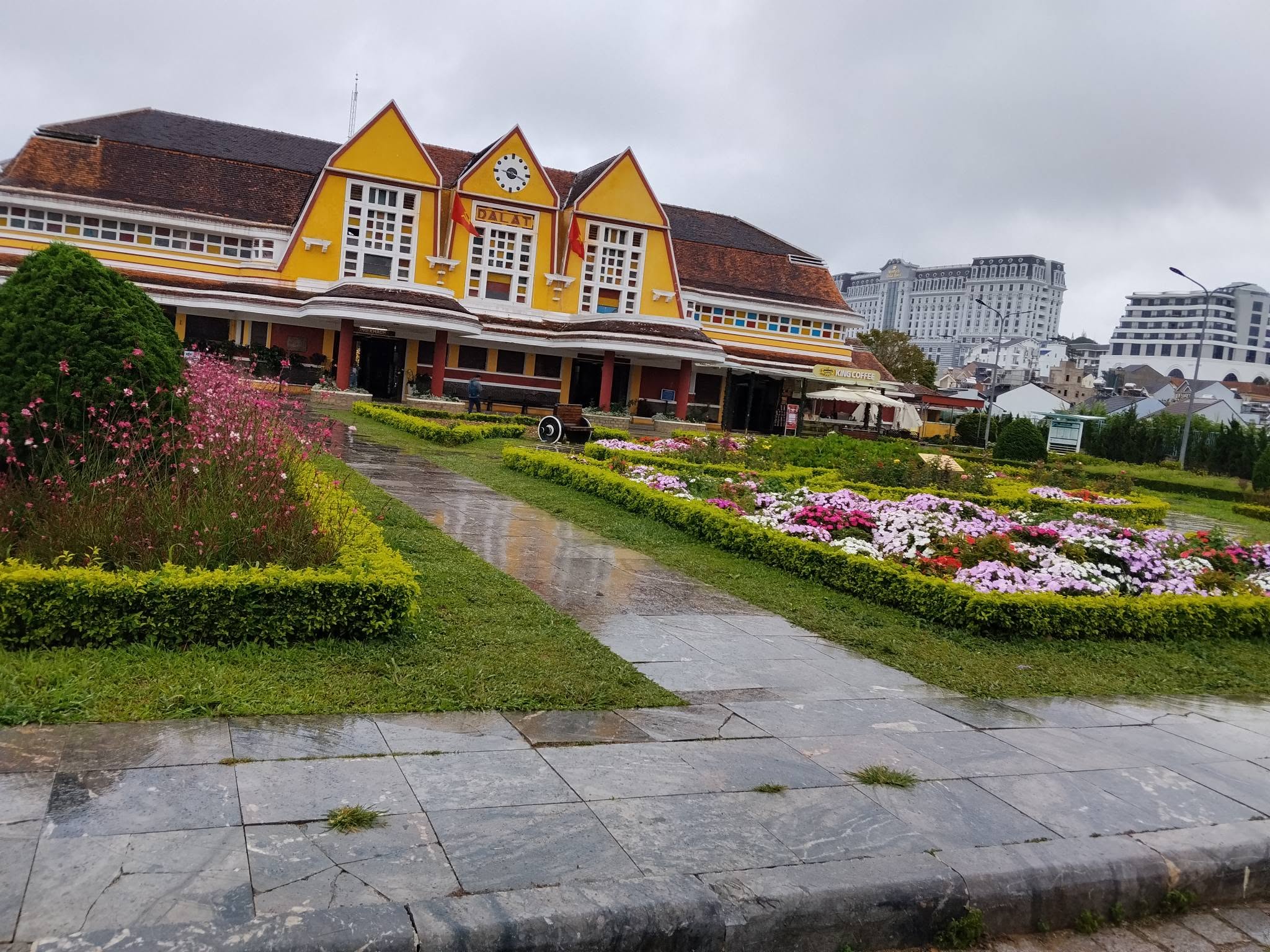
Da Lat Railway Station is located in Lam Vien – Da Lat Ward, Lam Dong Province, and is one of the most distinctive architectural landmarks associated with the formation and development of Da Lat. It is also one of the best-known railway stations in Vietnam’s Central Highlands and was once praised by the French press as one of the most beautiful railway stations in Indochina.
More than a transportation facility, Da Lat Railway Station is an important historical landmark reflecting the development of the highland city. The building combines European architectural influences with imagery associated with the Lang Biang mountains, creating a distinctive architectural character within Da Lat’s urban landscape.
Cultural researcher Dang Trong Ho has described Da Lat Railway Station as not merely a transportation structure but also an architectural symbol that embodies the story of the highland region and the layers of cultural heritage associated with Da Lat.
The History of Da Lat Railway Station
The history of Da Lat Railway Station is closely connected with the construction of the Thap Cham – Da Lat Railway, one of the most technically distinctive transportation projects in Indochina during the early 20th century.
After the decision to establish a resort area on the Lang Biang Plateau, the French administration sought to develop transportation links connecting Da Lat with the lowlands and coastal regions. In 1901, Governor-General Paul Doumer ordered studies for a railway project linking Da Lat with the main Hanoi – Saigon railway. Several survey missions were sent into the highlands, including the expedition led by Garnier in 1897 and another led by Captain Baudesson in 1901.
The construction of the Thap Cham – Da Lat railway was subsequently interrupted several times because of economic, political and military difficulties. The railway was built to the 1-meter gauge and was divided into three main stages: Thap Cham – Xom Gon, Xom Gon – Song Pha and Song Pha – Da Lat.
The Thap Cham – Xom Gon section was constructed from 1903 and opened in 1916. The railway was then extended to Song Pha in 1917. The section from Song Pha to Da Lat was the most difficult part of the entire route. Construction began again in 1922 and the different sections were completed over the following years.
The Thap Cham – Da Lat Railway and Its Engineering Challenges
From Song Pha, the railway had to cross high mountains, steep slopes and Ngoan Muc Pass before reaching the plateau. Construction took place in difficult terrain, dense forests and harsh climatic conditions, requiring numerous tight curves, bridges, tunnels and retaining walls.
The Song Pha – Da Lat section included five tunnels with a combined length of approximately 1,090 meters. Tunnel No. 3, between Tram Hanh and Cau Dat, was approximately 630 meters long and was the longest tunnel on the route.
Particularly notable was the installation of nearly 16 kilometers of Abt two-blade rack railway, distributed across three sections with steep gradients. The Song Pha – Eo Gio section was approximately 9 kilometers long with a gradient of up to 12%; the Dran – Tram Hanh section was about 4 kilometers long with a gradient of approximately 11.5%; and the Da Tho – Trai Mat section was about 2 kilometers long with a gradient of approximately 6%.
This special engineering solution enabled trains to overcome the steep slopes along the route from the coastal region to the highlands.
From Song Pha, at an elevation of approximately 186 meters, the railway climbed through Ngoan Muc Pass to Eo Gio at approximately 991 meters above sea level. It then continued through Dran, Tram Hanh, Cau Dat, Da Tho and Trai Mat before reaching Da Lat at an elevation of approximately 1,550 meters.
The section from Trai Mat to Da Lat is approximately 6.55 kilometers long and uses conventional rails. The line winds through the hills of Sao Nam and Chi Lang and passes beneath the automobile bridge on Tran Quy Cap Street before reaching Da Lat Railway Station.
After several stages of construction, the Thap Cham – Da Lat railway was gradually opened along its entire route. It once served as an important transportation link connecting Da Lat with the coastal region of Ninh Thuan and the national railway network.
The Distinctive Architecture of Da Lat Railway Station
According to the Da Lat Gazetteer, the present railway station was constructed from 1932 to 1938 and designed by French architects Révéron and Moncet. The building features characteristics of Anglo-Norman architecture, while its form and layout have also been described as similar to the railway station in Deauville in the Calvados region of northern France.
Other historical materials record that the station and its freight warehouse were constructed from 1928, based on a design concept inspired by the three peaks of the Lang Biang mountain range. The present station has retained architectural features associated with this concept.
The station is approximately 66 meters long, 11.5 meters wide and has a main hall approximately 11 meters high. Its floor plan is organized almost symmetrically around an axis perpendicular to the main façade. A large central hall is flanked by smaller rooms extending on both sides.
The symmetrical composition is expressed through various architectural elements, from the steep red-tiled roofs and folded roof sections to the angled roof forms and window system. The monumental character of the building is also evident in its reinforced-concrete roof trusses, which rise more than 6 meters high.
Three Roof Peaks Inspired by Lang Biang
The most striking feature of Da Lat Railway Station is its system of three tall roof peaks rising consecutively at the center of the façade. Beneath the peaks is the raised inscription “DALAT”, forming one of the building’s most recognizable visual features.
The three roof peaks are commonly associated with a stylized representation of the Lang Biang mountain range, one of the best-known mountain landscapes of the Lang Biang Plateau. Another interpretation connects the roof form with traditional architecture of the indigenous communities of the Central Highlands.
Regardless of interpretation, the combination of European architectural forms and imagery associated with the Central Highlands gives Da Lat Railway Station its distinctive identity.
Corresponding to the three roof peaks are three large windows divided into numerous small panes. The lower roof area also features multicolored glass windows, allowing natural light to enter the interior.
The passenger waiting hall beneath the colored glass windows is particularly notable for its distinctive light effects. The decorative details are relatively restrained, creating a modern, elegant appearance that complements the overall architectural composition.
Da Lat Railway Station and the Legendary Railway
The significance of Da Lat Railway Station extends beyond its architecture. It is closely connected with one of the most technically distinctive railway routes in Indochina.
The Thap Cham – Da Lat Railway was approximately 84 kilometers long and crossed complex terrain from the coastal region of Ninh Thuan to the highlands. Along the route, trains had to negotiate Ngoan Muc Pass, high mountain ranges, tunnels and rack railway sections.
From the coast of Ninh Thuan, trains once carried passengers through mountainous landscapes, over the pass, through tunnels and gradually upward toward the Lang Biang Plateau. The journey was therefore not only a transportation experience but also a remarkable encounter with both landscape and engineering.
The railway was operated along its entire route from the 1930s. However, following major historical changes, railway operations along the Thap Cham – Da Lat line gradually ceased toward the end of the 1960s.
The Da Lat – Trai Mat Section Restored
In 1991, the Da Lat – Trai Mat railway section was restored for tourism. It is the surviving section of the historic Thap Cham – Da Lat railway that continues to operate for visitors.
Today, tourist trains from central Da Lat travel through the city’s outskirts, passing vegetable gardens, flower gardens and hilly landscapes before reaching Trai Mat.
During the journey, passengers can enjoy coffee, listen to live musical performances and experience an atmosphere of nostalgia. Through the train windows, visitors can observe the characteristic landscapes of Da Lat, from rolling hills to gardens and highland neighborhoods.
The railway section has therefore become both a surviving element of railway heritage and a distinctive tourism experience associated with Da Lat.
Historic Railway Relics at Da Lat Station
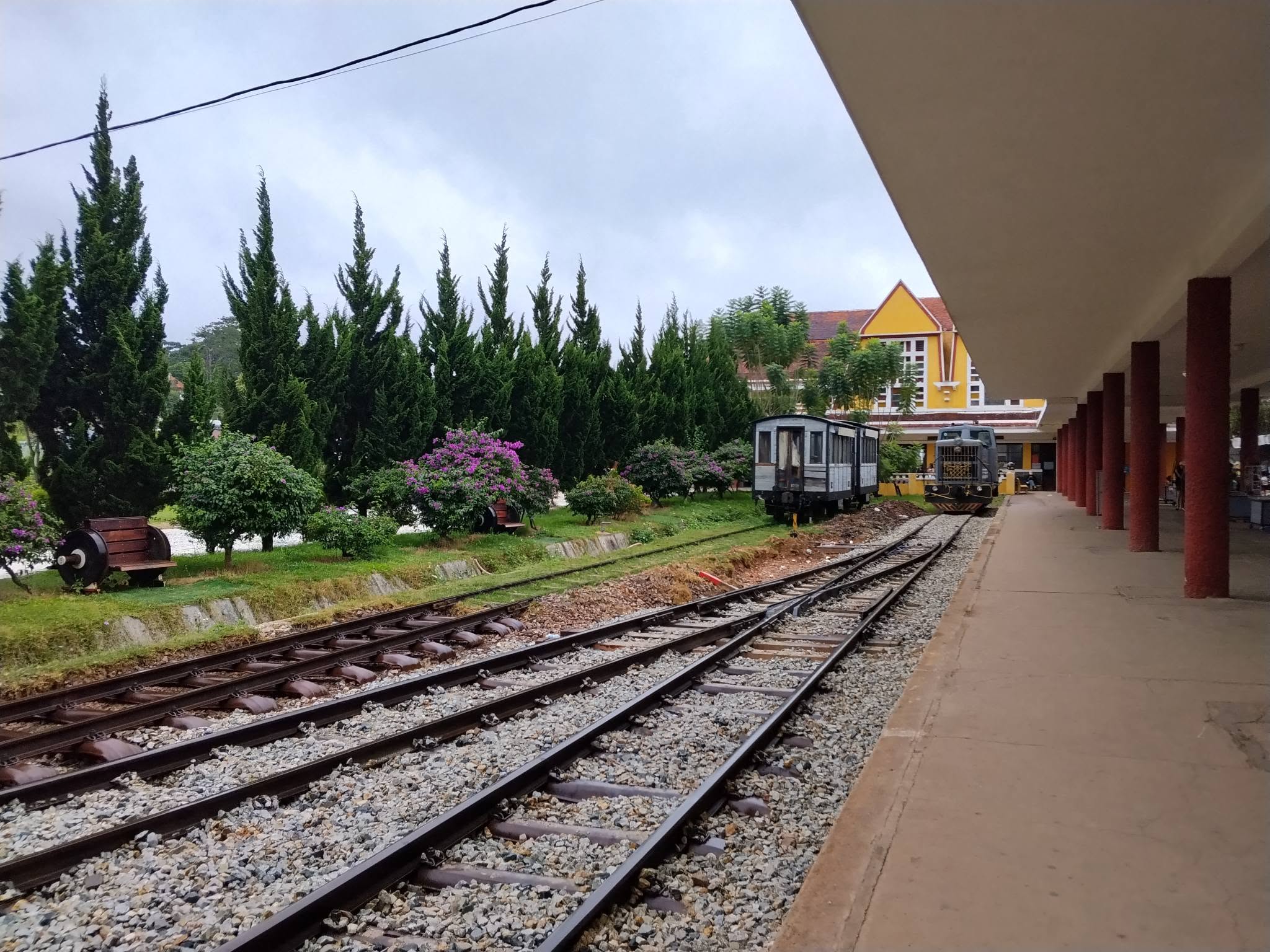
The station complex still preserves historic locomotives and railway carriages, recalling an important period in the history of railway transportation in the highlands.
Da Lat Railway Station currently preserves three locomotives, including a steam locomotive manufactured in the early 1940s. Together with the station building, platforms and the Da Lat – Trai Mat railway, these objects form a cultural landscape linking architecture, transportation technology and the history of the city.
According to the landscape planning approved by Lam Dong Province, the Da Lat Railway Station area covers more than 4.6 hectares, providing a framework for preserving and promoting the historical, architectural and landscape values of the station complex.
Da Lat Railway Station and the Development of the City
The emergence of the Thap Cham – Da Lat railway was closely connected with the development of Da Lat as a resort city on the Lang Biang Plateau.
The Indochina railway programme initiated by Governor-General Paul Doumer in the late 19th century laid the foundations for the development of a large-scale railway network in Indochina. The Hanoi – Saigon railway became the main trunk line, from which several branch lines were developed, including the Thap Cham – Da Lat route.
Connecting Da Lat with the railway network of the lowlands allowed the highland city to establish stronger links with other parts of Vietnam. When the Tuy Hoa – Dai Lanh section was completed on 4 October 1936, Da Lat gained an additional connection with the Hanoi – Saigon trans-Vietnam railway.
A temporary station was initially built near the site of the present Da Lat Railway Station. It resembled the small railway stations found in rural areas of France. The present station was later constructed to replace this temporary building.
A National Historical-Cultural Relic
Da Lat Railway Station was recognized as a national historical-cultural relic in 2001. Its value lies not only in the age of the building but also in the combination of architecture, railway history, urban history and the landscape of the highlands.
More than a century after the first surveys were conducted to establish transportation routes to the highlands, Da Lat Railway Station remains a distinctive landmark in the city’s urban landscape. Its three roof peaks, multicolored glass windows, historic locomotives and railway platforms create a space where European architectural influences meet the imagery of the Lang Biang mountains.
From a transportation facility, Da Lat Railway Station has evolved into a cultural and tourism destination where railway history, architecture and memories of Da Lat come together in one place.
Quick Information
| Item | Information |
|---|---|
| Name | Da Lat Railway Station |
| Historical names | Da Lat Railway Station, Da Lat Railway Terminal |
| Heritage type | Historical-cultural relic |
| Recognition | National historical-cultural relic, 2001 |
| Location | Lam Vien – Da Lat Ward, Lam Dong Province, Viet Nam |
| Street address | Nguyen Trai Street, Da Lat |
| Architects | Révéron and Moncet |
| Architectural style | Anglo-Norman |
| Present station | Constructed from 1932 to 1938 |
| Station length | Approximately 66 m |
| Station width | Approximately 11.5 m |
| Main architectural feature | Three roof peaks associated with the Lang Biang mountains |
| Historic railway | Thap Cham – Da Lat Railway |
| Railway length | Approximately 84 km |
| Special engineering feature | Abt rack railway system |
| Restored section | Da Lat – Trai Mat |
| Restoration year | 1991 |
| Key values | Architecture, railway history, urban history and Da Lat’s cultural heritage |
Location: Lam Vien – Da Lat Ward, Lam Dong Province, Viet Nam.