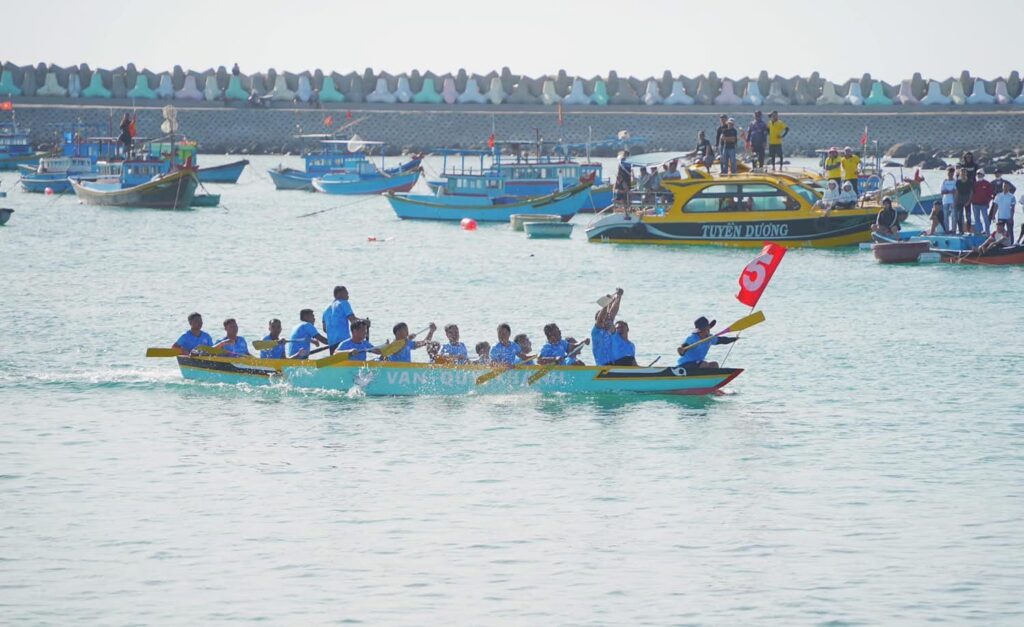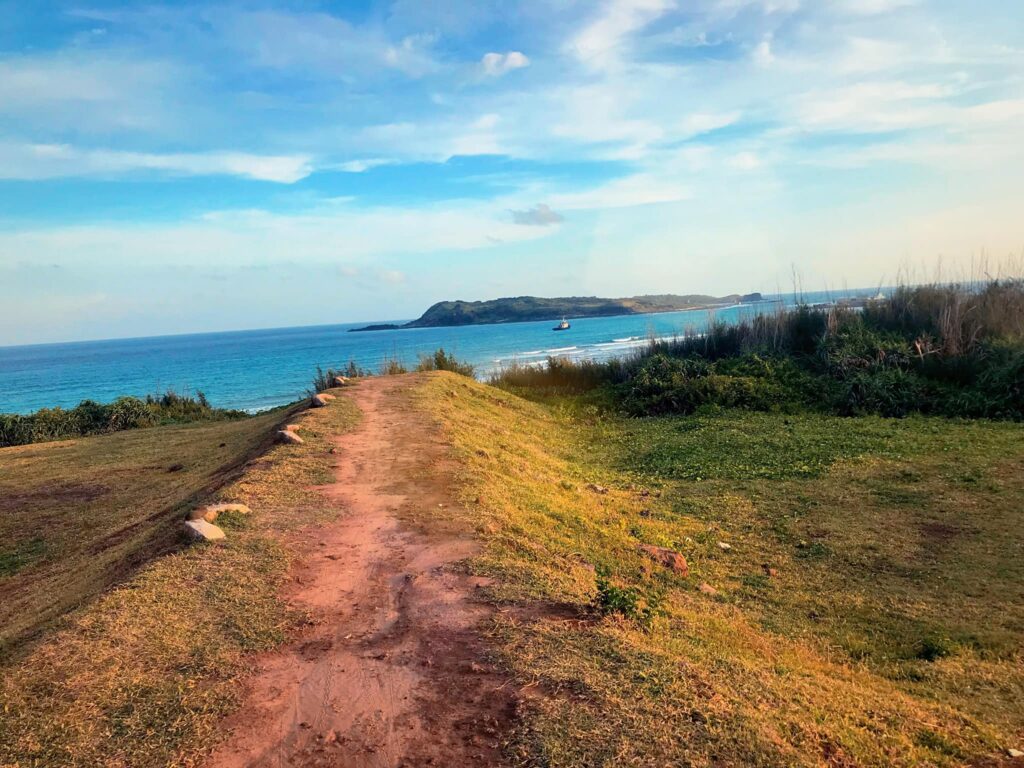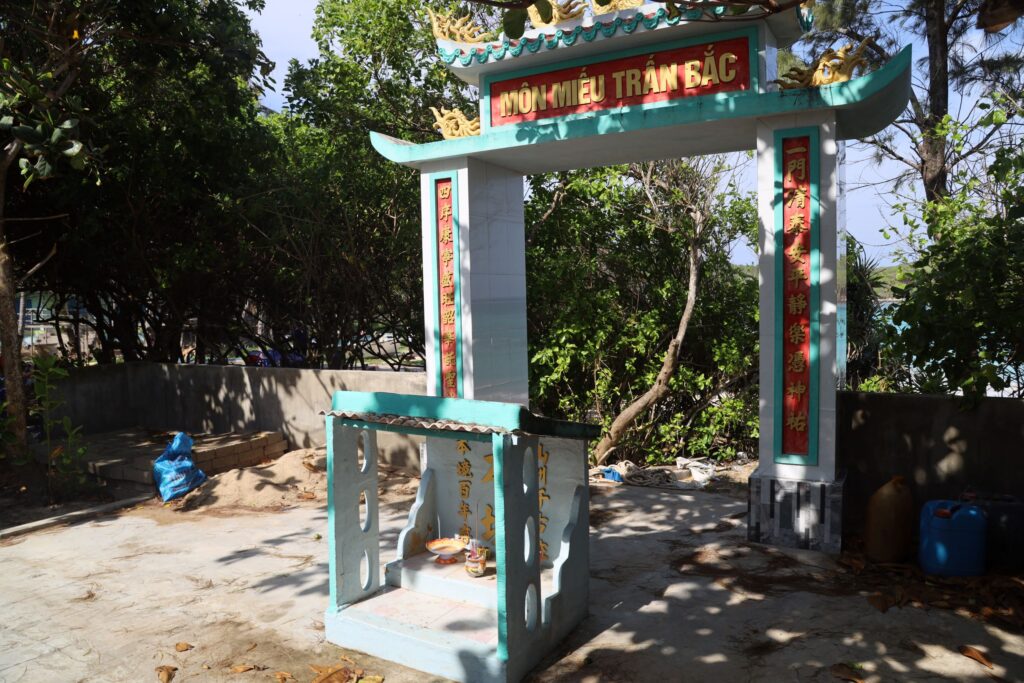
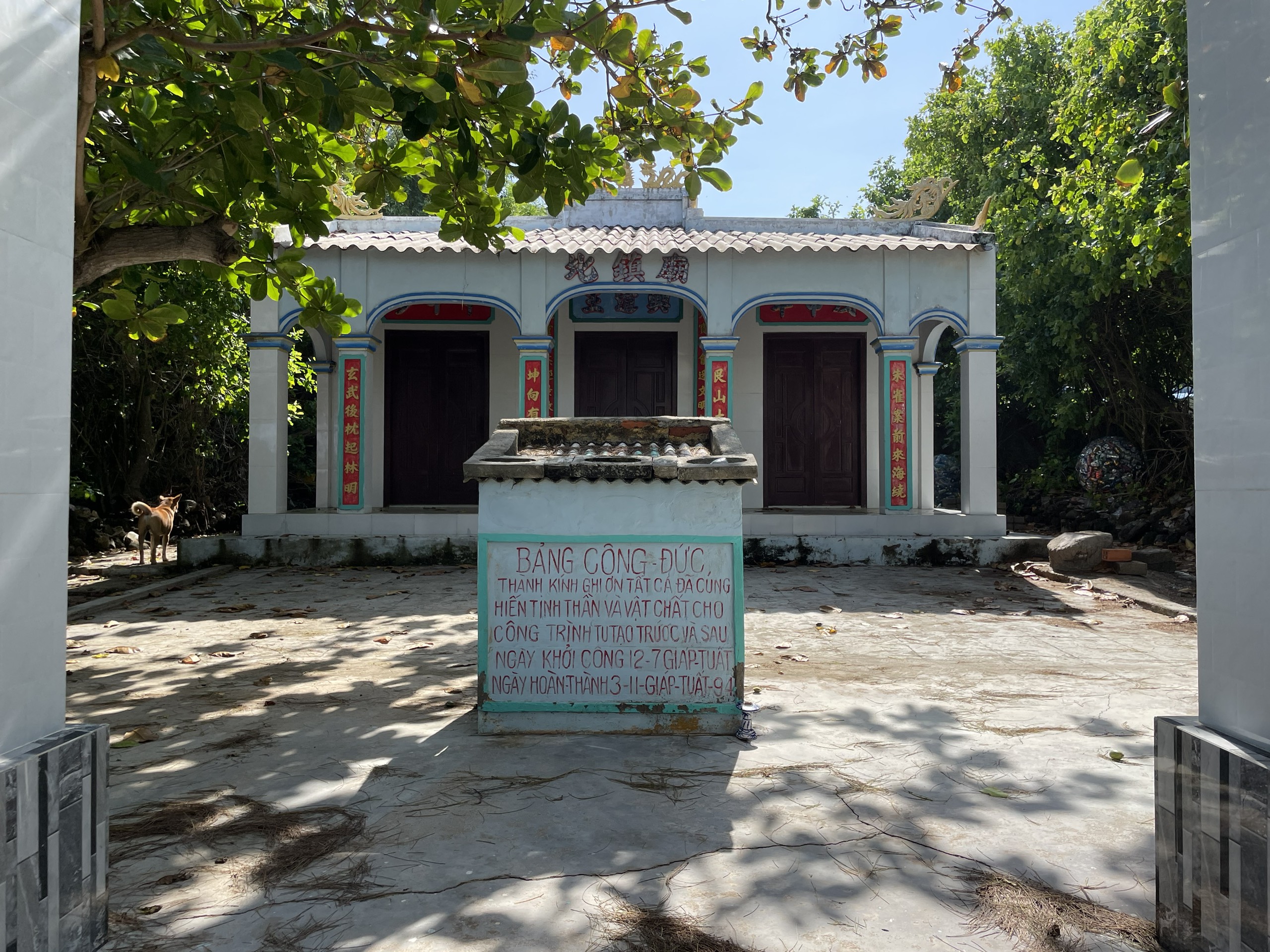
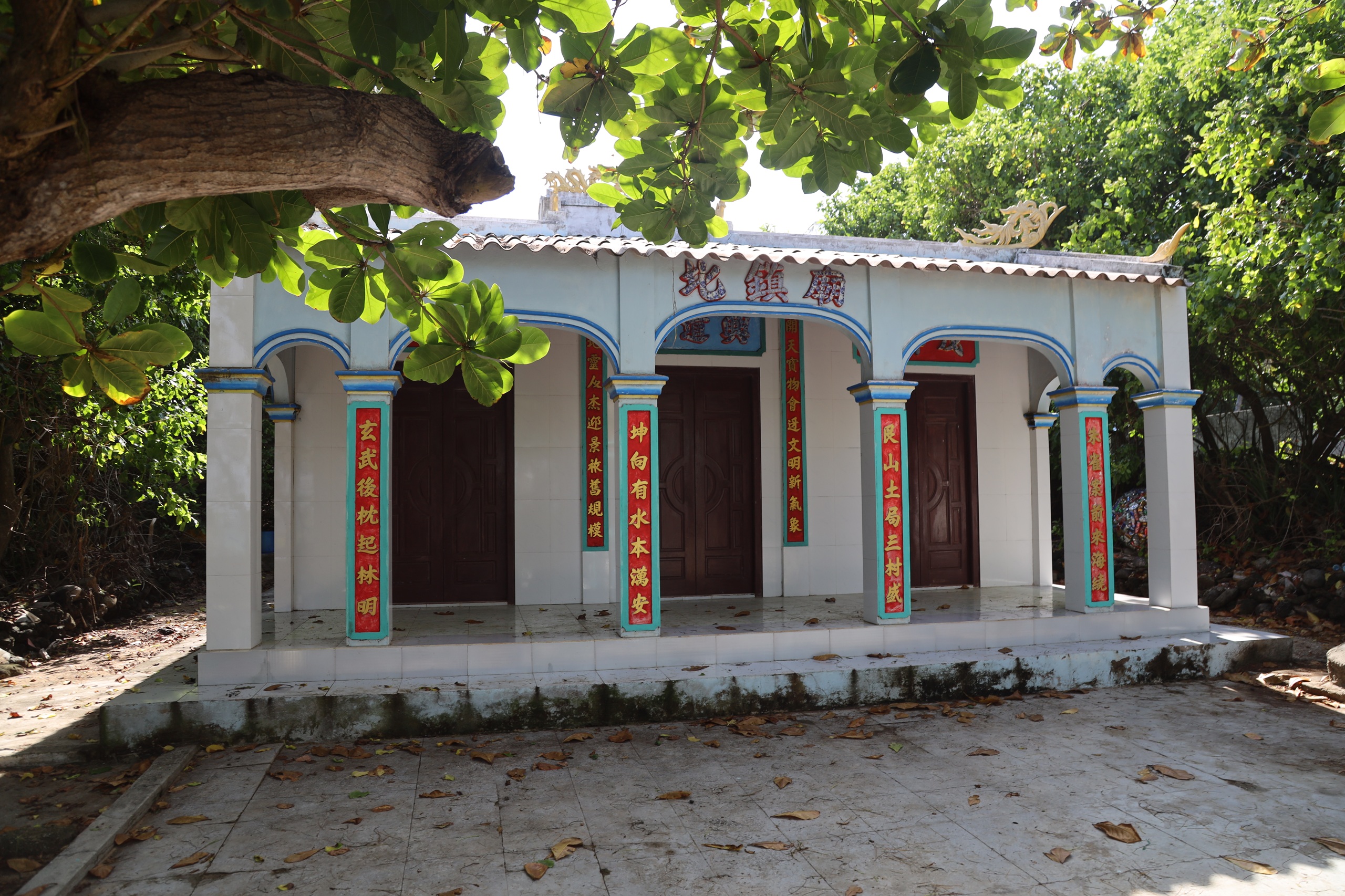
Tran Bac Shrine on Hon Tranh Island was built in the early 19th century. Facing the southwest, the shrine greets ocean winds and the soft golden glow of sunset. According to traditional geomancy, the surrounding landscape forms an auspicious configuration: the Azure Dragon to the left, the White Tiger to the right, the Black Tortoise (Huyen Vu Hill) behind, and the Vermilion Bird in front, with a vast open “bright hall” (minh đường) overlooking the sea.
It is a small, modest shrine without a three-entrance gate, unlike many other historical temples. To its right stands a burial site dedicated to 72 whales that, according to island oral tradition, washed ashore and died at the same time. Locals retrieved, buried, and later enshrined their sacred bones in this tomb as a symbol of gratitude and reverence.
The shrine was restored in 1994, and its front courtyard is now paved with Bat Trang tiles. Despite its simplicity, Tran Bac Shrine retains an ancient and solemn atmosphere. Above the rooftop is the inscription “Miếu Trấn Bắc”, accompanied by Chinese characters meaning “North-Guardian Shrine – Grand Guardian of the Realm.”
Inside the Shrine – Honoring Historical and Spiritual Figures
The moment one steps into the main hall, a large horizontal board inscribed with the characters “Hưng Đạo Vương” immediately catches the eye. At the central altar are the spirit tablets of Bùi Quận Công (Lord Bùi) and the Goddess Thiên Y A Na, accompanied by an image of Trần Hưng Đạo.
Two side altars honor the island’s Forefathers (Tiền Hiền) and Later Founders (Hậu Hiền).
The spirit tablet of Lord Bùi reads:
“Cung thỉnh Trấn Bắc quân Đô đốc phủ Chưởng phủ sự Thái bảo Bùi Quận công Thượng đẳng thần.”
— invoking him as a High-Ranking Deity and North-Guardian Lord.
Who Was Lord Tran Bac – Bùi Quận Công?
Historical records identify him as Bùi Tá Hán (1496–1568), originally from Quang Ngai Province. He served the Lê Dynasty, rising from a minor local official to Chief Commander of the Northern Army, Governor of Quang Nam, and Marquis of the Realm.
Renowned for his integrity and benevolence, he was beloved by the local population.
In 1558, when Lord Nguyễn Hoàng first came south to govern Thuan Hoa, invasions from the north were frequent. Bùi Tá Hán led Quang Nam troops to support him, deterring enemy forces. He also suppressed uprisings of the Đá Vách region and established six fortress posts to stabilize the frontier.
He is remembered as one of the pioneering generals of Vietnam’s early southward expansion.
When he passed away in 1568, he was posthumously granted the title Thái Bảo. Later, after several manifestations witnessed by local communities, the Nguyễn court ordered a shrine to be built in his honor and bestowed ceremonial robes and sacred objects for worship.
In 1834, under Emperor Minh Mạng, he was elevated as “Khuông Quốc Tĩnh Biên Thụ Đức Thượng Đẳng Thần” — a High-Order Deity who stabilizes the realm.
Local Legend: The Connection with Nguyễn Ánh
Island folklore recounts that during the conflicts with the Tây Sơn army, the future Emperor Nguyễn Ánh (Gia Long) and his generals often sought refuge on Phu Quy Island.
Tran Bac Shrine is linked to Bùi Huy Ích, a commander who protected Nguyễn Ánh during these turbulent times. Near the shrine, remnants associated with Nguyễn Ánh still exist, including a natural freshwater well used by him and his soldiers. Locals call it Gia Long Well to honor his presence on the island.
Architectural Layout and Sacred Sites
Tran Bac Shrine includes:
- The main entrance
- The central sanctuary
- The incense house
The Whale God Tomb (Nam Hai Shrine)
About 200 meters to the southeast lies Gia Long Well, a 7-meter-deep coral-stone well with a diameter of 1.2 meters. Uniquely, it provides fresh, sweet water year-round, while surrounding wells produce brackish water. For decades, this well supplied freshwater to military posts stationed on Hon Tranh.
Inside the shrine, many ancient Sino-Vietnamese couplets remain. One translated couplet reads:
“The saintly virtue protects the land, his heroic name endures — worthy of the exalted rank.
The divine general aids humanity, understanding all matters — deserving of the honor Tĩnh Biên.”
Another couplet carved in relief translates:
“In life, he was a general who protected the people from peril.
In death, he became a deity who saves the suffering of the world.”
Royal Decrees and Ritual Practices
The Nguyen emperors granted three royal decrees to Lord Tran Bac, instructing the villages of Hoi An, Trieu Duong, and My Khe to worship him. These decrees—issued under Emperors Tự Đức (Year 5), Đồng Khánh (Year 2), and Khải Định (Year 11?)—are preserved at the An Thạnh Whale Temple.
During annual ceremonies, the decrees are ceremonially carried in a procession from An Thạnh to Tran Bac Shrine and returned afterward.
Tran Bac Shrine observes two major annual rituals:
- 12th day of the third lunar month: Worship of Goddess Thiên Y A Na
- 7th day of the eighth lunar month: Worship of Lord Tran Bac
Although the shrine sits on a small, quiet island with few visitors, it remains immaculate — lovingly maintained by fishermen who stop by after long sea journeys to pray for calm seas, safety, and prosperity.
A Place Steeped in History and Reverence
As dusk falls and the fading sunlight washes the shrine in soft gold, seabirds return to their nests and the island grows still. From the boat cutting through the waves, the shrine appears and disappears behind the rocks — moss-covered, ancient, and silently dignified.
In that moment, one cannot help but feel gratitude for the ancestors who paved the way, carved out this land, and left behind a legacy of devotion. History continues to flow, and cultural values may fade if not cherished — but Tran Bac Shrine stands as a timeless reminder of the island’s spiritual heritage and the enduring spirit of its people.