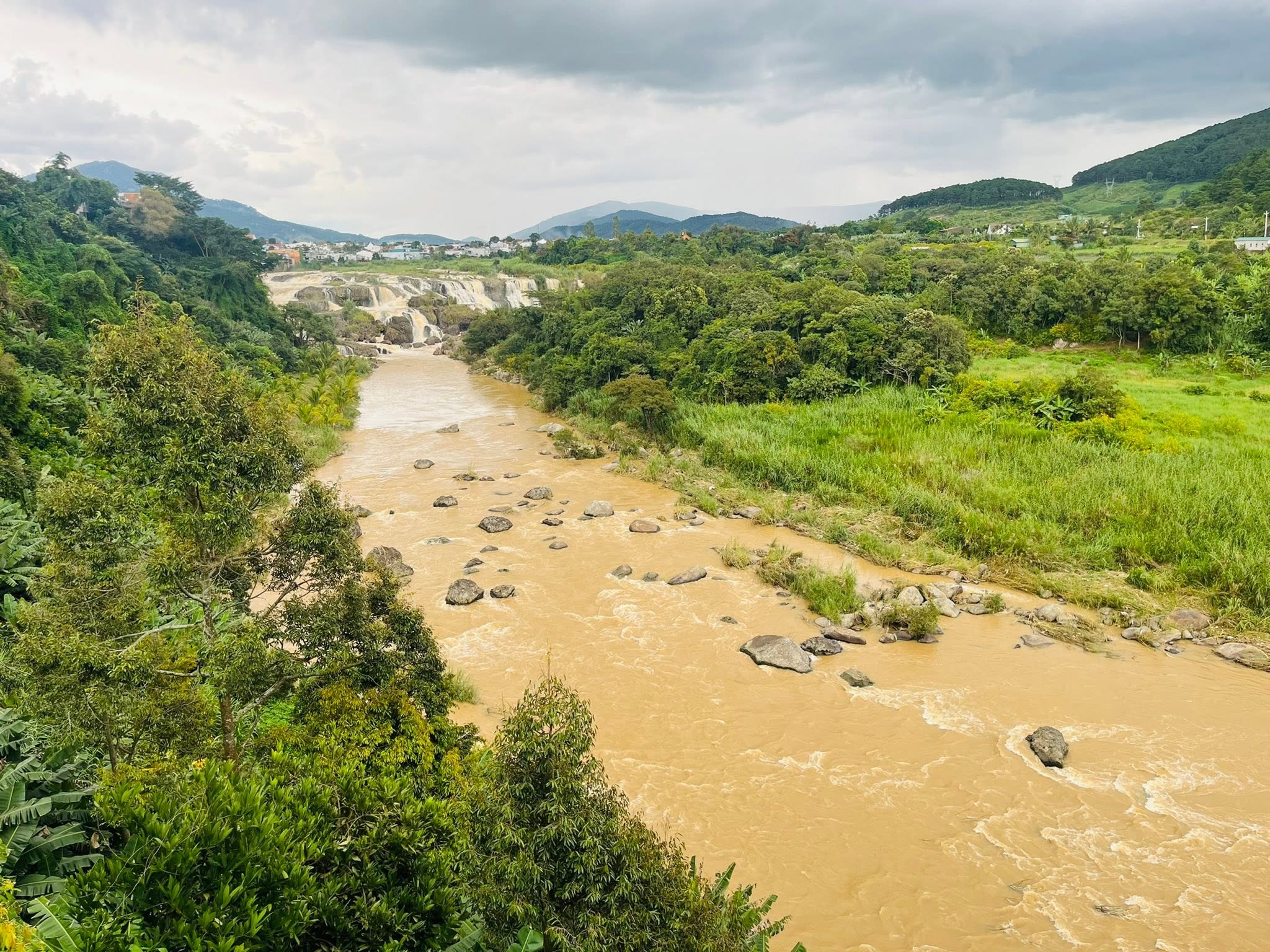
Location: Da Nhim River area, Duc Trong District, Lam Dong Province, Vietnam.
Once regarded as one of the most impressive waterfalls in Lam Dong, Gougah Waterfall, also known as O Ga Waterfall, was a notable natural attraction along the historic route between Da Lat and Ho Chi Minh City.
Traveling along National Highway 20 from Da Lat toward Ho Chi Minh City, visitors once reached a turnoff after passing through the Duc Trong area. From there, a concrete road of approximately 800 meters led to the waterfall.
Gougah was formed where the Da Nhim River encountered a geological fault in the Phu Hoi area. The river was divided into separate streams before cascading over the rocky terrain into a deep gorge. Surrounded by the highland landscape, forests, and open skies, the waterfall was once known for its powerful, pristine beauty.
The Name Gougah and Its Legends
The name Gougah is traditionally associated with the language of the indigenous K’Ho people.
The waterfall is also known by the popular name O Ga, or “Chicken Nest Waterfall.” One explanation connects this name with the distinctive appearance of the waterfall.
Before 1975, visitors reportedly observed the river splitting into two contrasting streams. One appeared yellowish-red, while the other flowed white and foamy. Seen against the gray rock walls, the two streams were said to resemble a split egg.
The rocks beneath and around the waterfall were also shaped by centuries of powerful currents, forming rounded depressions and cavities reminiscent of large bird nests. Over time, the name O Ga became associated with the waterfall.
Another local legend connects Gougah with Queen Nafulut, described in the story as a Vietnamese woman who married a Cham king. Some versions identify her with Princess Huyen Tran.
According to the legend, after the king was defeated and fled southward, the queen followed his path. During the journey, she became seriously ill and encountered a group of local inhabitants who helped her reach the waterfall to rest and recover.
On one occasion, she looked down into the deep and rugged gorge and asked the local people what the place was called. They answered that it was Gougah. According to the story, the name was subsequently passed down through generations.
Other legends surrounding the waterfall tell of Cham royal treasure that was supposedly hidden in the area as members of the Cham royal family fled toward the highlands. Local folklore speaks of a deep cave beneath the waterfall leading into the earth and guarded by supernatural forces.
Another story tells of a tragic love between a young man and woman from the Lach/K’Ho communities who were unable to marry because of conflicts between their tribes. According to the legend, their tears and sorrow became the powerful waterfall that roared through the mountains.
These stories belong to local folklore and have contributed to the cultural character and mystique surrounding Gougah.
Gougah During Its Golden Age of Tourism
From the French colonial period through the late 20th century, Gougah was an important stopping point along the road between Saigon and Da Lat, together with other famous waterfalls such as Pongour and Prenn.
During the 1980s to around 2005, the waterfall area was developed for tourism. Lam Dong Tourism Company and local authorities invested in access roads, concrete paths, viewing railings, a suspension bridge, and rest shelters along the gorge.
The powerful flow of the Da Nhim River and the dramatic drop of the waterfall attracted visitors for sightseeing, picnics, and photography.
According to the source material, in 2000, Gougah Waterfall was officially recognized and classified as a National Scenic Monument by the Ministry of Culture and Information.
The waterfall area was also developed with additional tourist facilities. Tai Nhan Tourism Co., Ltd. invested in a project with a total planned capital of more than VND 7 billion, divided into three phases.
The first phase, with an investment of nearly VND 2 billion, focused on reforestation, building access roads to the waterfall, restoring the surrounding landscape, and constructing rest shelters, viewing houses, refreshment stalls, and other facilities inspired by the traditional architecture of the Central Highlands.
A restaurant with a capacity of more than 150 guests, karaoke services, and overnight accommodation were also developed.
For visitors wishing to experience the forest at night, the resort once offered family accommodation for groups of two or four people. Groups could also enjoy ruou can, grilled meat, singing, dancing, and campfires before spending the night in tents under the stars.
Listening to the sounds of the Central Highlands forest around a campfire was part of the experience that made Gougah memorable to visitors.
The Original Two-Tiered Waterfall
According to descriptions of Gougah in its natural state, the waterfall stood approximately 17 meters high, with a waterfall face more than 30 meters wide. The Da Nhim River flowed over a basalt terrace before plunging into a deep rocky gorge.
One of the waterfall’s most distinctive features was the way a projecting rock divided the river into two contrasting streams.
One stream rushed powerfully over the rocks and dropped almost vertically into the gorge, creating a roar and a cloud of white spray. This stream was traditionally associated with the male waterfall, or Thac Duc.
The other stream flowed more gently across a series of lower rock terraces, forming a softer ribbon of water known as the female waterfall, or Thac Cai.
The contrast between the two streams gave Gougah a distinctive appearance and became one of the defining features of the waterfall.
At the base was a deep rocky valley containing large boulders shaped by the powerful currents over thousands of years. Water erosion created honeycomb-like formations, deep rounded cavities resembling potholes, and rocky openings covered with moss and old climbing vines.
The surrounding landscape was once covered by broadleaf forests and dense pine groves belonging to the Da Nhim River basin. Mist and spray from the waterfall created a cool, humid microclimate throughout the valley.
The Transformation of Gougah
A major turning point in the history of Gougah came with the construction of the Dai Ninh Hydropower Project, carried out during the period from 2003 to 2008.
The project was developed to utilize water resources in the Da Nhim River basin and transfer water toward the Luy River basin in Binh Thuan Province.
The construction of the project, including river diversion and the formation of the reservoir, changed the natural flow of the river.
By around 2007-2008, as the Dai Ninh reservoir was filled, the former Gougah waterfall area became deeply submerged beneath the reservoir’s rising water level. During the dry season, the flow that had once passed over the old rocky waterfall almost completely disappeared.
As a result, the tourist site was forced to close.
The transformation of the natural landscape also meant that Gougah could no longer retain the appearance and character for which it had originally been recognized. According to the source material, the Ministry of Culture, Sports and Tourism subsequently withdrew the national monument classification for Gougah Waterfall.
The Memory of a Lost Highland Landmark
Gougah is now remembered as a waterfall that once played an important role in the tourism landscape of Lam Dong.
Its story is more than the story of a waterfall. It encompasses the Da Nhim River, basalt cliffs, ancient forests, local legends, the development of tourism, and the transformation of a natural landscape by a major hydropower project.
The name Gougah, the popular name O Ga, legends surrounding the Cham royal family, stories of K’Ho and Lach communities, and memories of picnics, campfires, and nights beneath the Central Highlands sky have all become part of the cultural memory surrounding the site.
For Travelin, Gougah Waterfall is a notable destination in the history of Lam Dong’s tourism. Although the waterfall no longer retains the natural landscape described in earlier accounts, its story remains an important part of the region’s heritage and a reminder of how dramatically landscapes can change over time.