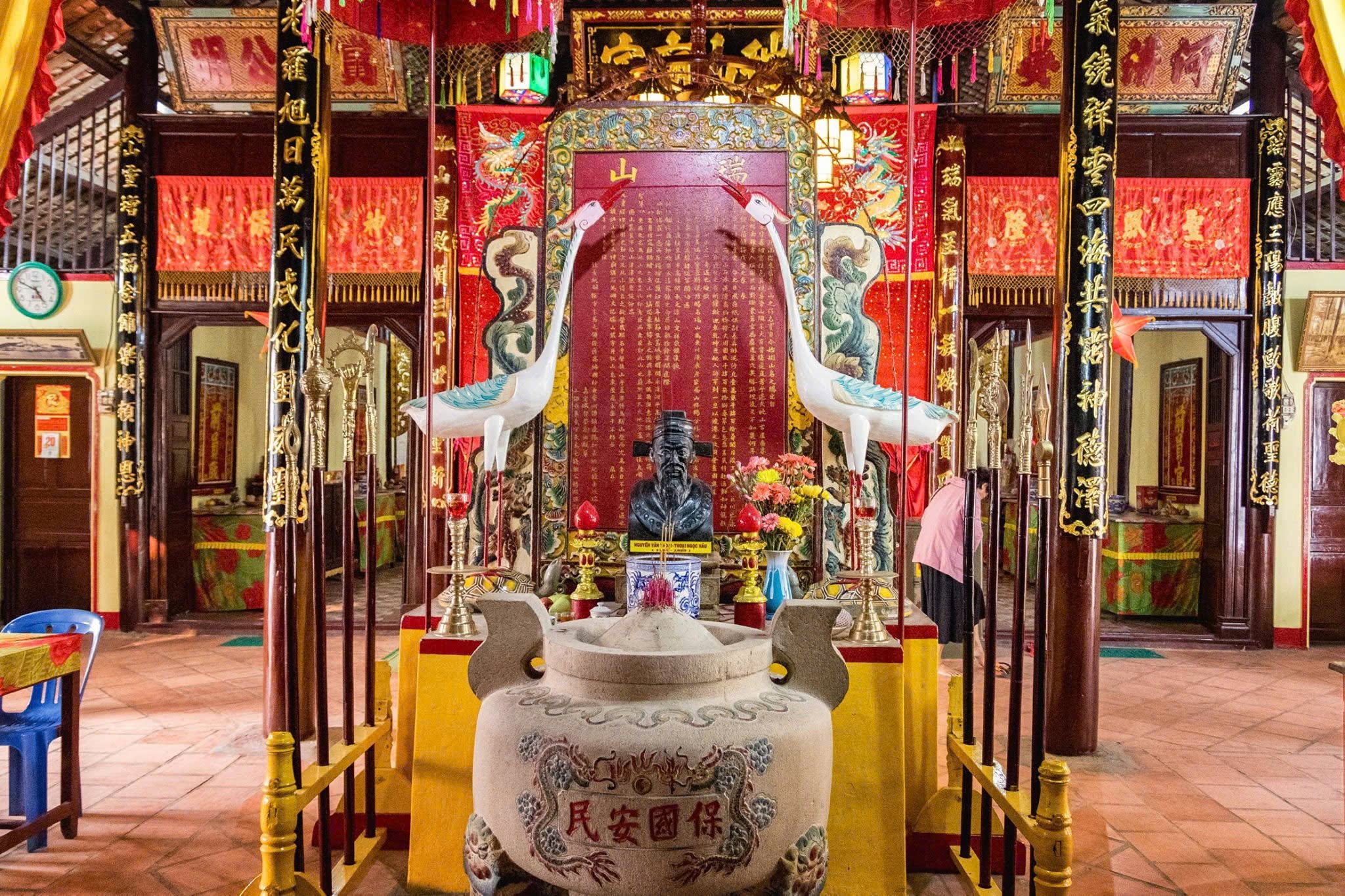
The Ky Yen Festival at the Thoai Ngoc Hau Communal House is a traditional festival of Thoai Son, An Giang Province, closely associated with the worship of Thoai Ngoc Hau Nguyen Van Thoai (1761–1829), a historical figure connected with the development, settlement, hydraulic works, and defense of the southwestern region of Vietnam in the early nineteenth century.
Held annually at the Thoai Ngoc Hau Communal House in the Nui Sap area of Thoai Son, the festival is a religious and community occasion dedicated to honoring the local tutelary deity. It expresses people’s wishes for peace, favorable weather, abundant harvests, prosperity, and the well-being of the community.
The festival preserves many important elements of the traditional communal-house festivals of southern Vietnam, including the ceremonies of welcoming the deity, Túc yết, Xây chầu, Đại bội, and Chánh tế. A particularly distinctive feature is the important role of Hát bội, or Vietnamese classical theater, which forms an integral part of both the ritual and artistic program.
In recognition of its historical, religious, artistic, and community values, the Ky Yen Festival at the Thoai Ngoc Hau Communal House was included in Vietnam’s National Intangible Cultural Heritage List under Decision No. 2947/QD-BVHTTDL dated 16 October 2020, in the category of traditional festivals.
Basic Information
- Heritage: Ky Yen Festival at the Thoai Ngoc Hau Communal House
- Vietnamese name: Lễ hội Kỳ Yên ở Đình Thần Thoại Ngọc Hầu
- Type: Traditional festival
- Cultural space: Thoai Ngoc Hau Communal House, Thoai Son, An Giang Province
- Historical figure worshipped: Thoai Ngoc Hau Nguyen Van Thoai (1761–1829)
- Main rituals: Welcoming the Deity, Thỉnh sanh, Túc yết, Xây chầu, Đại bội, Chánh tế, and Tôn vương
- National Intangible Cultural Heritage: 16 October 2020
- Decision: No. 2947/QD-BVHTTDL
- Heritage category: Traditional festival
- Province: An Giang
Thoai Ngoc Hau and the Historical Memory of Land Development
Thoai Ngoc Hau, whose real name was Nguyen Van Thoai, was born in 1761 and died in 1829. He was a military official of the Nguyen dynasty who spent many years working in the southwestern border region and became associated with the development of settlements, canals, roads, agricultural land, and frontier defenses.
The name Thoai Son itself preserves the historical memory associated with him. In local tradition, Thoai Ngoc Hau is remembered not only as a military and administrative figure but also as someone connected with the development of settlements and agricultural production in the region.
Hydraulic works and land development were particularly important in the Mekong Delta. The organization of waterways, flood control, transportation, and agricultural land helped expand settlement and create conditions for economic development.
Within local cultural memory, these historical contributions became part of the community’s religious tradition. The people of Thoai Son established a communal house dedicated to Thoai Ngoc Hau as the Thanh hoang bon canh, or tutelary deity of the local community.
The Ky Yen Festival therefore serves not only as a religious ceremony but also as an occasion for the community to recall an important period in the history of Thoai Son, when settlement, hydraulic development, agriculture, and social organization were taking shape in southwestern Vietnam.
The Festival Space and Traditional Rituals
Unlike some communal houses in southern Vietnam that traditionally hold major Ky Yen ceremonies on a three-year cycle, the Thoai Ngoc Hau Communal House maintains annual ritual ceremonies and Hát bội performances. This is one of the distinctive characteristics of the festival.
The ceremonies follow an established sequence, with each ritual representing a particular relationship between the deity, the community, and the sacred space of the communal house.
The Welcoming the Deity Ceremony, or Lễ Nghinh thần, takes place on the 10th day and marks the opening of the festival. It is an important ritual for welcoming deities and patron figures into the festival while praying for peace, favorable weather, good harvests, and prosperity.
According to tradition, the organizing committee invites the Patriarchs of Music, Rituals, and Hát bội, together with Guan Sheng Dijun, from Thoai Son Co Tu to the communal house. The royal decree preserved at the shrine is then ceremonially brought out and carried to the monument at Ong Thoai Lake before returning to the communal house.
Another important ceremony is Lễ Thỉnh sanh, associated with the worship of Than Nong, the Agricultural Deity. The ritual retains strong elements of traditional agricultural belief and expresses wishes for favorable weather, fertile fields, and abundant crops.
At midnight on the 10th day leading into the 11th day, the Túc yết Ceremony is performed. It formally reports to the deity that preparations for the main sacrificial ceremony have been completed. Offerings of flowers, fruit, sticky rice, incense, lamps, and other ritual items are carefully arranged.
Members of the ritual committee, ceremonial musicians, and ceremonial attendants then carry out the traditional sequence of rites. The nighttime setting creates a particularly solemn atmosphere as ritual music, prayers, and offerings fill the communal house.
Xây Chầu and the Art of Đại Bội
The Xây chầu Ceremony takes place on the 11th day and is also known as Khai tràng, Khai thiên lập địa, or Khai thông Thái cực. It is one of the most distinctive elements of the festival.
Xây chầu uses the sound of the ceremonial drum as a symbolic act of opening the ritual space and connecting humanity with Heaven and Earth. According to traditional beliefs, the drum also possesses the symbolic power to drive away harmful forces and protect the communal house and its surrounding community.
The person selected to perform the drum ritual is traditionally an elderly and respected member of the community. He is expected to have a stable family life, not be in a period of mourning, and understand the ceremonial procedures. Age is traditionally associated with longevity and the enduring strength of the village community.
The ceremonial drum itself is carefully prepared. Its surface may bear a Taijitu, or yin-yang symbol, representing the opening and movement of the cosmos according to traditional cosmological beliefs.
The Xây chầu ceremony leads into Đại bội, a highly distinctive form of ritual performance combining communal-house worship with Hát bội theater.
The structure of Đại bội symbolically represents the progression from Thái cực, Lưỡng nghi, Tam tài, Tứ tượng, Ngũ hành to Bát quái, reflecting traditional cosmological concepts.
The Đại bội performance at the Thoai Ngoc Hau Communal House includes several principal sections:
- Khai thiên tịch địa: Symbolizing Thái cực, with the character Bàn Cổ performing a ritual dance and offering incense.
- Xang Nhật Nguyệt: Representing the harmony and interaction of yin and yang.
- Tam tài: Associated with the concepts of Tam Đa, Tam Tinh, and Tam Hiền, expressing wishes for blessings, prosperity, and longevity.
- Tứ Thiên Vương dâng liễn: Four warrior figures representing the four directions of East, West, South, and North.
- Đứng cái: Symbolizing the Five Elements, Kim, Mộc, Thủy, Hỏa, and Thổ, and the cyclical balance of the four seasons.
- Bát tiên hiến thọ: Eight immortals performing dances to wish longevity upon the community.
- Gia quan tấn tước: Expressing wishes for career advancement, prosperity, and success.
These performances combine ritual and artistic expression. Their verses and blessings convey wishes for peace, favorable weather, good harvests, longevity, prosperity, and the well-being of the community.
After the ritual sections of Đại bội have concluded, the Hát bội troupe continues with traditional theatrical performances for local residents and festival visitors. These plays commonly emphasize moral values such as humanity, propriety, righteousness, wisdom, and trust, making traditional theater an important vehicle for moral education and cultural transmission.
The Chánh tế and Tôn vương Ceremonies
The Chánh tế Ceremony takes place around midnight on the 11th day leading into the 12th. It is the principal thanksgiving ceremony, expressing gratitude to the deity and honoring the Tien Hien and Hau Hien, or earlier generations and community founders who contributed to the local community.
Following the Chánh tế ceremony, Hát bội performances continue as part of the festival program.
Another notable ritual is Lễ Tôn vương, generally performed in the afternoon. This is a form of ritual theater combining Hát bội performance with ceremonial practice. It expresses the traditional belief that righteousness should triumph over wrongdoing and that a virtuous ruler brings peace, stability, and prosperity to the people.
During this performance, the Hát bội stage becomes more than a place for entertainment. It becomes part of the sacred ritual space, with characters, movements, dialogue, costumes, and ceremonial objects all contributing to the meaning of the ceremony.
After the ritual performance, offerings are formally presented to the deity, followed by ceremonies honoring the Hát bội ancestors before the festival reaches its conclusion.
Historical and Cultural Values
The Ky Yen Festival at the Thoai Ngoc Hau Communal House represents an important connection between the history of land development, communal-house worship, and southern Vietnamese cultural life.
The festival preserves memories of the settlement and development of Thoai Son, while also reflecting the long process of interaction among Kinh, Khmer, Hoa, and other communities living in the region.
Long-term coexistence created exchanges in religious practices, customs, economic life, and cultural traditions. The communal house and its festival consequently became a shared social space where communities could meet, participate, and maintain relationships.
Another particularly important value is the preservation of Hát bội. The art form is not merely presented as entertainment but is incorporated directly into Xây chầu, Đại bội, and Tôn vương ceremonies.
Local tradition associates Thoai Ngoc Hau with the introduction of Hát bội from central Vietnam into the southern region. The continued presence of Hát bội within the festival therefore creates a distinctive connection between the historical figure, the development of the region, and traditional performing arts.
The Thỉnh sanh ceremony and worship of Than Nong also preserve important layers of agricultural belief, reflecting people’s traditional wishes for favorable weather, abundant harvests, and a prosperous life.
Heritage Recognition and Preservation
In recognition of its historical, religious, performing-arts, and community values, the Ky Yen Festival at the Thoai Ngoc Hau Communal House was included in Vietnam’s National Intangible Cultural Heritage List under Decision No. 2947/QD-BVHTTDL dated 16 October 2020.
The recognition provides an important foundation for preserving the festival’s traditional ceremonies, Hát bội, ritual music, and the community knowledge associated with them.
The most important aspect of safeguarding the festival is not simply maintaining individual ceremonies, but preserving its entire cultural structure: the communal house, ritual committee, ceremonies, traditional music, Hát bội, community participation, and collective memory surrounding the historical figure being worshipped.
Today, the festival remains an annual occasion for the people of Thoai Son to honor Thoai Ngoc Hau, while also providing a space for community gatherings and the continuation of traditions passed down through generations.
For visitors, the festival offers a distinctive perspective on southern Vietnamese culture, where communal-house worship, tutelary-deity traditions, historical memories of land development, Hát bội theater, and agricultural beliefs come together within a single cultural landscape.
The Ky Yen Festival at the Thoai Ngoc Hau Communal House is therefore more than an annual religious celebration. It is a living repository of the historical memory of Thoai Son, preserving stories of people, land, community formation, and the cultural development of southwestern Vietnam.