The life-cycle rituals of the Cham Islam community in An Giang encompass a system of traditional practices associated with major milestones in a person’s life, from birth and coming of age to marriage and death. These rituals reflect the community’s Islamic worldview and understanding of human life, while also preserving cultural elements shaped by migration, long-term settlement, and cultural exchange with other communities in southern Vietnam.
Beyond their religious significance, these rituals strengthen the bonds between individuals, families, clans, and the wider community. Although many practices have changed in response to modern life, their fundamental cultural values continue to be preserved and transmitted among the Cham Islam community in An Giang.
Basic Information
- Heritage: Life-Cycle Rituals of the Cham Islam Community
- Location: An Giang Province, Vietnam
- Community: Cham Islam
- Heritage category: Social practices and beliefs
- Main stages: Birth, coming of age, and death
- Religion: Islam
- National Intangible Cultural Heritage: Decision No. 157/QĐ-BVHTTDL dated February 2, 2023
- Recognizing authority: Ministry of Culture, Sports and Tourism
The Cham Islam Community in An Giang
The Cham Islam community in An Giang is a Cham community that follows Islam. In earlier publications, the community was referred to by various names, including the Cham of Chau Doc, Cham of Chau Giang, or Cham Muslims in An Giang. Today, the term Cham Islam is commonly used to distinguish this community from other Cham communities following different religious traditions.
The Cham Islam community in southern Vietnam developed through several migration movements. One group migrated directly from central Vietnam, while another group moved to Cambodia during periods of war and upheaval before eventually returning to the southwestern region of Vietnam.
In An Giang, Cham communities traditionally live in puk villages or hamlets and pơlây communal areas, often intermingled with Kinh communities. Long-term settlement in the cultural environment of southern Vietnam created conditions for Islamic traditions to interact with local cultural elements, giving the Cham Islam community of An Giang its distinctive cultural character.
Rituals During the Birth Stage
For the Cham Islam community in An Giang, the birth of a child is not only a family event but also an important moment in establishing the child’s relationship with the family, community, and homeland.
Traditionally, after childbirth, the placenta is washed and buried beneath the staircase. According to traditional beliefs, this practice reminds the child that, wherever they may travel in life, they should remember the place where they were born, their family, and their homeland.
Traditionally, the mother also spent a period of time near a fire after childbirth and used traditional medicinal preparations. After approximately one week, the ashes and remnants of the medicines were also buried near the place where the placenta had been buried. These practices reflect the traditional understanding of the close relationship between an individual, the family home, and the place of origin.
Hair-Cutting and Naming Ceremony
Approximately seven days after birth, the family traditionally holds a hair-cutting and naming ceremony. Religious figures, knowledgeable members of the community, and elders may participate in the ritual.
During the traditional ceremony, prayers are recited to bless the child. A small lock of hair is then cut, fragrant oil may be applied, and the child receives a name.
Traditional Cham Islam naming practices include several forms of names, including religious names, intellectual or scholarly names, and ordinary names, reflecting the relationship between religious life, learning, and everyday community life.
Rituals During Coming of Age and Marriage
The coming-of-age stage is marked by practices that reflect new religious and social responsibilities within the Cham Islam community.
For boys, Khotanh, the circumcision ritual, is associated with the religious responsibilities of an Islamic believer. Traditionally, the ritual was performed by a person responsible for Khotanh within the Cham community and accompanied by prayers. In contemporary discussions, the cultural and religious significance of this tradition should be distinguished from modern medical practice.
For girls, Ga Sam, a traditional seclusion practice, was historically associated with reaching puberty. Before 1975, girls were traditionally expected to stay in a private space where they could carry out daily activities and learn traditional skills under family supervision. This practice is no longer observed in the Cham Islam community of An Giang today.
Marriage and Wedding Rituals
Marriage holds an important place in Cham Islam community life. Traditionally, men and women were expected to marry within the same religion. In cases where a person from another religious background married into the community, religious procedures associated with conversion to Islam could be required before the wedding.
Traditional marriage customs include an engagement ceremony and a wedding ceremony. During the engagement, the groom’s family brings offerings to the bride’s family and the two families establish the arrangements for the marriage.
The wedding traditionally takes place over two days, including a family gathering and the main wedding day. Both families prepare their homes, clothing, and ceremonial arrangements. People with knowledge of traditional customs, such as ôn uốk and mụ uốk, guide the bride and groom in their dress and ceremonial practices.
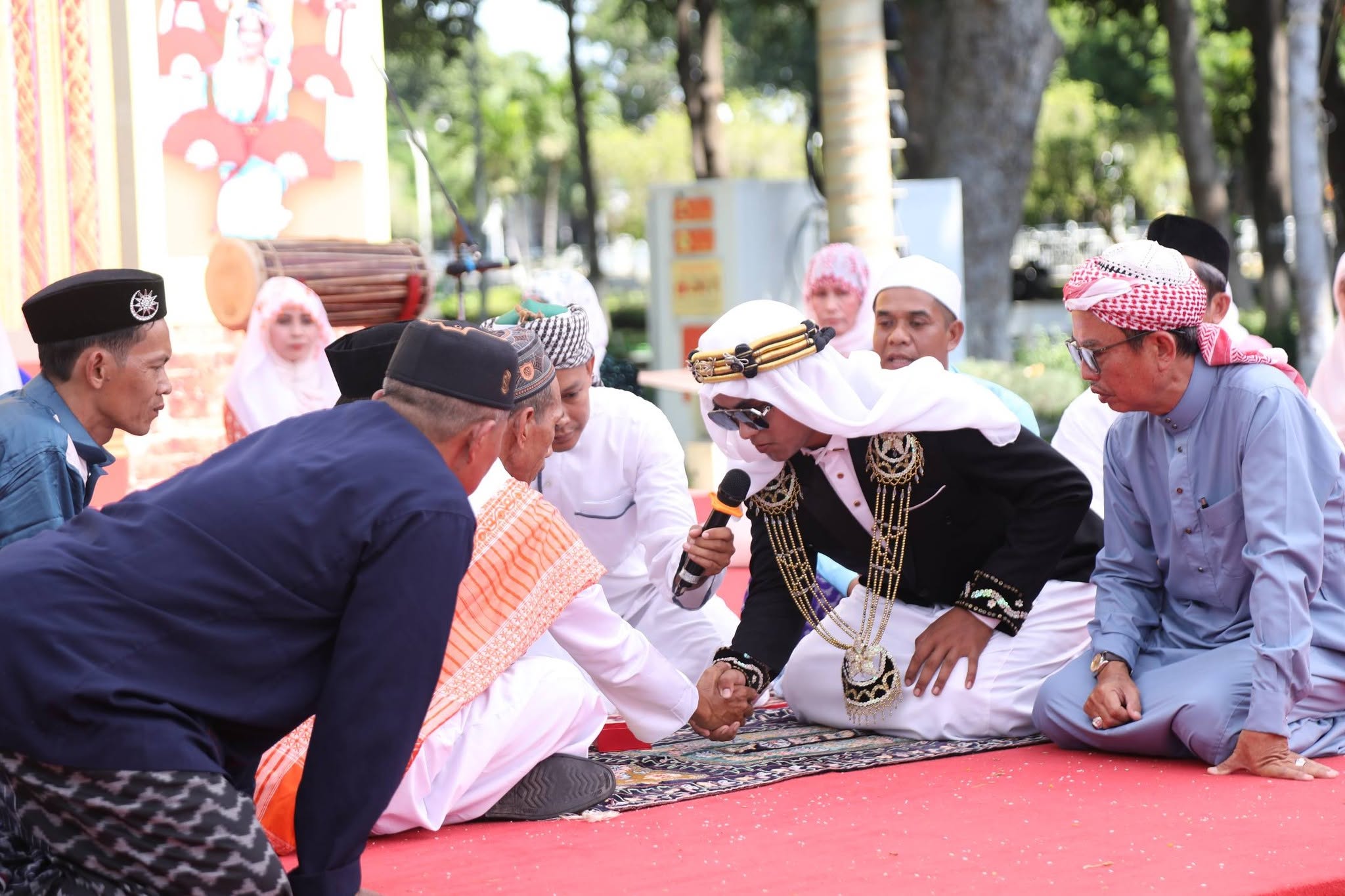
One of the central rituals is Kobol, the formal confirmation of the marriage. The groom appears before the bride’s family, the wali, the matchmaker, and witnesses. Before the formal declaration, Khot Bah is delivered, reminding the groom of marital responsibilities, the obligations of husband and wife, and the rules governing married life. Following the formal declarations by both sides, religious figures and elders recite prayers for the couple.
Another distinctive detail is the bride’s hairpin decorated with a crescent moon and star, a symbol associated with her Islamic identity. After the wedding, the two families continue their relationship through visits and traditional practices supporting the newly married couple.
Rituals During the Death Stage
In the Cham Islam tradition, death is understood as a natural part of human existence. When a family member is approaching death, relatives and members of the community gather to recite prayers, wishing for the deceased to depart this life peacefully.
After death, the body is washed and wrapped in white burial cloth according to Islamic ritual practice. Traditionally, burial takes place within approximately 24 hours of death.
The Cham Islam community in An Giang practices burial rather than cremation. The deceased is traditionally placed on the right side, with the face and chest directed westward toward Mecca, the sacred direction in Islam. Clothing and personal objects are not buried with the deceased. The grave is levelled and marked with a gravestone or posts identifying the deceased.
After burial, prayers continue at specific times within the traditional practice, including the seventh, tenth, fortieth, and hundredth days, as well as the first anniversary of the person’s death. The Cham Islam community does not traditionally establish an ancestor altar for deceased relatives. According to Islamic religious principles, worship through portraits or statues is not practiced.
Thus, even in the final stage of life, the emphasis of the ritual tradition is placed on prayer, cleanliness, equality in death, and community bonds, rather than worshipping the deceased through an ancestral altar.
Cultural Values and Community Identity
The distinctive character of the Cham Islam life-cycle rituals in An Giang lies in the interaction between Islamic religious traditions, Cham cultural heritage, and the historical process of migration and cultural exchange in southern Vietnam.
The rituals can be understood as a continuous journey:
- At birth, the child is connected to family, homeland, and community through practices such as burying the placenta, hair-cutting, and naming.
- At coming of age, the individual assumes new religious and social responsibilities.
- At marriage, two individuals establish a family while creating bonds between two families and the wider community.
- At death, the deceased is returned to the community through burial rituals and prayer.
Similarities between the life-cycle rituals of Cham Islam communities and those of Cham Bani and Cham Brahman communities can be understood in the context of their historical connections and shared Cham roots. However, differences in religion, migration patterns, and living environments have resulted in distinct ritual traditions within each community.
The Life-Cycle Rituals of the Cham Islam community in An Giang are therefore more than a collection of individual customs. They form a living cultural system that expresses relationships among family, kinship, village communities, religious communities, and ethnic identity.
Safeguarding and Transmission of the Heritage
The Life-Cycle Rituals of the Cham Islam Community in An Giang were officially included in Vietnam’s National Intangible Cultural Heritage List under Decision No. 157/QĐ-BVHTTDL dated February 2, 2023, under the category of Social Practices and Beliefs.
The recognition not only acknowledges the cultural significance of these rituals but also highlights the importance of safeguarding a body of traditional knowledge that has been transmitted primarily through religious leaders, elders, and knowledgeable members of the community.
One important challenge is the transformation of traditional rituals under the influence of modern life. Some practices have been simplified or discontinued, while others continue with adaptations suited to contemporary circumstances.
Safeguarding efforts therefore need to focus on documentation and transmission, including audio and video recording, collecting prayers used in ceremonies, translating and preserving ritual texts, and encouraging younger generations to learn about the cultural heritage of their own community.
Most importantly, heritage preservation should be carried out with the active participation of the Cham Islam community itself, respecting its religious life and cultural agency. In this way, preservation is not simply about documenting practices from the past, but about enabling the heritage to remain a living part of contemporary community life.
Frequently Asked Questions
What are the main stages of the Cham Islam life cycle?
The life-cycle rituals consist of three main stages: birth, coming of age, and death, each associated with important rituals involving individuals, families, and the wider community.
When were the Cham Islam life-cycle rituals recognized as national intangible cultural heritage?
They were included in Vietnam’s National Intangible Cultural Heritage List under Decision No. 157/QĐ-BVHTTDL dated February 2, 2023.
Do Cham Islam families have a naming ceremony for newborn children?
Yes. Traditionally, around seven days after birth, the family holds a hair-cutting and naming ceremony, often involving religious figures and elders.
Is the Ga Sam seclusion practice still observed?
No. Ga Sam was a traditional practice associated with girls reaching puberty, but it is no longer practiced among the Cham Islam community in An Giang.
Do the Cham Islam people in An Giang bury or cremate their dead?
The traditional practice is burial rather than cremation. The deceased is washed, wrapped in white cloth, and buried according to Islamic traditions.
What is the cultural significance of the life-cycle rituals?
The rituals connect individuals with their families, kinship networks, religious community, and Cham cultural identity while transmitting traditions and values from one generation to the next.