

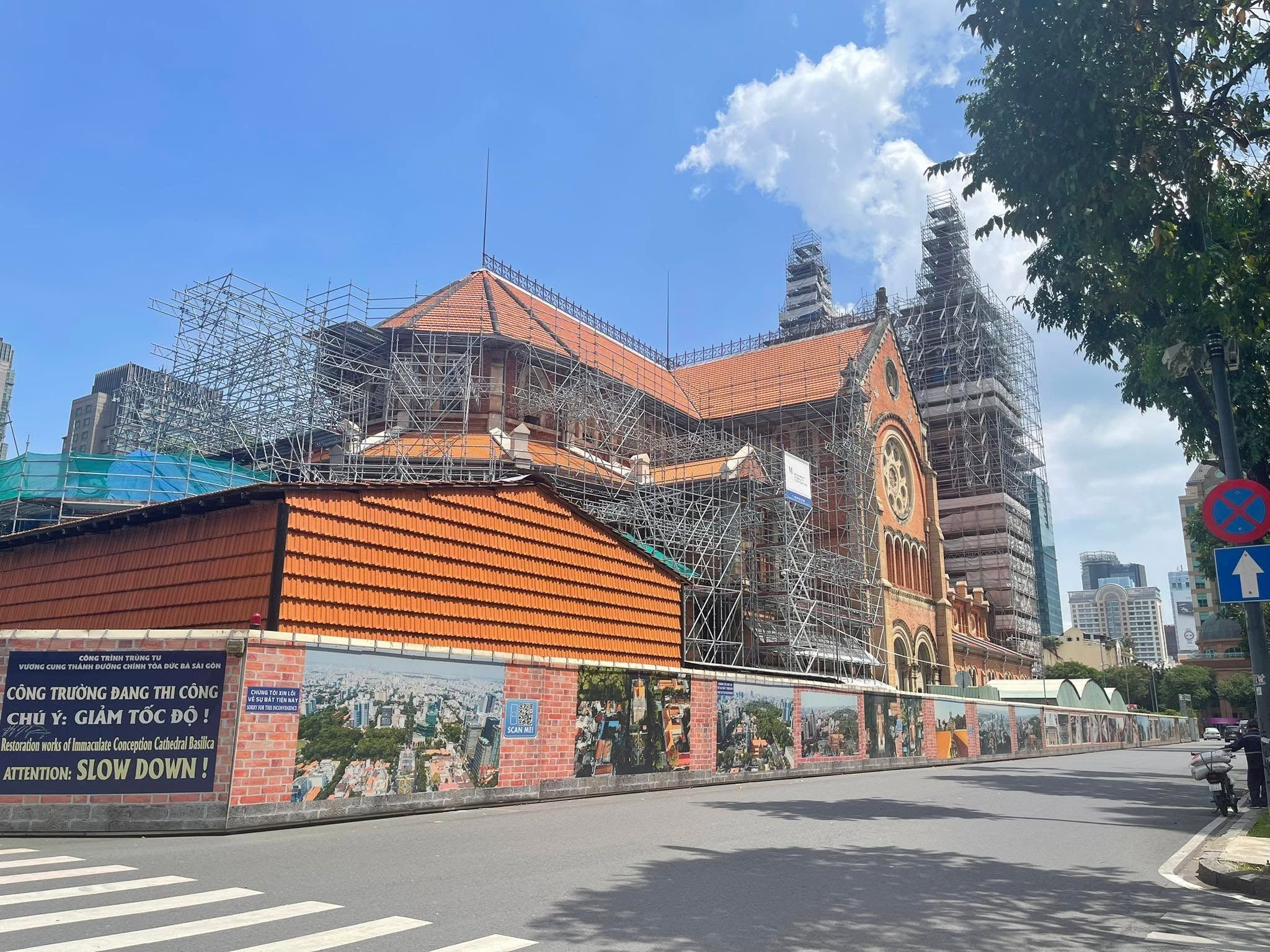
Located in the heart of Ho Chi Minh City, Notre-Dame Cathedral Basilica of Saigon is one of Vietnam’s most iconic religious and architectural landmarks. Construction began in 1877, and the cathedral was officially inaugurated in 1880. Combining Romanesque and Gothic architectural influences, the building is renowned for its distinctive red-brick façade, twin bell towers and magnificent stained-glass windows.
With more than 140 years of history, Saigon Notre-Dame Cathedral is not only an important center of Catholic worship but also a symbol of the cultural heritage, architectural history and urban identity of Ho Chi Minh City.
History of Notre-Dame Cathedral Basilica of Saigon
The First Catholic Churches in Saigon
The history of Notre-Dame Cathedral dates back to the early French colonial period in southern Vietnam.
Following the French occupation of Saigon, a small church was established on Street No. 5, now Ngo Duc Ke Street, to serve the growing Catholic community.
As the original building became too small, a larger wooden church was constructed in 1863 along the Grand Canal, also known as the Charner Canal, near what is now Nguyen Hue Walking Street.
Bishop Lefebvre presided over the foundation stone ceremony on March 28, 1863. The wooden church was completed in 1865 and became known as Saigon Church.
However, the building deteriorated due to termite damage and the tropical climate. Religious services were temporarily relocated while plans for a more permanent cathedral were developed.
Architectural Design Competition in 1876
In August 1876, the French colonial administration organized an architectural competition for a new cathedral that would reflect Saigon’s growing importance.
Among 18 submitted designs, the proposal by French architect J. Bourard was selected.
His design combined the solidity and symmetry of Romanesque architecture with the vertical proportions and decorative elements of Gothic architecture.
Three possible construction sites were considered: the former examination grounds near today’s Le Duan and Hai Ba Trung intersection, the site of the wooden church along the Charner Canal, and the cathedral’s present location.
The current site was ultimately selected because of its prominent position in the developing city center.
Architect J. Bourard was also responsible for supervising the construction.
Construction from 1877 to 1880
On October 7, 1877, Bishop Isidore Colombert, also known in Vietnamese as Bishop My, presided over the foundation stone ceremony.
After approximately two and a half years of construction, the cathedral was officially inaugurated on April 11, 1880, during Easter celebrations.
The inauguration ceremony was attended by Charles Le Myre de Vilers, Governor of Cochinchina, along with religious and colonial officials.
Many construction materials, including cement, steel, roofing tiles, stained glass and decorative elements, were imported from France.
The total construction cost was approximately 2.5 million French francs, funded by the French colonial administration.
As a result, the cathedral was initially known locally as the “State Church.”
Architectural Highlights of Saigon Notre-Dame Cathedral
A Combination of Romanesque and Gothic Architecture
Notre-Dame Cathedral Basilica of Saigon is an outstanding example of European religious architecture in Vietnam.
Its design combines Romanesque features, including massive walls, rounded arches and balanced proportions, with Gothic-inspired elements such as tall towers, decorative windows and a strong sense of verticality.
The building also reflects architectural adaptations to Saigon’s tropical climate.
This combination gives the cathedral a distinctive character and makes it one of the most recognizable historic buildings in Ho Chi Minh City.
The Famous Red-Brick Exterior
One of the cathedral’s most distinctive features is its red-brick exterior.
The bricks were manufactured in Toulouse, France, and transported to Saigon during construction.
Unlike many buildings of the same period, the cathedral’s exterior walls were left exposed without plaster or decorative paint.
The natural reddish-pink color of the bricks has become an enduring visual symbol of the cathedral.
Twin Bell Towers Rising Approximately 60 Meters
When the cathedral was completed in 1880, its original bell towers stood approximately 37 meters tall.
In 1895, two pointed spires were added according to supplementary designs by architect Fernand Gardes.
With these additions, the towers reached approximately 60 meters in height, including the crosses at their summits.
For decades, the twin towers were among the most prominent architectural features of Saigon’s skyline.
Inside the towers are six large bronze bells cast in France in 1879 by the Bollée foundry.
The bells have a combined weight of nearly 30 metric tons and are tuned to six musical notes: G, A, B, C, D and E.
This historic bell system remains an important part of the cathedral’s architectural and religious heritage.
Roofing and Structural Design
The cathedral’s roof combines European construction techniques with design considerations suited to Vietnam’s tropical climate.
Historical architectural records indicate that more than 100,000 roofing tiles were used across different sections of the building.
Some supporting walls are approximately 1.4 meters thick, providing structural stability for the large roof and bell towers.
These original construction features are among the elements requiring careful conservation during restoration.
Stained-Glass Windows and Interior Decoration
The cathedral’s interior is distinguished by its stained-glass windows, religious sculptures and decorative lighting.
Many of the original stained-glass windows were produced by the Lorin workshop in France.
Their designs depict biblical figures and religious scenes, accompanied by decorative motifs that reflect both European and Asian artistic influences.
Sunlight filtering through the colored glass creates a peaceful atmosphere inside the cathedral.
The sanctuary, marble altar, chandeliers and ornamental details further enhance the building’s architectural and artistic significance.
The Statue of Our Lady of Peace
In the square directly in front of Notre-Dame Cathedral stands the Statue of Our Lady of Peace, one of the most recognizable religious monuments in Ho Chi Minh City.
From the Bishop Pigneau de Béhaine Monument to the Virgin Mary Statue
In 1903, the French colonial administration installed a bronze monument depicting Bishop Pigneau de Béhaine, also known as Bishop Bá Đa Lộc, holding the hand of Prince Cảnh.
The monument stood on a red granite pedestal in front of the cathedral.
The bronze figures were removed in 1945, while the original pedestal remained.
In 1958, Father Joseph Pham Van Thien commissioned a new statue of the Virgin Mary, carved from white Carrara marble in Italy.
The statue was produced in Pietrasanta, a town famous for its marble craftsmanship, and transported by sea to Saigon in February 1959.
Symbolism of the Statue
The Statue of Our Lady of Peace stands approximately 4.6 meters tall and weighs around 5.8 metric tons.
It depicts the Virgin Mary standing upright, holding a globe topped with a cross.
Her eyes are directed toward the sky, symbolizing a prayer for peace in Vietnam and throughout the world.
A serpent beneath her feet represents a traditional symbol in Catholic religious art.
On February 17, 1959, Cardinal Krikor Bedros XV Aghagianian blessed the statue during a religious ceremony.
The pedestal bears the Latin inscription:
REGINA PACIS – ORA PRO NOBIS
This translates to:
Queen of Peace, pray for us.
Following the installation and blessing of the statue, the name Notre-Dame Cathedral became increasingly popular among the people of Saigon.
From Saigon Cathedral to a Minor Basilica
On December 8, 1959, Bishop Simon-Hòa Nguyễn Văn Hiền presided over the consecration of the cathedral and its main altar.
In 1960, the Holy See established the Catholic hierarchy in Vietnam, with archdioceses in Hanoi, Hue and Saigon.
The cathedral became the seat of the Archbishop of Saigon.
On November 13, 1962, Pope John XXIII granted the cathedral the title of Minor Basilica.
Its official ecclesiastical name is the Cathedral Basilica of Our Lady of the Immaculate Conception.
This designation reflects the cathedral’s importance within the Catholic Church in Vietnam.
Over the decades, the cathedral has hosted numerous religious ceremonies, including episcopal ordinations and major celebrations of the Archdiocese of Saigon.
On December 9, 2000, Archbishop Jean-Baptiste Pham Minh Man consecrated a new altar in the cathedral’s sanctuary.
Major Restoration of Notre-Dame Cathedral Basilica of Saigon
After more than a century of exposure to tropical weather, environmental pollution and natural deterioration, several sections of the cathedral required extensive repairs.
Although the building survived major periods of conflict without being destroyed, its roofing, bell towers, supporting structures and decorative elements gradually deteriorated.
In 2015, Archbishop Paul Bui Van Doc announced plans for a major restoration project to preserve the cathedral for future generations.
Restoration work began in 2017, involving conservation specialists, architects, engineers and experienced international contractors.
The project includes repairing roofing tiles, strengthening structural components, restoring architectural details and conserving historic stained-glass windows.
Because of the cathedral’s historical significance and complex construction, restoration has required specialized techniques and careful planning.
Two Golden Crosses Reinstalled on March 19, 2026
An important milestone in the cathedral’s restoration took place on March 19, 2026, when two newly gilded crosses were raised to the tops of the cathedral’s twin spires.
The ceremony coincided with the Feast of Saint Joseph.
Among those present were Archbishop Marek Zalewski, the Resident Papal Representative in Vietnam; Archbishop Joseph Nguyen Nang of Saigon; members of the restoration committee; and specialists involved in the project.
The original crosses had been removed in 2023 to facilitate restoration work.
During the ceremony, the religious leaders participated in a symbolic blessing before specialized cranes lifted the crosses into position.
The first cross was raised to the spire on the school side, at a height of approximately 57 meters.
The installation marked an important step in restoring one of Ho Chi Minh City’s most recognizable architectural landmarks.
Visiting Notre-Dame Cathedral in Ho Chi Minh City
Notre-Dame Cathedral Basilica of Saigon is located at Paris Commune Square (Công trường Công xã Paris), in the historic center of Ho Chi Minh City.
Its central location makes it a convenient stop for travelers exploring the city’s colonial-era architecture, cultural attractions and historic streets.
Visitors can admire the cathedral’s twin towers, red-brick façade and the Statue of Our Lady of Peace from the surrounding public square.
The cathedral is also a popular photography location, particularly in the early morning when the surrounding streets are relatively quiet.
Nearby Attractions
Several famous attractions are located within walking distance of the cathedral:
- Saigon Central Post Office: A historic building known for its distinctive European-inspired architecture.
- Nguyen Van Binh Book Street: A pedestrian-friendly street lined with bookstores, cafés and cultural spaces.
- Independence Palace: A major historical landmark associated with Vietnam’s modern history.
- Nguyen Hue Walking Street: A lively pedestrian boulevard in the heart of Ho Chi Minh City.
- Saigon Opera House: An elegant historic theater featuring French colonial architecture.
Together, these attractions make the cathedral area an excellent starting point for a walking tour of central Saigon.
Mass Schedule at Notre-Dame Cathedral
The following Mass times are based on the schedule provided for the cathedral and should be treated as reference information.
Sunday Masses
| Time | Service |
|---|---|
| 5:30 AM | Vietnamese Mass |
| 8:00 AM | Vietnamese Mass |
| 9:30 AM | English Mass |
| 4:00 PM | Vietnamese Mass |
| 5:30 PM | Vietnamese Mass |
| 7:00 PM | Vietnamese Mass |
Weekday Masses
Monday to Saturday:
- 5:30 AM
- 5:30 PM
Saturday evening Mass: 5:30 PM.
The cathedral also organizes certain prayer services and religious activities online.
Important: Mass schedules and visitor access may change during restoration. The times above have not been independently verified as the current schedule. Visitors are advised to confirm the latest arrangements with the cathedral before attending.
Travel Tips for Visiting Notre-Dame Cathedral
As an active Catholic place of worship, Notre-Dame Cathedral should be visited respectfully.
Visitors are encouraged to wear modest clothing, maintain a quiet atmosphere and avoid disrupting religious ceremonies.
Photography restrictions may apply in certain areas, particularly during Mass.
Due to ongoing restoration work, some sections of the cathedral may be temporarily closed or inaccessible.
Travelers should check current visitor access arrangements before planning their visit.
The surrounding area remains an important part of Ho Chi Minh City’s historic urban landscape and can be explored together with nearby cultural attractions.
A Timeless Symbol of Saigon
More than 140 years after its inauguration, Notre-Dame Cathedral Basilica of Saigon continues to hold a special place in the cultural and architectural identity of Ho Chi Minh City.
Its red-brick walls, historic bronze bells, stained-glass windows, twin towers and the Statue of Our Lady of Peace tell the story of a city shaped by centuries of cultural exchange and urban development.
Beyond its religious importance, the cathedral represents a significant chapter in the history of Saigon and the preservation of Vietnam’s architectural heritage.
For international travelers, Notre-Dame Cathedral Basilica of Saigon remains one of the most remarkable landmarks to discover when exploring Ho Chi Minh City, offering insights into the city’s history, architecture and cultural traditions.