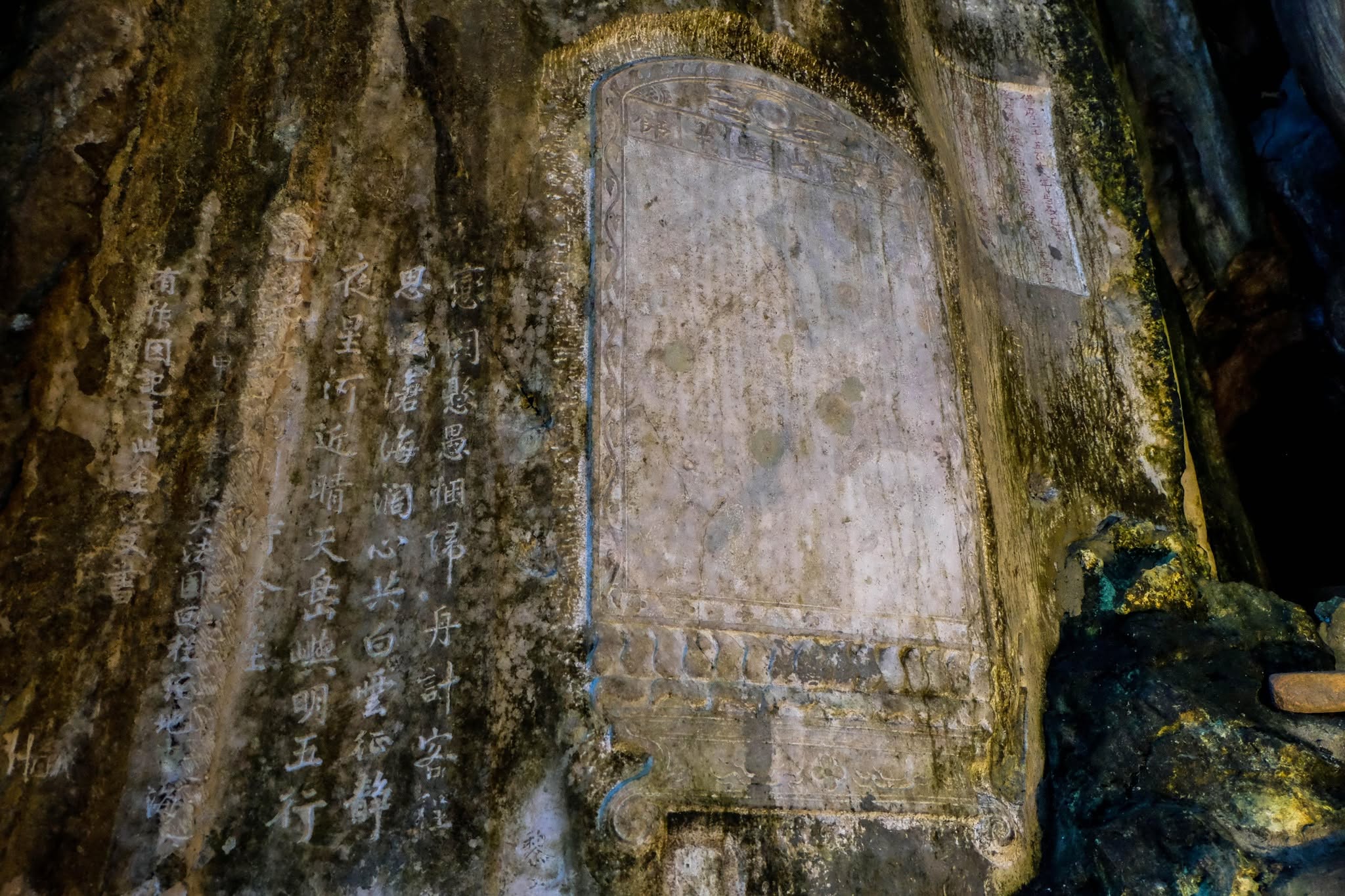
Hidden among the towering rock faces and remarkable caves of the Marble Mountains in Da Nang, the Ma Nhai inscriptions form an extraordinary collection of ancient texts carved directly into natural stone. Preserved across nearly four centuries, these inscriptions offer valuable insights into Vietnam’s history, religion, literature, calligraphy, and artistic traditions.
Written in classical Chinese characters and the Vietnamese Nôm script, the inscriptions record the thoughts, experiences, and contributions of Nguyen Dynasty emperors, royal officials, Buddhist monks, scholars, poets, and travelers who visited the Marble Mountains. They also reveal important connections between Vietnam and other Asian societies through maritime trade, religious exchange, and cultural interaction.
Comprising 78 documented inscriptions dating from the first half of the 17th century to the 20th century, the collection represents one of Vietnam’s most significant surviving bodies of historical rock inscriptions. Each text is an original historical record inseparable from the natural setting in which it was created.
On November 26, 2022, “Ma Nhai Inscriptions at Marble Mountains, Da Nang City, Vietnam” was officially inscribed on the UNESCO Memory of the World Asia-Pacific Regional Register.
This recognition marked an important milestone in the preservation and international promotion of Da Nang’s documentary heritage.
The Ma Nhai Inscriptions and Nearly 400 Years of History
The term Ma Nhai refers to inscriptions, poems, commemorative texts, or other written records carved directly into natural rock surfaces, cliffs, and cave walls.
Unlike freestanding stone steles that can be moved from one location to another, Ma Nhai inscriptions are generally inseparable from the landscape in which they were created. Their historical significance therefore extends beyond the written content to include their original physical and cultural setting.
At the Marble Mountains, the inscriptions are concentrated primarily on Thuy Son, the largest and most culturally prominent of the five mountains, known for its Buddhist temples, sacred caves, and dramatic limestone and marble formations.
The inscriptions were created over a long historical period, beginning under the Nguyen Lords in southern Vietnam, continuing through the Nguyen Dynasty, and extending into the middle decades of the 20th century.
Long before the Marble Mountains became an important Buddhist center for Vietnamese communities, the area had already served as a sacred landscape associated with the Champa civilization.
Archaeological and cultural remains indicate that the mountains held religious significance for earlier inhabitants, reflecting the region’s complex cultural history.
Between the 17th and 19th centuries, as Hoi An developed into a major international trading port and maritime commerce expanded throughout southern Vietnam, the Marble Mountains became a destination for monks, merchants, government officials, scholars, and travelers.
Visitors came to worship, appreciate the scenery, participate in religious activities, and leave written records of their experiences.
The mountains occupied a particularly favorable location near the Co Co River, a historical waterway connecting the Han River estuary with the Dai Chiem estuary and the trading port of Hoi An.
During the flourishing period of maritime commerce, this river route facilitated contact between local communities and merchants from China, Japan, and other parts of Asia.
The resulting exchanges helped create a culturally diverse environment in which Buddhism, literature, calligraphy, and international trade left lasting traces.
Many of these connections are preserved in the Ma Nhai inscriptions.
In 1802, when the Nguyen Dynasty established Hue as its imperial capital, Da Nang became strategically important to the defense and transportation networks of the royal court.
The Marble Mountains consequently attracted considerable attention from the Nguyen emperors.
Emperor Minh Mang is recorded as having visited the mountains three times. Following his visits, he ordered the restoration and improvement of religious buildings, including the repair of pagodas, the restoration of Buddhist statues, the casting of bells, and the presentation of Buddhist scriptures.
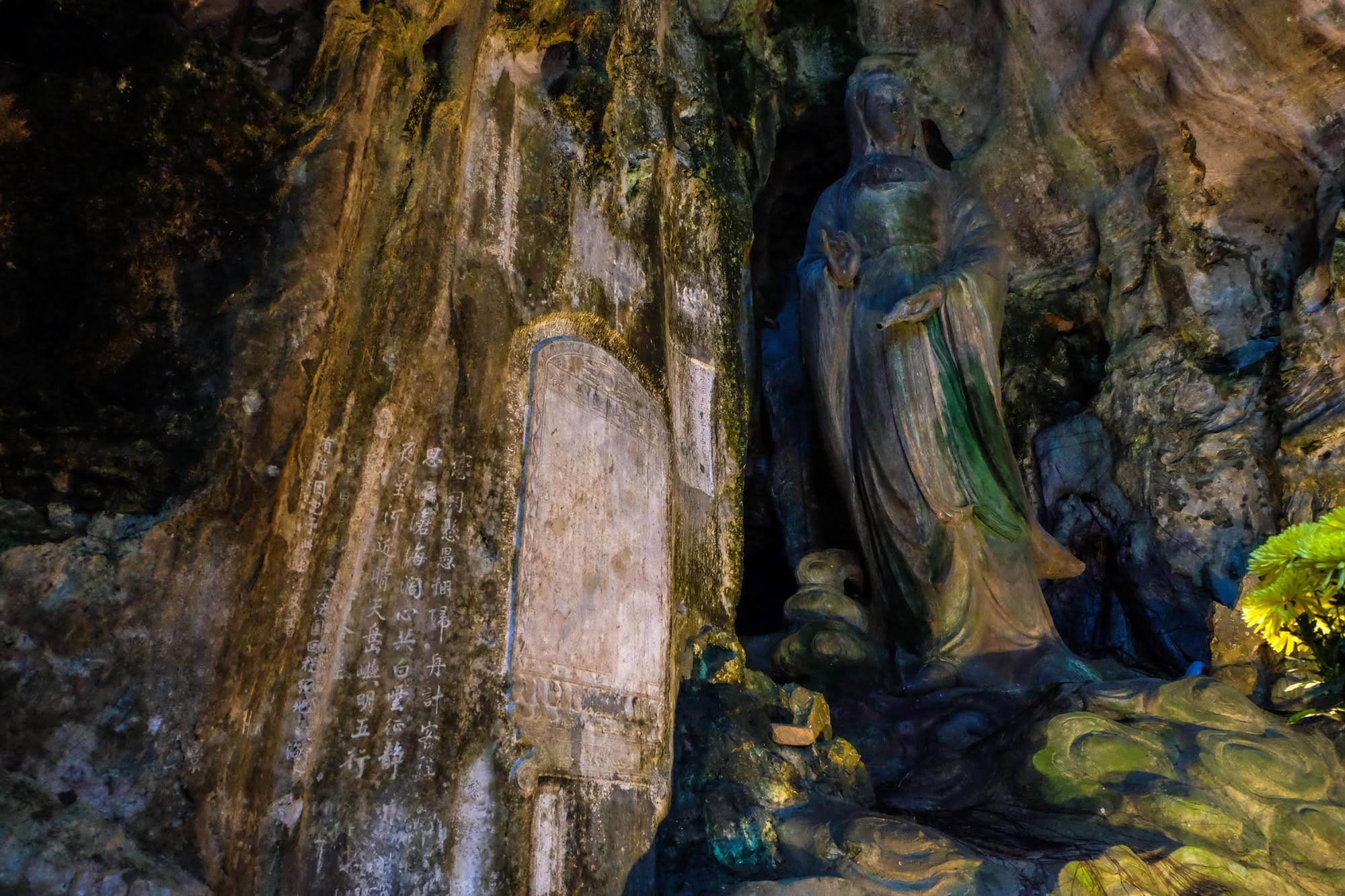
Later emperors, including Thieu Tri, Tu Duc, and Thanh Thai, also showed an interest in the Marble Mountains.
Royal family members, senior officials, and prominent scholars accompanying imperial visits often composed poems, commemorative writings, and inscriptions that were subsequently carved into the cave walls.
According to the historical work Ngu Hanh Son Luc, successive emperors and officials visited the mountains, leaving poems, commemorative inscriptions, and dedicatory writings on the surrounding rock surfaces.
As a result, the Marble Mountains developed into more than a scenic and religious destination. They became a place where generations of Vietnamese intellectuals recorded their memories, beliefs, and appreciation of the natural landscape.
Following the end of the Nguyen monarchy in 1945, the creation of new rock inscriptions gradually declined amid political upheaval and warfare.
One of the latest recorded inscriptions is Du Ngu Hanh Son (A Visit to the Marble Mountains), composed by Thich Dieu Ngo and carved in 1961.
Since then, the surviving Ma Nhai inscriptions have increasingly been regarded as an irreplaceable historical collection requiring specialized conservation and scholarly study.
The Collection of 78 Inscriptions and Its Outstanding Works
According to the UNESCO regional registration dossier, the Ma Nhai collection at the Marble Mountains consists of 78 inscriptions written in classical Chinese and Nôm, distributed mainly across the caves and natural rock faces of Thuy Son.
The collection includes imperial writings, commemorative steles, Buddhist inscriptions, poems, dedicatory texts, names of visitors, religious praises, and parallel sentences.
Their subjects range from the history of Buddhist institutions and the restoration of temples to reflections on nature, religious philosophy, personal experience, and the history of the country.
Huyen Khong Cave is among the most important locations, with approximately 30 inscriptions recorded in historical surveys.
It contains several notable examples of classical literature, calligraphy, and stone-carving artistry.
One prominent work is Bach Thach Hoang Sa Thuy Tac Doi, attributed to senior official Truong Quang Dan. Its elegant lettering combines characteristics of running script and cursive script, demonstrating the expressive possibilities of traditional Chinese calligraphy.
Another significant inscription associated with Huyen Khong Cave is Phong Nguyet Tinh Thanh, composed by Tieu Cao Nguyen Van Mai, who served as a provincial administrative official in Quang Nam.
Written in Nôm using the hat noi poetic form associated with Vietnamese ca tru musical traditions, the work is particularly valuable as an example of Vietnamese-language literary expression within a collection dominated by classical Chinese texts.
Other poems, including Kha Lan Son Sac, Vong Ngu Hanh Son, and Ngu Hanh Tu Sac, reflect the admiration of historical writers for the scenery of the Marble Mountains.
Through these verses, visitors can encounter the aesthetic sensibilities of earlier generations and their reflections on the relationship between nature, history, and national identity.
Hoa Nghiem Cave and Tang Chon Cave are also important locations within the inscription system.
These caves preserve early Buddhist inscriptions connected to the religious history of southern Vietnam under the Nguyen Lords.
Among the most historically significant are Ngu Uan Son Co Tich Phat Tich Diet Lac, dated 1631, and Pho Da Son Linh Trung Phat, dated 1640.
They are among the earliest surviving inscriptions identified at the Marble Mountains.
Both are associated with the Buddhist monk Hue Dao Minh, who is recorded as having undertaken the restoration of Buddhist sites, established religious activities, and mobilized support from Buddhist followers.
The inscriptions document the participation of devotees in religious construction and charitable contributions, providing evidence of the development of Buddhist communities during the 17th century.
Tang Chon Cave also preserves the remains of an inscription known as Nam Bao Dai Hinh Bi.
Much of its original text has been deliberately removed, leaving only its Chinese-character title and certain decorative features.
Although damaged, the surviving elements remain useful for studying the artistic characteristics of stone inscriptions from the period of the Nguyen Lords.
Together, these works demonstrate the remarkable diversity of the Marble Mountains collection in terms of historical period, literary genre, authorship, and artistic expression.
The distribution of individual inscriptions among the caves varies across historical surveys. Some studies record approximately 30 inscriptions in Huyen Khong Cave, 20 in Tang Chon Cave, 21 in Hoa Nghiem Cave, three in Linh Nham Cave, and two in Van Thong Cave, while other inventories use different methods of classification and location identification.
For this reason, the total of 78 inscriptions in the 2022 registration dossier provides the principal reference figure, rather than combining potentially inconsistent counts from different surveys.
Historical Significance, International Exchange, and the Art of Stone Calligraphy
One of the most important characteristics of the Marble Mountains inscriptions is their value as original historical evidence of cultural and commercial exchange in Asia during the 17th century.
The Pho Da Son Linh Trung Phat inscription, carved in 1640, is especially significant.
It records contributions made by Buddhist devotees toward the construction and development of religious facilities at the Marble Mountains.
According to scholarly interpretations of the inscription, it identifies 82 donors and records substantial contributions toward the construction of Binh An Pagoda.
The donations reportedly amounted to 1,915 quan in currency, 65 lang of silver, and 570 can of copper, using historical Vietnamese units of money and measurement.
The inscription’s historical importance, however, extends well beyond the value of these contributions.
The identities and places of origin of the donors provide valuable evidence of the diverse communities participating in religious life at the Marble Mountains.
Alongside Vietnamese contributors from areas corresponding to Hoa Vang, Dien Ban, and Hoi An, the inscription also records the involvement of Chinese and Japanese individuals.
This demonstrates that by the 17th century, the Marble Mountains had become a Buddhist center connected to communities beyond the immediate locality.
It also reveals the close relationship between religious patronage and the maritime trading networks linking Vietnam with other Asian societies.
The inscription has attracted particular scholarly attention for the information it provides about women’s participation in religious donations, social relationships, and marriages between members of different communities in the historical trading environment of Hoi An.
Such evidence contributes to research on cultural, economic, and social relations among Vietnam, China, and Japan.
Beyond their historical content, the Ma Nhai inscriptions constitute an exceptional collection of calligraphy and stone-carving art.
The texts display several classical Chinese calligraphic styles, including regular script (Kaishu), running script (Xingshu), cursive script (Caoshu), and clerical script (Lishu).
Each style is distinguished by its character structure, brushstroke rhythm, and visual expression.
When transferred from written models onto natural stone, these characters were carefully carved by skilled artisans.
Some inscriptions feature delicate, flowing lines, while others display powerful and sharply defined strokes.
The relationship between the calligraphic composition and the irregular surfaces of the rock creates a distinctive form of artistic expression.
The early inscriptions Ngu Uan Son Co Tich Phat Tich Diet Lac and Pho Da Son Linh Trung Phat are particularly valuable for their decorative elements, which reflect the artistic traditions of the Nguyen Lords’ period.
The creation of a Ma Nhai inscription required several stages of specialized work.
Artisans first selected a suitable location on the rock face, prepared and leveled the surface where necessary, arranged the text, and then carved the characters according to a prepared composition.
Traditional knowledge associated with the Non Nuoc stone-carving community indicates that the work demanded not only technical skill but also familiarity with Chinese characters, calligraphic structure, and the properties of natural stone.
The resulting inscriptions represent a collaboration between the literary abilities of their authors, the artistic traditions of calligraphy, and the craftsmanship of stone carvers.
For scholars of language and literature, the collection provides original material for examining classical Chinese and Nôm writing, historical place names, official titles, poetic forms, and changing patterns of literary expression.
For historians of religion, the inscriptions document the development of Buddhism in southern Vietnam and offer evidence of interactions among different religious and philosophical traditions.
They also reveal how sacred landscapes functioned as meeting places for communities connected through trade, scholarship, and religious practice.
Uniqueness, Historical Damage, and Conservation Efforts
A defining feature of the Marble Mountains Ma Nhai inscriptions is their uniqueness and inseparable relationship with the natural landscape.
Each inscription occupies a specific rock surface and possesses its own dimensions, layout, textual content, artistic style, and historical context.
No two inscriptions are identical, and an original text lost through erosion or destruction cannot be replaced by a replica of equivalent documentary value.
Unlike movable stone steles preserved in museums, most Ma Nhai inscriptions at the Marble Mountains remain attached to the cliffs and cave walls where they were originally carved.
Their significance therefore includes not only the written information but also the natural and cultural environment in which that information has survived.
However, nearly four centuries of exposure have left the inscriptions vulnerable to deterioration.
Humidity, water seepage, temperature changes, moss, vegetation, warfare, and human activities have all affected their condition.
Some inscriptions have become eroded or cracked, while others have lost individual characters or been partially obscured by paint, cement, and other materials.
In certain cases, sections of the original text were removed or later markings were added, altering the appearance and integrity of the historical inscriptions.
According to research figures cited in historical materials, approximately 52 of 79 inscriptions identified in one survey remained sufficiently legible for study.
These figures describe the condition of the collection at a particular stage of research and should not be confused with the 78 inscriptions included in the 2022 UNESCO regional registration dossier.
The deterioration of the inscriptions highlights the importance of long-term conservation.
Recognizing their historical and cultural significance, Da Nang’s authorities and heritage management agencies have undertaken various initiatives to protect and study the collection.
At the Marble Mountains, conservation measures have included installing visitor information signs, discouraging physical contact with inscriptions, maintaining the surrounding environment, and monitoring conditions that could damage the stone surfaces.
Specialized research and digital technology have also become increasingly important.
Documentation through high-resolution photography, appropriate inscription-rubbing techniques, digital scanning, transcription, translation, and database development can help preserve the information contained in the inscriptions.
These methods also enable researchers to examine texts that may become increasingly difficult to read because of natural weathering.
Digitization can improve access for Vietnamese and international scholars studying Buddhism, historical linguistics, literature, calligraphy, and maritime cultural exchange.
Public exhibitions, publications, educational programs, and presentations of traditional Chinese and Nôm calligraphy can further introduce the inscriptions to a wider audience.
Involving schools and local communities is particularly valuable for encouraging younger generations to appreciate the importance of documentary heritage.
Conservation work may also involve the careful treatment of biological growth, the assessment of damaged surfaces, and the stabilization of cracked or weakened rock.
Such interventions require specialized expertise and scientific assessment to avoid further damage to the original inscriptions.
Protecting the Ma Nhai collection is therefore not simply a matter of preserving ancient writing.
It means safeguarding a unique historical archive permanently embedded within the natural landscape of the Marble Mountains.
Recognition on the UNESCO Memory of the World Asia-Pacific Regional Register
On November 26, 2022, the 9th General Meeting of the Memory of the World Committee for Asia and the Pacific (MOWCAP), held in Andong, North Gyeongsang Province, South Korea, officially approved the inscription of “Ma Nhai Inscriptions at Marble Mountains, Da Nang City, Vietnam” on the Memory of the World Asia-Pacific Regional Register.
The meeting took place from November 23 to November 26, 2022, and considered 13 nominations submitted by seven participating countries: South Korea, Indonesia, China, Vietnam, Singapore, Iran, and Bangladesh.
The Marble Mountains nomination received recognition for the authenticity and integrity of its documentary materials, its regional historical significance, its contribution to understanding women’s roles in international cultural exchange, and the proposed measures for sustainable conservation and public access.
The registration acknowledged the outstanding value of an original collection of historical texts documenting connections that extended far beyond the boundaries of a single locality or country.
It also marked the first documentary heritage from Da Nang to receive regional recognition under UNESCO’s Memory of the World Programme.
Importantly, registration on the Memory of the World Asia-Pacific Regional Register is distinct from inscription on the UNESCO World Heritage List under the 1972 World Heritage Convention.
The Memory of the World Programme focuses on the identification, preservation, and accessibility of documentary heritage, including manuscripts, archives, inscriptions, and other historically significant records.
The 2022 recognition created new opportunities for research collaboration, conservation initiatives, educational activities, and the international promotion of Da Nang’s cultural heritage.
For visitors exploring the Marble Mountains, the Ma Nhai inscriptions offer a deeper understanding of this celebrated destination.
Beyond the ancient pagodas, spectacular caves, and dramatic mountain scenery, the inscriptions reveal the intellectual and spiritual history of the people who visited the site over hundreds of years.
The characters carved into stone tell stories of Buddhist monks, emperors, merchants, scholars, poets, and communities connected through religion, literature, and maritime trade.
They preserve memories of a period when Central Vietnam played an important role in regional cultural exchange.
Today, the Ma Nhai inscriptions at the Marble Mountains stand as a remarkable meeting point of nature, history, religion, literature, and artistic craftsmanship.
Their preservation contributes not only to the cultural identity of Da Nang but also to the wider understanding of Vietnam’s historical connections with the Asia-Pacific region.
Basic Information
| Item | Details |
|---|---|
| Heritage name | Ma Nhai Inscriptions at Marble Mountains |
| Location | Marble Mountains Scenic Landscape, Da Nang City, Vietnam |
| Main distribution | Primarily on Thuy Son Mountain, within natural caves and on rock faces |
| Heritage type | Documentary heritage, historical inscriptions carved into natural stone |
| Number of inscriptions in the registration dossier | 78 |
| Historical period | First half of the 17th century to the 20th century |
| Writing systems | Classical Chinese characters and Vietnamese Nôm script |
| Literary forms | Imperial writings, commemorative inscriptions, poetry, dedicatory texts, religious praises, and parallel sentences |
| Authors and historical figures | Nguyen Dynasty emperors, royal officials, scholars, Buddhist monks, and religious patrons |
| Notable locations | Huyen Khong Cave, Hoa Nghiem Cave, Tang Chon Cave, Van Thong Cave, and Linh Nham Cave |
| Notable inscriptions | Ngu Uan Son Co Tich Phat Tich Diet Lac (1631); Pho Da Son Linh Trung Phat (1640) |
| Outstanding values | History, Buddhism, international cultural exchange, classical literature, calligraphy, and stone-carving craftsmanship |
| Recognition | UNESCO Memory of the World Asia-Pacific Regional Register |
| Recognizing body | Memory of the World Committee for Asia and the Pacific (MOWCAP) |
| Recognition date | November 26, 2022 |
| Recognition location | Andong, South Korea |