

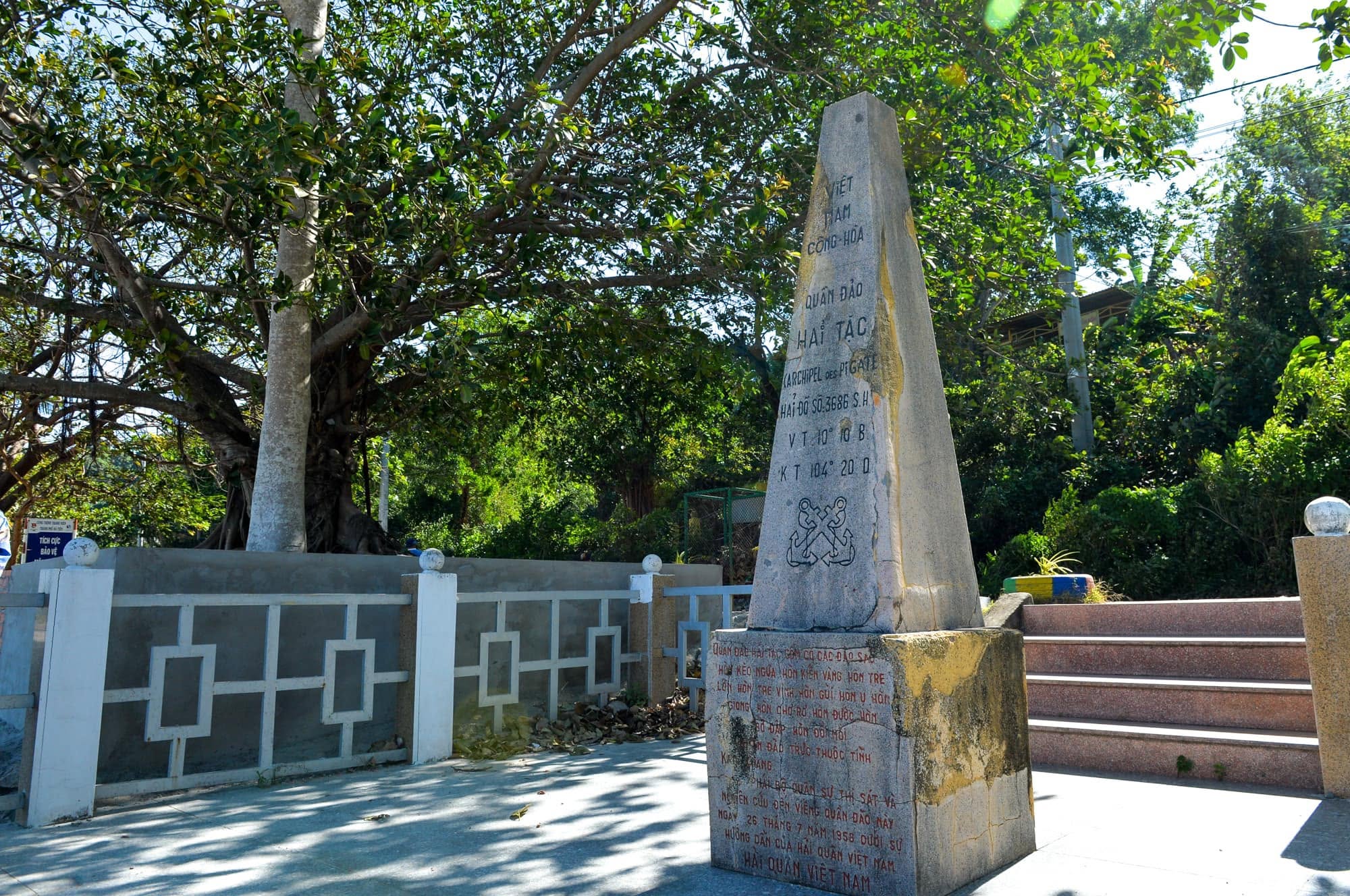
The Pirate Islands Sovereignty Marker, located on the western side of Hon Doc Island (Hon Tre Lon), is a historical landmark in Tien Hai Commune, An Giang Province, Vietnam. Formerly part of Ha Tien City in Kien Giang Province, the island belongs to the Pirate Islands (Hai Tac Archipelago) in the Gulf of Thailand.
Erected in 1958, the concrete marker preserves historical information about the archipelago and represents an important symbol of Vietnam’s maritime sovereignty.
For the residents of Tien Hai, the marker is more than a historical structure. It reflects their connection to the islands, their homeland, and the surrounding waters.
A Historical Marker Erected in 1958
After decades of exposure to tropical sunshine, sea winds, and saltwater, some of the inscriptions on the marker have gradually faded. Nevertheless, the structure continues to preserve valuable historical details.
An inscription on the marker reads:
“Quần đảo Hải tặc. Hải đồ số: 3686 S.H; vĩ tuyến 10 độ 10’8; kinh tuyến 104 độ 20’0”.
Its English meaning is:
“Pirate Islands Archipelago. Nautical Chart No. 3686 S.H; latitude 10°10′8; longitude 104°20′0.”
The base of the concrete monument contains an inscription listing several islands within the archipelago:
“Quần đảo Hải tặc gồm có các đảo sau: Hòn Kèo Ngựa, Hòn Kiến Vàng, Hòn Tre Lớn, Hòn Tre Vinh, Hòn Gùi, Hòn Ụ, Hòn Giang, Hòn Chơ Rơ, Hòn Đước Non, Hòn Bờ Đập, Hòn Đồi Mồi”.
Translated into English:
“The Pirate Islands Archipelago consists of the following islands: Hon Keo Ngua, Hon Kien Vang, Hon Tre Lon, Hon Tre Vinh, Hon Gui, Hon U, Hon Giang, Hon Cho Ro, Hon Duoc Non, Hon Bo Dap, and Hon Doi Moi.”
Another inscription records a historical visit:
“Phái bộ quân sự thị sát và nghiên cứu, đến viếng quần đảo ngày 28/7/1958, dưới sự hướng dẫn của Hải quân Việt Nam”.
This can be translated as:
“A military inspection and research delegation visited the archipelago on July 28, 1958, under the guidance of the Vietnamese Navy.”
These inscriptions provide a historical record of the archipelago’s geographical documentation and a military survey conducted in the mid-20th century.
A Symbol of Pride for the People of Tien Hai
For generations of island residents, the sovereignty marker has been an important part of their local history and identity.
Despite the passage of time and constant exposure to the marine environment, the monument continues to be respected and preserved by the local community.
Standing amid the vast waters of the Gulf of Thailand, the marker symbolizes the historical connection between the islands and Vietnam.
For local residents, protecting the monument is also a way of preserving their heritage and expressing pride in their homeland.
Visiting the Sovereignty Marker on the Pirate Islands
The sovereignty marker is located on the western side of Hon Doc Island, the largest and most populated island in the Pirate Islands Archipelago.
Hon Doc is also the main destination for travelers visiting Tien Hai Commune.
During a trip to the Pirate Islands, visitors can combine a visit to the marker with other local attractions, including:
- Bai Bac Beach: A coastal destination known for its natural scenery.
- Traditional fishing villages: Places where visitors can observe everyday island life.
- Floating fish farms: An opportunity to learn about local aquaculture.
- Natural beaches and rocky coastlines: Scenic areas for sightseeing and photography.
The sovereignty marker offers visitors an opportunity to learn about the history of the archipelago beyond its beaches and seafood.
Visitors are encouraged to respect the monument, avoid touching or damaging its inscriptions, and help preserve the surrounding environment.
A Historical Landmark in the Gulf of Thailand
Today, the Pirate Islands are attracting growing interest from travelers seeking peaceful coastal destinations in southern Vietnam.
The archipelago is known for its relatively unspoiled landscapes, fishing communities, fresh seafood, and traditional island lifestyle.
Among these attractions, the 1958 Pirate Islands Sovereignty Marker stands out as a landmark of historical significance.
Although the inscriptions have gradually faded under decades of sunshine and sea winds, the monument remains an enduring reminder of the islands’ history and maritime heritage.
For visitors exploring the Pirate Islands, stopping at this historical site provides a deeper understanding of the archipelago and its place in Vietnam’s history.