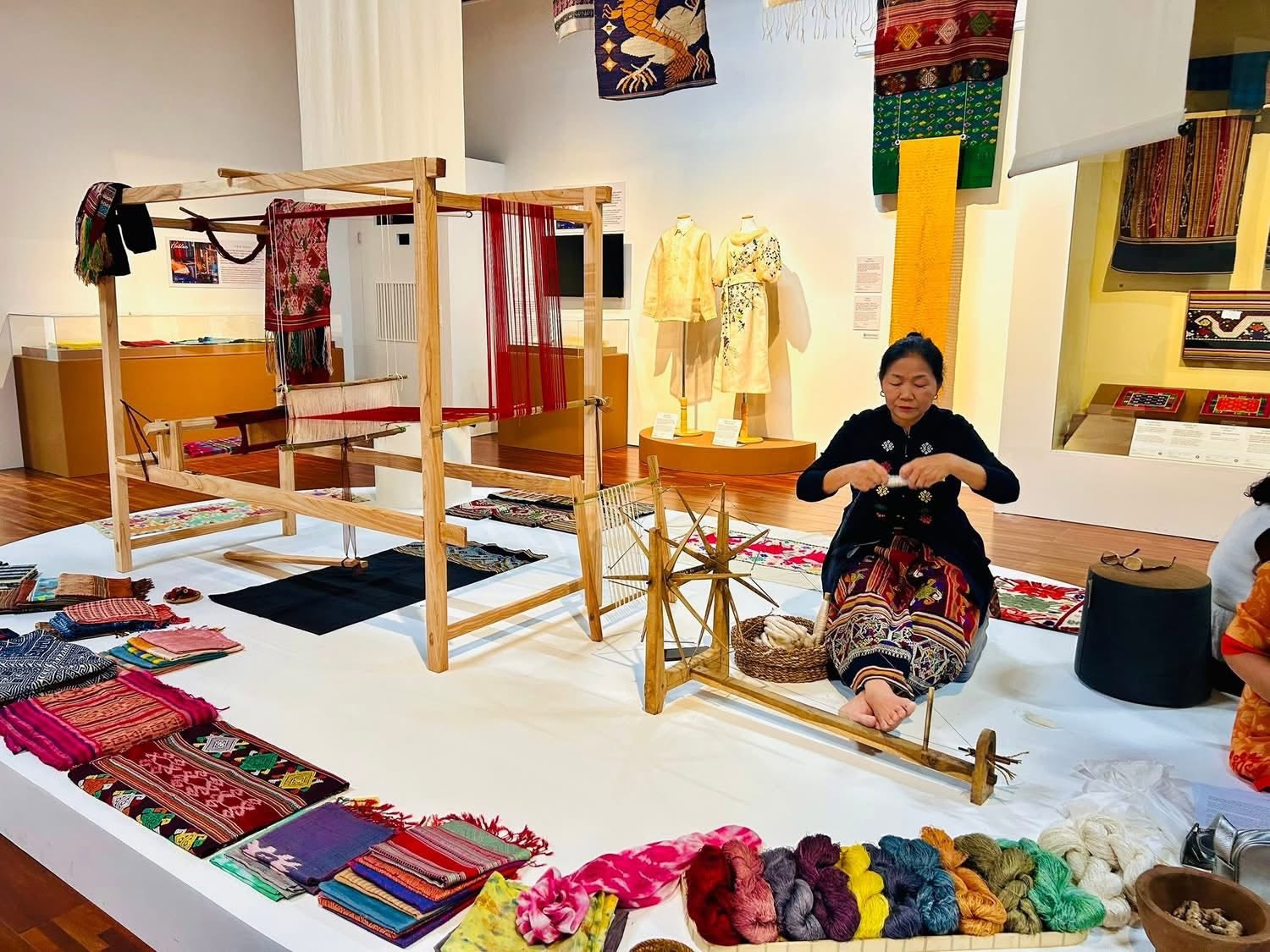
Thai brocade weaving in Nghe An Province is a long-standing traditional craft closely connected with the material life, spiritual world, and cultural identity of Thai communities in the province’s mountainous districts. Passed down through generations, weaving has produced distinctive clothing and household items while preserving folk knowledge, aesthetic concepts, collective memories, and cultural values transmitted through the skilled hands of generations of Thai women.
Under Decision No. 1657/QD-BVHTTDL dated June 3, 2025, Thai brocade weaving in Nghe An Province was officially included in Vietnam’s National Intangible Cultural Heritage List, under the category of Traditional Craft.
The recognition acknowledges the distinctive values of Thai brocade weaving while affirming the important role of the community in safeguarding, practicing, and transmitting a traditional craft that has become an integral part of Thai cultural life in western Nghe An.
Brocade Weaving in Thai Cultural Life
For generations, brocade weaving has been present in many Thai households. For numerous communities, it is not simply a way of producing clothing, but also a measure of a woman’s skill, diligence, and ability to care for her family.
Using traditional looms placed inside stilt houses, Thai women carry out a series of intricate processes, including growing and preparing raw materials, spinning fibers, dyeing, preparing the warp, setting up the loom, weaving the fabric, and creating decorative patterns. Each stage requires patience, experience, and the ability to remember pattern systems passed down from mother to daughter and grandmother to granddaughter.
Brocade fabrics are often characterized by harmonious colors, with traditional tones such as red, black, white, yellow, green, and indigo. Patterns are arranged according to established principles and may incorporate geometric forms, borders, plants, animals, mountains, rivers, and other symbols associated with the Thai worldview.
These motifs serve purposes beyond decoration. Behind every line and pattern lies a way of understanding nature, humanity, the universe, and the relationship between people and their living environment. Familiar elements of everyday life are transformed into visual expressions through color and woven patterns.
Brocade is used to make shirts, skirts, headscarves, shawls, bags, mattresses, blankets, curtains, decorative objects, and various household items. During important occasions such as weddings, housewarming ceremonies, festivals, family rituals, ancestor ceremonies, and community events, traditional clothing and woven textiles hold a particularly important place.
Traditional clothing does more than express outward beauty. It also reflects an individual’s connection with their community, lineage, and homeland. The patterns woven into the fabric serve as markers of cultural identity, expressing ethnic pride and an awareness of one’s cultural roots.
Brocade weaving can therefore be understood as a living archive of Thai culture. Every piece of fabric contains knowledge about raw materials, traditional techniques, colors, pattern composition, clothing customs, and aesthetic concepts accumulated over generations.
Safeguarding and Promoting Thai Brocade Weaving in Nghe An
The recognition of Thai brocade weaving in Nghe An as national intangible cultural heritage is significant for the preservation of traditional culture. The recognition decision states that People’s Committees at the relevant levels, within their assigned responsibilities and authority, are responsible for carrying out state management in accordance with legislation on cultural heritage.
The decision also assigns responsibility for implementation to the Chief of the Ministry Office, the Director of the Department of Cultural Heritage, the Chairman of the Nghe An Provincial People’s Committee, the Director of the Nghe An Department of Culture, Sports and Tourism, and other relevant agencies, organizations, and individuals. The decision took effect from the date of signing.
The recognition is not merely an honor. It also creates opportunities for brocade weaving to receive greater attention through cultural preservation programs, vocational training, traditional craft development, handicraft production, and community-based tourism.
In Na Village, Huu Lap Commune, in the former Ky Son area, many women continue to work at their looms, maintaining traditional weaving techniques and teaching the craft to younger generations. For them, weaving is not simply a source of income but also a responsibility to preserve the values passed down by their mothers and grandmothers.
Artisan Lo Thi Mai, who has made significant contributions to bringing local women together in the Na Village brocade weaving group, has pursued an approach that can be described as “preserving the craft while sustaining the craft as a livelihood.” Alongside preserving traditional patterns and techniques, the weaving group has sought to improve designs and diversify products by combining traditional elements with contemporary needs.
Today, brocade products extend beyond traditional clothing to include handbags, scarves, wallets, fashion accessories, souvenirs, and decorative items. This approach creates additional markets for woven products, generates employment, and contributes to improving local incomes, particularly for women in mountainous communities.
For younger generations, learning to weave also creates a practical and direct connection with traditional culture. A craft that was once regarded largely as the work of mothers and grandmothers is increasingly being recognized by younger people as a cultural practice in which every handmade textile carries values that cannot simply be replicated by mass-produced industrial goods.
The transmission of the craft involves more than learning how to operate a loom. It includes learning how to select colors, memorize patterns, understand symbolic meanings, and master the complete process of producing a finished textile. This is essential if the craft is to survive with its cultural identity intact rather than becoming merely a collection of decorative products designed for the market.
The Value of Brocade Weaving for Sustainable Development
Thai brocade weaving carries significant historical, cultural, artistic, social, and economic values. First, the craft reflects the community’s creativity in using natural materials, producing colors, processing fibers, and developing a richly symbolic system of patterns.
It is also a way of preserving cultural memory through material objects. Patterns, clothing styles, and ways of using woven products help express the distinctive characteristics of different communities, settlement areas, and Thai cultural spaces.
Socially, weaving contributes to strengthening family and community bonds. Weaving, teaching the craft, preparing clothing for rituals, and producing handicrafts create opportunities for interaction and learning between generations. Older people pass on their experience, while younger generations acquire traditional techniques and gradually explore new applications.
Economically, weaving has the potential to become a foundation for livelihoods connected with community-based tourism. Visitors can experience the weaving process, learn about the meanings of traditional motifs, participate in selected craft activities, and purchase products made directly within the village. When appropriately organized, weaving can become part of a cultural tourism value chain, generating additional income while maintaining local identity.
For the craft to develop sustainably, however, preservation must address both traditional techniques and the community’s role as the cultural custodian of the heritage. Product innovation should be undertaken with respect for traditional patterns, knowledge, and local cultural values. At the same time, support is needed for artisans, training programs, market access, product branding, quality improvement, and the protection of the rights and interests of craft practitioners.
The inclusion of Thai brocade weaving in Nghe An Province on Vietnam’s National Intangible Cultural Heritage List marks an important milestone in the preservation and promotion of this traditional craft. It recognizes the generations of women who have quietly preserved individual threads, colors, and patterns and carried them forward through time.
From the looms inside traditional stilt houses, Thai brocade weaving now has opportunities to enter contemporary life in new forms, preserving its cultural identity while adapting to modern market needs. With appropriate support, this traditional craft can continue to enrich Thai cultural life, provide livelihoods for local communities, and become a distinctive component of cultural and community-based tourism in Nghe An.
Heritage Information
- Heritage name: Thai Brocade Weaving in Nghe An Province
- Category: Traditional Craft
- Location: Thai communities in Nghe An Province, particularly the mountainous areas of western Nghe An
- Practice spaces: Family homes, stilt houses, villages, weaving groups, and traditional Thai craft communities
- Practitioners: Thai communities, particularly artisans and women engaged in weaving
- Representative products: Brocade fabric, shirts, skirts, scarves, bags, blankets, mattresses, household items, and handicrafts
- Key values: Historical, cultural, artistic, folk knowledge, community identity, and traditional livelihood values
- Year included in the National Intangible Cultural Heritage List: 2025
- Recognition decision: Decision No. 1657/QD-BVHTTDL dated June 3, 2025