


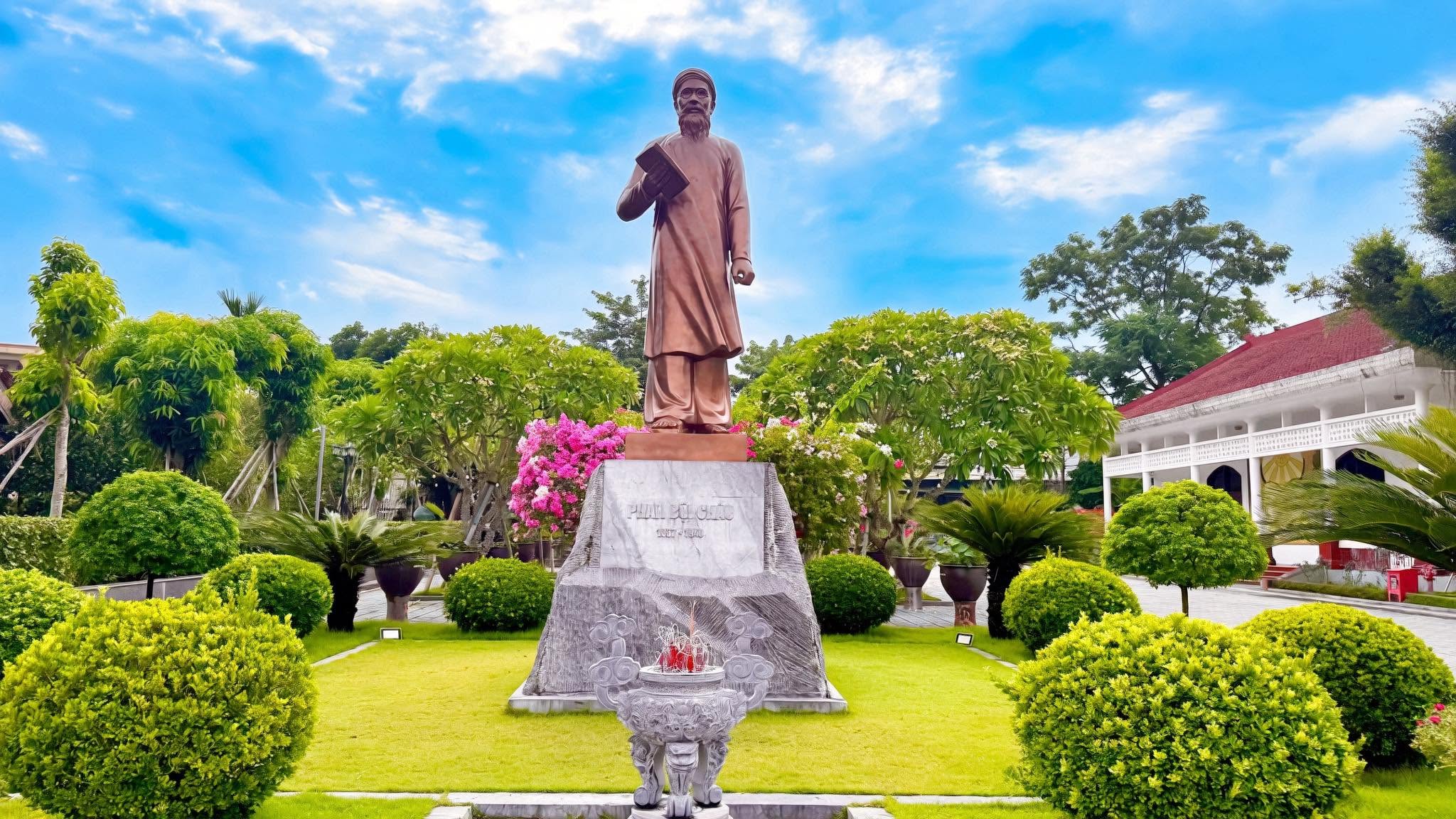
The Phan Boi Chau Memorial Site in Nam Dan is a historical complex associated with the life, homeland, family, and early years of patriotic activities of Phan Boi Chau, one of the most prominent figures in Vietnam’s national liberation movement during the early 20th century.
The complex consists of two locations approximately 1.5 kilometers apart in Nam Dan District, Nghe An Province. His paternal hometown is located in Hamlet 2, Xuan Hoa Commune, while his maternal hometown is situated in Nam Dan Town. Together, these two locations form a unified historical space reflecting Phan Boi Chau’s family background, childhood, character formation, and important milestones in the life of this renowned patriot.
Phan Boi Chau’s birth name was Phan Van San, and his literary name was Sao Nam. He was born on December 26, 1867, into a poor Confucian family in Sa Nam Village, Nam Dan District, Nghe An Province. He was a major cultural figure, thinker, patriotic activist, and influential leader of Vietnam’s national liberation movement in the early 20th century.
At a time when Vietnam was under French colonial rule, Phan Boi Chau devoted nearly three decades to seeking a path to national salvation. His activities took him across many regions in Vietnam and abroad, including Quang Nam, Nghe An, Tuyen Quang, Dong Kinh, Than Ho, Thuong Hai, Que Viet, Japan, China, and Thailand. These places were associated with his efforts to mobilize forces, organize patriotic movements, seek international support, and promote ideas for national liberation.
Phan Boi Chau initiated and participated in several important patriotic movements and organizations, including the Duy Tan Association, the Dong Du Movement, and the Vietnam Restoration League, as well as numerous other revolutionary activities. The movements he promoted attracted support from different sections of society, especially young people. For the younger generation of his time, Phan Boi Chau became a symbol of patriotism, national self-reliance, and the aspiration to regain independence for Vietnam.
On June 30, 1925, Phan Boi Chau was kidnapped by the French colonial authorities in Shanghai, China, and brought back to Vietnam to stand trial before the Hanoi Special Tribunal. In response to strong public pressure in Vietnam and abroad, the colonial authorities did not execute him but instead placed him under house arrest in Hue. On the morning of October 29, 1940, corresponding to the 29th day of the ninth lunar month in the year Canh Thin, Phan Boi Chau died in a thatched house at Ben Ngu Slope in Hue.
The Phan Boi Chau Memorial Site in Nam Dan is closely associated with the patriot from his birth through the early years of his journey into national salvation activities. His family home was once a meeting place for patriotic scholars, local intellectuals, former participants in the Can Vuong movement, revolutionary activists, and anti-colonial figures from various regions. They gathered here to exchange views and discuss the national situation and possible paths toward liberation.
Among those who visited and interacted with Phan Boi Chau’s family was Pho Bang Nguyen Sinh Sac, the father of President Ho Chi Minh. As a child, Nguyen Sinh Cung, who later became President Ho Chi Minh, reportedly accompanied his father on visits to Phan Boi Chau and listened to discussions among the older generation about the fate of the country. These experiences are considered to have contributed to the formation of his early awareness of national suffering, compassion for the people, and the determination to seek a path toward national liberation.
During his years of revolutionary activities at home and abroad, before being arrested and placed under house arrest in Hue, Phan Boi Chau returned to visit his homeland and family several times. His final visit took place in the spring of 1926, after he had been captured by the French authorities and brought back to Vietnam.
With its profound historical, cultural, and educational values, the Phan Boi Chau Memorial Site in Nam Dan is not only a place commemorating a great Vietnamese patriot but also an important destination for educating visitors about revolutionary traditions, patriotism, and the principle of gratitude to previous generations. The buildings within the complex are harmoniously arranged within the landscape. Their architecture is modest, elegant, and understated, reflecting the scholarly character and refined personality of Phan Boi Chau.
Phan Boi Chau’s Paternal Hometown
The paternal hometown site of Phan Boi Chau is located outside the Ta Lam Dyke, in Hamlet 2, Xuan Hoa Commune, Nam Dan District. From the site, visitors can see the Dai Hue Mountain Range to the front and the Lam River behind it. To the northwest lies Ru Dun, a location associated with Vietnam’s history of resistance against foreign invaders and traditionally regarded as one of the bases of Mai Hac De.
The paternal hometown site covers approximately 754 square meters and includes a gate, surrounding walls, a courtyard, a garden, and a memorial stele house. The area is simply arranged, blending with the traditional rural landscape of Nghe An and creating a peaceful, solemn atmosphere.
The entrance gate consists of two square brick pillars that taper toward the bottom, with a distance of 4.55 meters between them. Each pillar has three sections: a base, a shaft, and a top. The gate is connected to a surrounding wall with a total perimeter of 112.27 meters, defining and protecting the site.
The courtyard covers 116.5 square meters and is paved with concrete blocks. Two frangipani trees stand on either side, creating a balanced and tranquil setting. The garden covers approximately 576.5 square meters and contains areca palms, coniferous trees, and other greenery suited to the traditional landscape.
The memorial stele house has an area of 27.97 square meters, measuring 5.95 meters by 4.7 meters, with a height of 4.35 meters from the floor to the roof peak. The structure is built of reinforced concrete in the form of a four-roof pavilion, with fish-scale roof tiles. A sun motif is placed along the ridge, while the roof corners curve slightly upward, giving the structure an elegant appearance.
The roof is supported by four concrete pillars, each approximately 2.5 meters high and 0.15 meters in diameter. The floor is paved with decorative tiles and raised 0.64 meters above the courtyard. The front and two sides are open, while the rear is enclosed by a wall. This arrangement ensures ventilation while maintaining the solemn character of the memorial structure.
Phan Boi Chau’s Maternal Hometown and Memorial Area
The maternal hometown is the place where Phan Boi Chau was born and where he spent his childhood. Located in Nam Dan Town, Nam Dan District, the site covers approximately 4,878 square meters and consists of two main areas: the memorial area and the commemorative area.
The memorial area includes the family’s thatched houses, courtyard, garden, and former living space. The commemorative area consists of an exhibition house displaying documents and artifacts related to Phan Boi Chau’s life and activities, together with supporting facilities.
The Memorial Area
The entrance gate is formed by two pillars made of steel pipes designed to resemble bamboo. The gate itself is also made of steel shaped like bamboo and measures 1.71 meters wide. This simple design recalls the traditional rural character of Nghe An and harmonizes with the surrounding landscape.
The entrance path is 1.7 meters wide and 15.5 meters long. It is now paved with cement finished to resemble red earth, although it was formerly an unpaved dirt path. On both sides are rows of man hao tea plants and two straight lines of areca palms. Betel vines grow around the palm trunks, creating a landscape strongly associated with traditional Vietnamese village gardens.
The courtyard covers approximately 35 square meters, measuring 7 meters by 5 meters, and is finished with red-earth-colored cement. A row of man hao tea plants and a mulberry tree are located in front of the courtyard. The garden covers approximately one sao of land in the central Vietnamese measurement system, equivalent to about 500 square meters. It contains crops and fruit trees such as bananas, guavas, longans, mangoes, pomelos, and jackfruit. This garden reflects the familiar living and farming environment of a rural Confucian family in Nghe An during the late 19th century.
The upper house was built in 1860 on the occasion of the marriage between Phan Van Pho and Nguyen Thi Nhan. It has an area of 46.11 square meters, measuring 8.7 meters by 5.3 meters, and consists of three compartments with two gables. The house reflects the traditional residential architecture of Nghe An in the 19th century.
Its structural frame is made of wood, the roof is thatched, and the floor is compacted earth. The roof structure follows the traditional double-rafter and continuous-beam system, a common feature of vernacular architecture in north-central Vietnam. The house is closely associated with Phan Boi Chau’s family during his early years and illustrates the living conditions of a poor Confucian family in rural Nam Dan.
The lower house covers 42.32 square meters and measures 9.2 meters by 4.6 meters. It also consists of three compartments with two gables. Smaller than the upper house, it is positioned perpendicular to it, creating an L-shaped layout. A wooden gutter runs between the two buildings.
The lower house also features a wooden frame, thatched roof, compacted-earth floor, and the same traditional double-rafter and continuous-beam construction. The perpendicular arrangement of the two houses creates a relatively enclosed living space typical of traditional rural homes in Nghe An.
The Commemorative Area
The supplementary exhibition house was built in 1997. It covers 276.24 square meters and measures 20.4 meters by 13.1 meters. The building consists of five compartments, with brick walls constructed using traditional lime-and-earth mortar approximately 0.25 meters thick. Its beams and columns are made of reinforced concrete. The height from the floor to the roof ridge is approximately 9 meters, and the floor is paved with decorative tiles.
A terrace and corridor surround the building. The interior is divided into two rooms: an exhibition room occupying four interconnected compartments and a reception room occupying one compartment. The exhibition house introduces documents, photographs, artifacts, and information relating to Phan Boi Chau’s family, homeland, patriotic activities, and contributions to Vietnamese history.
The site currently preserves 134 documents and artifacts, including 51 antiques and 83 historical relics. The collection consists of various materials, including paper, wood, stone, bronze, bamboo, and other traditional substances. These objects are valuable sources associated with Phan Boi Chau’s life, family, and revolutionary activities, helping to clarify the historical, cultural, and social context of Vietnam from the late 19th to the early 20th century.
Two major commemorative ceremonies are held annually at the site. The death anniversary of Phan Boi Chau takes place on the 29th day of the ninth lunar month, while his birth anniversary is commemorated on December 26 according to the solar calendar. These events are attended by local residents, officials, and representatives of relevant agencies and organizations.
In addition to these two major occasions, local people often visit the site to burn incense and express their gratitude during traditional festivals and observances, including Tet Nguyen Dan, Thuong Nguyen, Trung Nguyen, and the first and fifteenth days of the lunar month.
The Phan Boi Chau Memorial Site in Nam Dan is an important component of Nghe An Province’s historical and cultural heritage. The paternal and maternal hometown sites preserve not only the physical traces associated with the life of this prominent patriot but also the family environment, local traditions, and cultural background that helped shape his character and patriotic spirit.
Recognizing its particularly outstanding historical, cultural, and educational values, the Phan Boi Chau Memorial Site in Nam Dan, Nam Dan District, Nghe An Province, was designated a Special National Monument by the Prime Minister under Decision No. 2499/QD-TTg dated December 22, 2016.


