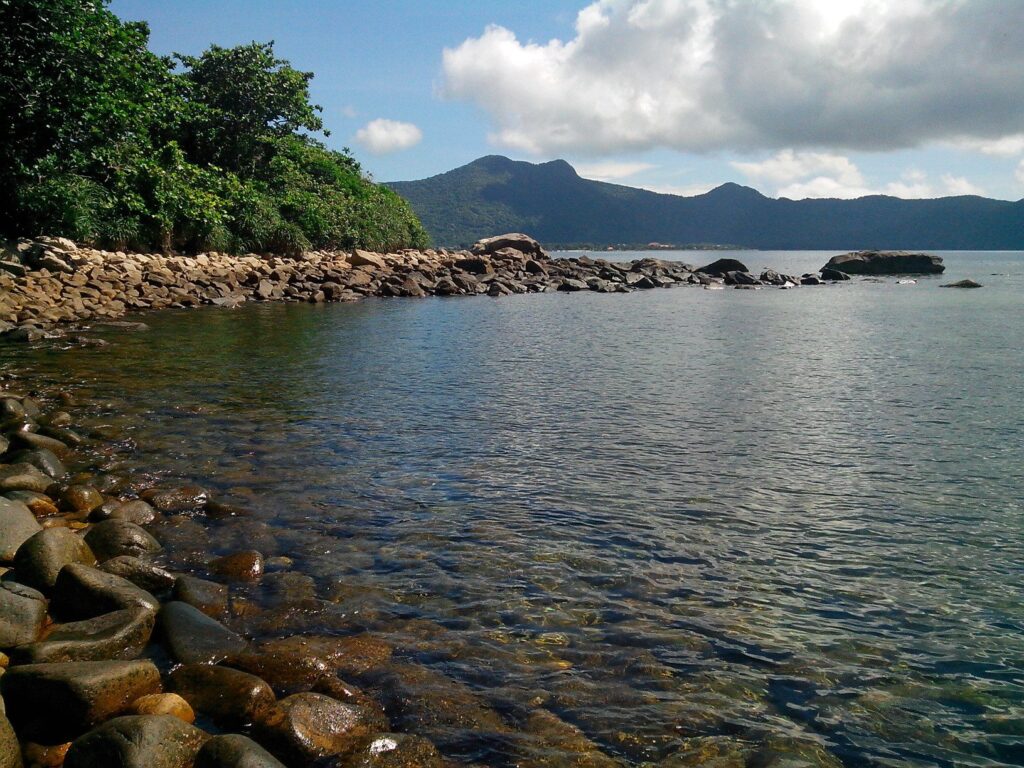

Hon Ba is one of the 16 islands that make up the Con Dao Special Zone, Ho Chi Minh City. When visitors arrive in Con Dao by sea through Ben Dam Port, they can easily spot this small island lying within the Ben Dam Bay.
The Story of Lady Phi Yen and Prince Hoi An
For centuries, the people of Con Dao have passed down a poignant legend about Lady Phi Yen and her son, Prince Hoi An (also known as Prince Cai).
Around the end of 1783, during his second retreat to Con Lon (the old name for Con Dao) to escape the Tay Son army, Lord Nguyen Anh faced repeated defeats. He intended to send Prince Hoi An to France as a political hostage to seek foreign military assistance.
Lady Phi Yen, the lord’s concubine, strongly opposed the idea and advised:
“The conflict with the Nguyen Hue brothers is an internal matter. You should rely on local forces. If you bring in foreign powers, even if you win, that victory will not be honorable and may lead to future troubles.”
Her sincere counsel made Nguyen Anh suspicious, thinking she had hidden intentions or connections with the Tay Son. Although spared from execution thanks to the intervention of the court officials, she was imprisoned in a stone cave on a small island near Con Son. Since then, locals have called that island Hon Ba (Lady’s Island).
The Tragedy of Prince Hoi An
Seeing his mother unjustly imprisoned, young Prince Hoi An cried bitterly and begged to stay with her. Nguyen Anh remained unmoved. Fearing the boy might one day oppose him, he ordered that the child be thrown into the sea.
The prince’s small body drifted to Dam Trau Beach, where villagers from Co Ong found and buried him with deep respect. Today, his resting place is known as Mieu Cau (The Prince’s Shrine).
Lady Phi Yen Is Rescued
During her confinement, Lady Phi Yen survived thanks to forest fruits brought by a white gibbon. Later, when the Tay Son forces advanced, Nguyen Anh fled Con Lon for Phu Quoc. This gave Lady Phi Yen the chance to escape execution.
The white gibbon and a black tiger guided her out of the cave and back to Co Ong Village. She asked villagers to build a small hut beside her son’s grave so she could stay close to him.
From this story, generations of Con Dao residents have kept a famous folk verse:
The wind carries little Cai to the heavens
While Rau Ram remains to endure life’s bitterness
“Cai” refers to Prince Hoi An, while “Rau Ram” (Vietnamese coriander) represents Lady Phi Yen, whose nickname was “Răm.”
It is said that she would often walk along Dam Trau Beach in the late afternoons to ease her unending sorrow.
Sites Connected to Lady Phi Yen Today
Even today, several sacred and historical locations in the Con Dao Special Zone, Ho Chi Minh City are closely associated with Lady Phi Yen:
- Hon Ba (Little Con Son) – the island where she was once imprisoned
- An Son Shrine (Miếu Bà Phi Yến) – a temple dedicated to Lady Phi Yen, recognized as a provincial-level cultural and historical site in 2007
- Mieu Cau – the shrine of Prince Hoi An in Co Ong Village
These sites have become spiritual landmarks for both locals and visitors who wish to learn about the moving story of a loyal, resilient woman and her ill-fated son.