


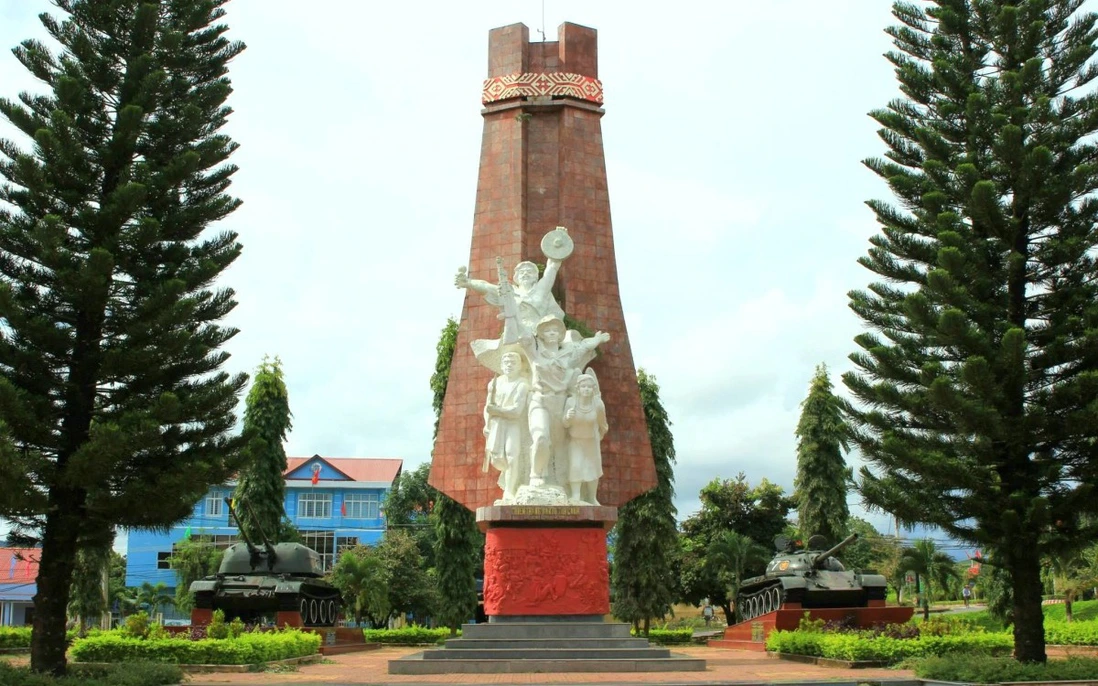
The Dak To – Tan Canh Victory Historical Site is a complex of historical locations associated with major battles in the northern Central Highlands during the Vietnam War, most notably the Dak To Campaign of 1967, the Dak To II Campaign of 1969 and the Spring-Summer Campaign of 1972. The site is located in Dak To and Sa Thay districts, Kon Tum Province, and commemorates important victories achieved by Vietnamese forces and local communities during the struggle that significantly altered the balance of forces on the Central Highlands battlefield.
From the heights of Ngoc Bo Bieh and Ngoc Ring Rua, the entire Dak To – Tan Canh area can be observed. The terrain forms a basin surrounded by numerous high mountain ranges. To the west and southwest lies the Ngoc Bo Bieh range, with elevations of approximately 800 to 1,200 meters, extending from southeast to northwest toward the Lower Laos region and northeastern Cambodia. To the north is the Ngoc Tu range, reaching approximately 890 meters, while to the east stands Ngoc Long Mountain at approximately 903 meters, with Route 14 connecting the area to Kon Tum.
As a strategic gateway to the northern Central Highlands, Dak To held exceptional military importance. Beginning in 1957, the Ngo Dinh Diem administration gradually established a system of military bases, airfields and logistical facilities in the area, while implementing policies of forced resettlement into fortified settlements. During the Vietnam War, Dak To – Tan Canh became one of the areas where fierce fighting took place between US forces, the Army of the Republic of Vietnam and the People’s Army of Vietnam.
Major Campaigns at Dak To – Tan Canh
The First Dak To Campaign, 1967
The First Dak To Campaign took place in November 1967. It was one of the major campaigns conducted by Vietnamese forces and local communities in the Central Highlands to destroy a significant portion of US forces and force the enemy to deploy mobile units to the region, thereby creating favorable conditions for coordination with other battlefields throughout South Vietnam.
On September 10, 1967, the Party Committee and Command of the Central Highlands Front decided to launch the Dak To Campaign. The campaign command consisted of Commander Hoang Minh Thao, Political Commissar Tran The Mon and Deputy Commander Cao Van Khanh. Participating forces included the 1st Infantry Division with the 320th, 66th and 174th Regiments; the 24th Infantry Regiment; the 40th Artillery Regiment; the 304th Infantry Battalion; special forces and local forces from Kon Tum.
The United States deployed the 1st Brigade of the 4th Infantry Division, the 173rd Airborne Brigade, elements of the 1st Cavalry Division and air force units. The Army of the Republic of Vietnam also committed the 3rd Airborne Task Force to the fighting.
At that time, Dak To was a valley situated near the intersection of Routes 14 and 18, approximately 40 kilometers north of Kon Tum. The US military established a system of bases, airfields and artillery positions there. Among them, E42 Base at Tan Canh and Dak To 2 Base played important roles in the northern Central Highlands defense network.
The campaign command adopted a strategy centered on taking the initiative, creating favorable conditions and luring enemy forces into prepared battlefields for destruction in stages. The plan combined frontal attacks with attacks against the enemy’s rear while using local forces and diversionary operations to disperse enemy attention.
The main offensive direction was southwest of Dak To, extending from Ngoc Bo Bieh and Ngoc Tang through Ngoc Com Liet to Hill 875. Multiple defensive positions were established. The heights at Ngoc Bo Bieh and Ngoc Tang served as initial engagement areas designed to draw in US forces, while Ngoc Com Liet and Hill 875 were identified as decisive battle areas.
From mid-October 1967, Vietnamese forces simultaneously intensified operations in Gia Lai and Dak Lak and along Routes 14, 19 and 21 in order to deceive the enemy and maintain secrecy regarding the Dak To direction. By November 2, the forces had basically completed their battlefield deployments.
On November 3, 1967, US forces began landing troops around the strategic heights and attacking Vietnamese positions at Ngoc Tang and Ngoc Bo Bieh. Fighting quickly became intense. Battalion 6 was among the first units to enter combat, stubbornly holding positions along the Ngoc Bo Bieh range and repelling repeated US attacks.
In the following days, the 173rd Airborne Brigade successively deployed troops to Hills 823, 845 and 882 on the Ngoc Com Liet range. Units of the 66th Regiment conducted interception operations and ambushes, inflicting heavy losses on the US airborne forces. At the same time, the 320th Regiment operated at Ngoc Dơ Lang, while the 24th Regiment and local forces attacked positions northeast of Dak To, Tan Canh, Ngoc Xia, Ngoc Van and surrounding heights.
Under pressure from multiple directions, the US deployed reserve forces from the 1st Cavalry Division and the 3rd Airborne Task Force. US air power intensified its attacks, using bombers and B-52 aircraft against areas believed to contain Vietnamese forces.
One of the key US objectives was Hill 875, which the campaign command had identified as the decisive battle area. The 174th Regiment deployed forces to hold the position and maintained mobile units ready to engage the enemy.
On November 17 and 18, US forces repeatedly attacked Hill 875 but were repelled. On November 19, American forces launched another major assault supported by aircraft and artillery. The 174th Regiment coordinated its mobile forces with the defensive units at the position, creating an encirclement and offensive formation that destroyed most of the 2nd Battalion of the 173rd Airborne Brigade.
The battle for Hill 875 became the decisive engagement of the campaign and demonstrated the development of mobile offensive tactics combined with fortified positions in mountainous and forested terrain.
On November 22, 1967, Vietnamese forces voluntarily withdrew from Hill 875, bringing the First Dak To Campaign to an end. According to campaign summaries, Vietnamese forces in the Central Highlands fought numerous engagements, putting approximately 4,500 enemy troops out of action, shooting down or destroying around 70 aircraft, destroying 18 artillery pieces and 52 military vehicles, and inflicting heavy losses on several US units.
The First Dak To Campaign achieved its objectives, forcing US forces to concentrate large numbers of troops in the Central Highlands. It contributed to a significant change in the enemy’s strategic deployment and created favorable conditions for Vietnamese forces to prepare for the General Offensive and Uprising of Spring 1968, known as the Tet Offensive. The campaign also provided important experience in the use of diversionary engagements, drawing the enemy into prepared battlefields and combining mobile attacks with fortified positions.
The Dak To II Campaign, 1969
In the summer of 1969, the Central Highlands Battlefield Command launched the Dak To II Campaign to continue destroying US mobile forces, break through defensive positions and gradually undermine military measures associated with the strategy of “Vietnamization.”
After 45 days and nights of fighting, Vietnamese forces and local communities engaged in hundreds of battles, inflicting heavy losses on enemy forces and destroying numerous military vehicles, weapons, ammunition and supply depots, fortifications and logistical facilities.
The Dak To II Campaign was considered an important victory on the Central Highlands battlefield. It contributed to weakening the enemy’s mobile forces and gradually forced US forces into a more passive defensive posture.
The Spring-Summer Campaign of 1972 in the Northern Central Highlands
Following the victories achieved by the forces of the three Indochinese countries in 1971, the balance of forces on the battlefield changed significantly. The Politburo decided to launch a strategic offensive in 1972 on multiple fronts, with the Central Highlands serving as one of the key battlefields.
On September 10, 1971, the General Command assigned the Central Highlands Front the task of destroying enemy forces and liberating Dak To – Tan Canh, while creating conditions for further operations toward Kon Tum and other areas if circumstances allowed.
The campaign involved numerous main-force units of the Central Highlands Front, reinforcements from the General Command and Military Region 5, as well as local forces and militia. In addition to infantry units, the forces included artillery, tanks, engineers, special forces and air defense units.
The Spring-Summer Campaign in the northern Central Highlands began on March 30 and ended on June 5, 1972. Vietnamese forces successively captured important heights west of the Poko River before advancing toward Dak To – Tan Canh.
The most significant achievement was the destruction and collapse of the defensive system at Dak To – Tan Canh. The 22nd Division of the Army of the Republic of Vietnam was destroyed, while the 14th Armored Regiment suffered heavy losses. Dak To – Tan Canh was liberated, creating substantial pressure on enemy forces in Kon Tum.
After 68 days and nights of fighting, Vietnamese forces achieved major military results, destroying or severely damaging numerous enemy units, military vehicles, supply depots and logistical facilities while liberating a large area of Kon Tum Province.
Although the campaign did not achieve the objective of liberating Kon Tum town, the Spring-Summer Campaign of 1972 in the northern Central Highlands nevertheless brought about a significant change in the balance of forces and battlefield posture, contributing to the overall success of the 1972 strategic offensive.
Sites Within the Dak To – Tan Canh Victory Historical Complex
The Dak To – Tan Canh Victory Historical Site includes numerous locations associated with major battles and the enemy’s defensive system, notably E42 Base, Phuong Hoang Airfield, L19 Airfield, Hill 1015 and Hill 1049.
E42 Base covers approximately 20 hectares and is situated on a hill approximately 600 meters high, surrounded by rivers, mountains and transportation routes. The area has been zoned for protection, with boundary markers, directional signs and heritage protection signs installed. Several traces of former military fortifications and trenches can still be identified within the site.
L19 Airfield is located northwest of E42 Base, approximately 100 meters from its central area. The airfield had a runway approximately 1 kilometer long and 50 meters wide and was used by light aircraft, including the L-19.
Phuong Hoang Airfield is approximately 7 kilometers west of E42 Base, near Route 14. Its runway was approximately 1.4 kilometers long and was built to accommodate larger aircraft operated by the US military.
Hill 1015, also known as Charlie Hill, is located on the Ngoc Bo Bieh range west of the Poko River, in the area of Ro Koi and Po Co communes. The elevated position had considerable strategic importance within the northern Central Highlands battlefield.
Hill 1049, also known as Delta Base, is located on the Ngoc Ring Rua range in Ho Moong Commune, Sa Thay District, at an elevation of more than 1,000 meters above sea level. Together with Hill 1015, it is one of the locations of particular historical significance within the Dak To – Tan Canh Victory heritage complex.
Today, several parts of the historical site have been restored and upgraded, including memorial stele houses, a thematic exhibition building dedicated to the Dak To – Tan Canh Victory and facilities used to introduce and educate visitors about the site’s historical significance.
The complex also includes the Dak To Martyrs’ Cemetery, where many officers and soldiers who died on the Dak To battlefield are buried. Among them are the members of the heroic Tank Crew No. 377: Nguyen Nhan Trien, Hoang Van Ai, Tran Quang Vinh and Nguyen Dac Luong.
Artifacts associated with the Dak To – Tan Canh battlefield are preserved and displayed at museums and traditional-history centers throughout Vietnam, including the Dak To – Tan Canh Traditional History House, Kon Tum Provincial Museum, Museum of Army Corps 3, Military Region 5 Museum, War Remnants Museum, Vietnam National Museum of History, Vietnam Military History Museum and the Armored Forces Museum.
Historical Significance of the Site
The Dak To – Tan Canh Victory represents an important milestone in the history of revolutionary struggle on the Central Highlands battlefield. The campaigns fought here weakened enemy military forces, gradually broke down the defensive system in the northern Central Highlands and contributed to significant changes in the balance of forces across the southern battlefield.
In particular, the Dak To – Tan Canh Victory of 1972, together with major victories in the Tri Thien and southeastern battlefields, contributed to the gradual defeat of the “Vietnamization” strategy and forced the United States to alter its military policy in Vietnam.
With its outstanding historical, military and cultural values, the Dak To – Tan Canh Victory Historical Site was recognized by the Prime Minister as a Special National Monument under Decision No. 2499/QD-TTg dated December 22, 2016.
On January 18, 2022, the Prime Minister issued Decision No. 93/QD-TTg, adding Hill 1015 and Hill 1049 in Sa Thay and Dak To districts, Kon Tum Province, to the Special National Monument of the Dak To – Tan Canh Victory Site.
Today, the historical complex serves as an important destination for historical research, revolutionary tradition education and commemoration of the officers, soldiers and civilians who fought and died on the northern Central Highlands battlefield. Names such as Dak To, Tan Canh, Ngoc Bo Bieh, Ngoc Ring Rua, Hill 1015, Hill 1049 and Hill 875 have become historic landmarks associated with a defining period of the resistance against the United States.


