


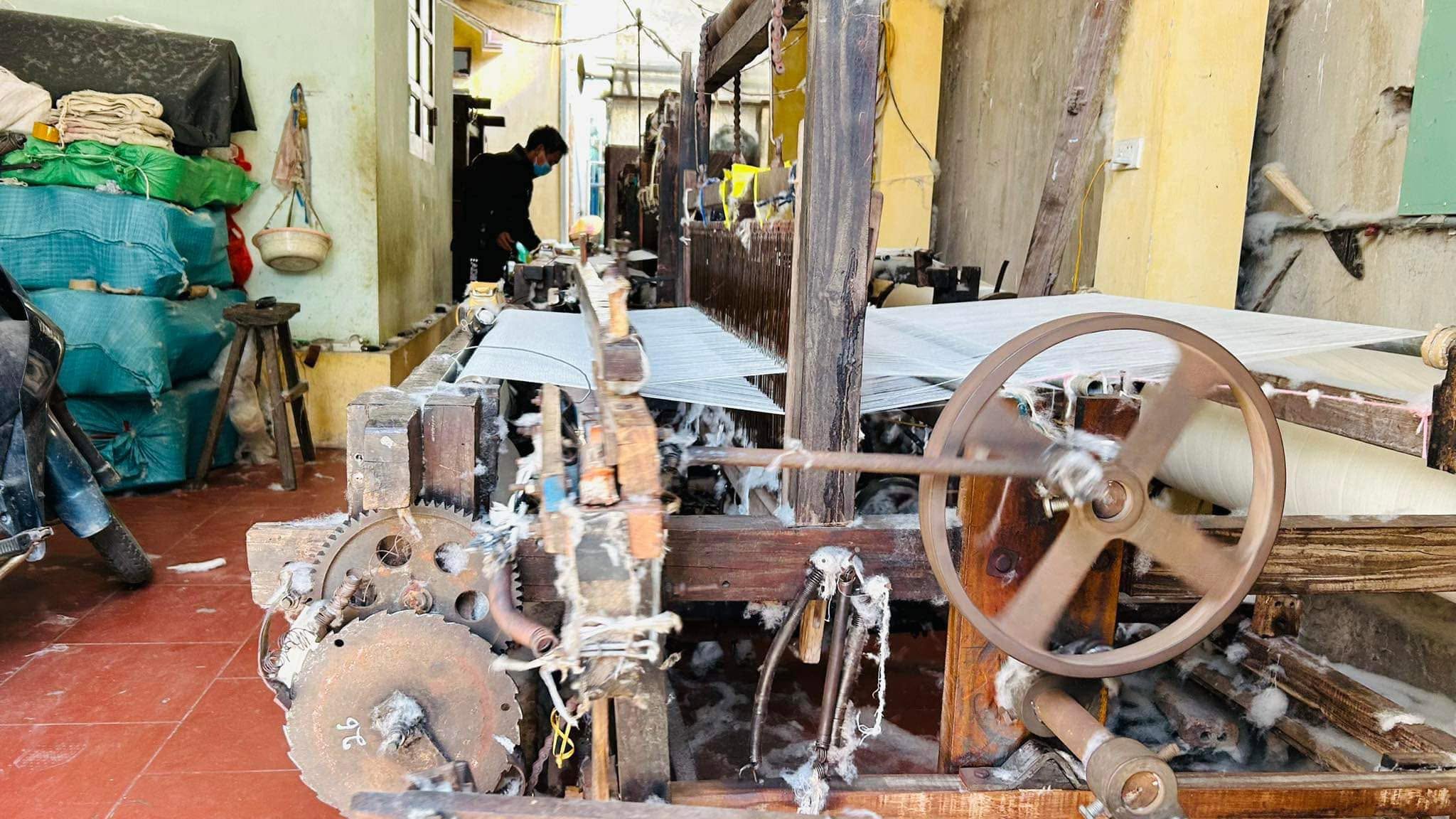
Co Chat Silk-Reeling Village and Cu Tru Weaving Village, located in Ninh Giang Commune, Ninh Binh Province, are two traditional craft communities closely associated with the history of silk production and textile weaving in northern Vietnam. Situated on fertile alluvial land along the Ninh Co River, these villages represent different stages of a longstanding textile tradition, from extracting delicate silk threads from silkworm cocoons to weaving fabrics for everyday use.
While Co Chat is renowned for its traditional silk-reeling craft, where silkworm cocoons are processed into fine, lustrous threads, Cu Tru is known for its weaving activities, using traditional looms and modern equipment to produce a variety of textile products.
Despite changes in market demand and the development of industrial manufacturing, local craftspeople have continued to preserve traditional knowledge while gradually adopting machinery to improve productivity and product quality.
Today, Co Chat and Cu Tru are valued not only for their economic contributions but also for the skills, working traditions, and cultural memories they preserve along the Ninh Co River.
History of Co Chat Silk-Reeling Village and Its Traditional Silk Craft
Co Chat Village lies along the Ninh Co River, in a region where agriculture and traditional handicrafts have long shaped the livelihoods of communities in the Red River Delta.
Under Vietnam’s current administrative arrangement, Co Chat belongs to Ninh Giang Commune, Ninh Binh Province, within the territory formerly associated with Nam Dinh Province.
For generations, the village has been closely identified with silk reeling, an essential stage in the traditional silk-production process.
Silk reeling requires a careful combination of suitable silkworm cocoons, water, controlled temperatures, and skilled handling.
In the traditional silk-production chain, silkworm farmers raise silkworms until they spin cocoons. The cocoons are then collected, sorted, and transferred for processing to extract the silk filaments.
In Co Chat, craftspeople rely on knowledge accumulated through years of practice to select suitable cocoons, treat them in hot water, and locate the filament ends needed for reeling.
Because individual silk filaments are extremely fine, several are combined to produce a continuous raw silk thread with the required thickness and strength.
Throughout the process, workers must carefully control the reeling speed, thread tension, and consistency of the combined filaments.
If these operations are not performed correctly, the silk may break, become tangled, or fail to meet the desired quality standards.
For this reason, even where tools and machinery are available, silk reeling continues to require practical experience and close attention to detail.
According to local tradition, Co Chat’s silk-reeling craft has existed for hundreds of years and has provided a livelihood for generations of families.
Craft knowledge has traditionally been passed down through observation, practical training, and participation in household production.
The sight of workers beside steaming water vessels, golden silkworm cocoons, and rotating silk reels was once a familiar part of village life.
After reeling, the silk may undergo additional processes, including twisting, treatment, and weaving, depending on its intended use.
Through its traditional production techniques, Co Chat became known as a source of silk yarn for weaving and related textile activities.
The value of the craft lies not only in its finished products but also in the accumulated understanding of cocoon quality, temperature control, and filament handling that has been preserved across generations.
Traditional Silk-Reeling Techniques and the Art of Producing Fine Silk Threads
Producing high-quality silk requires several carefully coordinated stages, beginning with the selection of raw materials and continuing through reeling, winding, and storage.
Each stage influences the quality of the final product.
Selecting and sorting silkworm cocoons
Silkworm cocoons are the primary raw material used in silk reeling.
Craftspeople select cocoons according to their suitability for processing and sort them based on relevant characteristics and quality.
Well-formed cocoons help improve the efficiency of reeling, reduce filament breakage, and produce more consistent silk threads.
Treating cocoons in hot water
The selected cocoons are placed in hot water at an appropriate temperature to soften the natural gum that binds the silk filaments together.
This process allows workers to locate and draw out the filament ends from the cocoon.
Temperature and processing time must be carefully controlled because unsuitable conditions may affect the strength and quality of the silk.
Finding filament ends and reeling silk
Once the cocoons have been prepared, the worker identifies the filament ends and guides them into the reeling mechanism.
Because the filament from a single cocoon is extremely fine, several filaments are usually combined during reeling to form a raw silk thread of suitable thickness.
The worker continuously monitors the process, introducing additional filaments when necessary to maintain consistency.
This stage is one of the clearest demonstrations of the skill and experience required in traditional silk production.
Winding and preparing the silk
After reeling, the silk passes through guiding components and is wound onto reels or other collection equipment.
Careful winding helps prevent excessive tangling, overlapping, and thread breakage.
Depending on production requirements, the silk may undergo additional treatment or twisting before being supplied to weaving workshops.
Storing and distributing silk
Finished silk must be stored under suitable conditions to minimize the effects of humidity and other environmental factors.
It can then be supplied as raw material for weaving and related textile industries.
Historically, many stages of silk reeling were performed using manual tools and traditional winding reels.
Today, mechanized equipment can assist with certain operations, increasing productivity and reducing physical labor.
Nevertheless, an understanding of cocoon quality, filament characteristics, and appropriate processing techniques remains essential.
The combination of traditional experience and technological improvements has helped preserve the practical value of Co Chat’s silk-reeling heritage.
Cu Tru Weaving Village and the Development of Textile Production Along the Ninh Co River
Located not far from Co Chat, Cu Tru Weaving Village is another traditional craft community in Ninh Giang Commune, Ninh Binh Province.
While Co Chat is associated with extracting silk from silkworm cocoons, Cu Tru is recognized for transforming yarn into woven fabrics.
Together, the two villages illustrate different stages of textile production in the Red River Delta.
For many generations, the rhythmic sounds of wooden looms and weaving shuttles formed part of everyday life in local households.
Traditional weaving requires knowledge of yarn characteristics, warp preparation, weft insertion, and fabric construction.
Preparing weaving materials
The choice of yarn depends on the type of fabric being produced.
In traditional silk weaving, silk yarn is an important material. However, textile production in Cu Tru has also used other types of yarn at different times to meet changing market demands.
Before weaving begins, the yarn is prepared, sorted, and processed as necessary.
Preparing and operating the loom
Warp threads are arranged on the loom at a density appropriate for the intended fabric.
Weft threads are then passed through the warp to create the woven structure.
In traditional hand weaving, the worker operates the loom using coordinated hand and foot movements, allowing successive rows of threads to interlock.
This process requires consistent timing and accuracy to produce an even fabric surface and minimize defects.
Finishing woven products
After weaving, the fabric may be inspected, cut, treated, or finished according to its intended purpose.
Depending on the workshop and production period, products associated with Cu Tru have included face towels, bath towels, clothing fabrics, and certain specialized textile materials.
Textiles intended for medical applications, where produced, must meet specific technical and quality requirements. Ordinary weaving processes alone do not establish suitability for medical use.
One of the most significant changes in the village’s development has been the transition from traditional handlooms to weaving equipment supported by electric motors.
In earlier times, individual weavers performed many operations manually.
With the introduction of machinery, certain stages became mechanized, increasing output and allowing workers to operate or supervise multiple machines more efficiently.
These changes have helped textile production adapt to commercial demand.
However, modern weaving also requires skills in machine operation, quality control, and equipment maintenance.
According to previously published local accounts, weaving has provided employment for many residents and contributed to household incomes.
The number of workers and scale of production may vary over time according to market conditions, material availability, and business opportunities.
Beyond its economic importance, Cu Tru’s weaving tradition preserves memories of working life along the Ninh Co River.
From the rhythmic movements of traditional looms to the operation of motorized weaving machines, each stage of development reflects the community’s ability to adapt to social and economic change.
Preserving Co Chat and Cu Tru Craft Heritage Through Cultural Tourism
Co Chat Silk-Reeling Village and Cu Tru Weaving Village share an important connection within the textile history of northern Vietnam.
One village is known for processing silkworm cocoons and producing silk threads, while the other is associated with weaving yarn into fabrics for everyday use.
Their presence within the same region provides an opportunity to understand the different stages involved in transforming natural fibers into textile products.
In an era of industrialization, traditional silk reeling and weaving face considerable challenges.
Competition from mass-produced textiles, fluctuations in raw material prices, productivity requirements, and changes in consumer demand all influence the sustainability of local production.
Attracting younger generations to continue traditional crafts is another important concern.
Preserving these traditions therefore requires more than maintaining the production of finished goods.
It also involves safeguarding specialized techniques and practical knowledge.
Skills such as selecting suitable cocoons, controlling temperatures during silk reeling, maintaining thread consistency, preparing looms, and identifying weaving defects represent valuable aspects of the region’s intangible craft heritage.
Documenting production methods, preserving traditional equipment, and encouraging apprenticeship can help protect techniques that may otherwise become less widely practiced.
At the same time, adopting appropriate technologies can support product quality and help workshops remain competitive.
Opportunities for craft village tourism
Because Co Chat and Cu Tru specialize in different but historically connected activities, the villages have potential to become destinations for travelers interested in traditional Vietnamese handicrafts.
At workshops that are able to welcome visitors, travelers may observe how silk-reeling workers select cocoons, process them in hot water, and extract delicate silk filaments.
Watching a small cocoon gradually yield fine, lustrous silk can offer a memorable introduction to traditional textile craftsmanship.
In Cu Tru, educational visits could focus on loom construction, the arrangement of warp and weft threads, and the principles of fabric weaving.
Where suitable guided programs are available, visitors may have opportunities to try simple operations using traditional hand-weaving equipment.
However, hands-on activities should take place in safe environments under appropriate supervision and without disrupting production.
In particular, hot-water cocoon processing and the operation of motorized weaving machinery involve potential safety risks. Visitors should never handle such equipment without permission and professional guidance.
Travelers should not assume that every workshop in Co Chat or Cu Tru offers regular tours or public demonstrations.
Those interested in specialized visits should contact local authorities, production facilities, or tour organizers in advance to confirm whether arrangements are possible.
In addition to the crafts themselves, the riverside landscape of the Ninh Co River contributes to the appeal of the area.
Traditional residential communities, rural scenery, and everyday working life provide further insight into the relationship between local occupations and the natural environment of the Red River Delta.
In the future, connecting silk-reeling and weaving villages with cultural attractions and historical sites in the former Nam Dinh region could help create educational and experiential tourism programs.
Craft demonstrations for students, cultural researchers, and international travelers may also encourage greater appreciation of traditional manual skills.
For local communities, carefully managed craft tourism could provide additional opportunities to promote products, diversify income, and inspire younger residents to take an interest in traditional occupations.
Such development should respect working environments, local livelihoods, and the authenticity of the cultural knowledge being presented.
Along the Ninh Co River, Co Chat Silk-Reeling Village and Cu Tru Weaving Village preserve stories of craftsmanship, patience, and creativity in Vietnam’s Red River Delta. From the small silkworm cocoon to the delicate silk filament, and from the rhythmic movements of traditional looms to finished woven fabrics, these two villages continue to represent an important part of the cultural memory of the former Nam Dinh region, now within Ninh Binh Province.
Quick Information
| Item | Details |
|---|---|
| Craft villages | Co Chat Silk-Reeling Village and Cu Tru Weaving Village |
| Vietnamese names | Làng ươm tơ Cổ Chất and Làng dệt Cự Trữ |
| Current location | Ninh Giang Commune, Ninh Binh Province, Vietnam |
| Historical region | Former Nam Dinh Province |
| Geographical setting | Along the Ninh Co River |
| Craft type | Traditional silk-reeling and textile-weaving villages |
| Co Chat specialty | Reeling silk from silkworm cocoons |
| Cu Tru specialty | Textile weaving and woven fabric production |
| Main silk-reeling material | Silkworm cocoons |
| Silk-reeling techniques | Cocoon selection, hot-water treatment, filament extraction, reeling, and winding |
| Weaving techniques | Yarn preparation, warp arrangement, weft insertion, weaving, and fabric finishing |
| Representative products | Silk yarn, woven fabrics, face towels, bath towels, and clothing textiles |
| Traditional equipment | Cocoon-processing vessels, silk-reeling wheels, and handlooms |
| Modern equipment | Mechanized silk-reeling equipment and motorized weaving looms |
| Cultural significance | Preservation of silk-production knowledge, weaving techniques, and traditional craftsmanship |
| Potential visitor experiences | Learning about silk reeling, observing weaving, and meeting local craftspeople where visits can be arranged |
| Tourism potential | Craft village tourism, cultural tourism, heritage education, and rural experiences |







