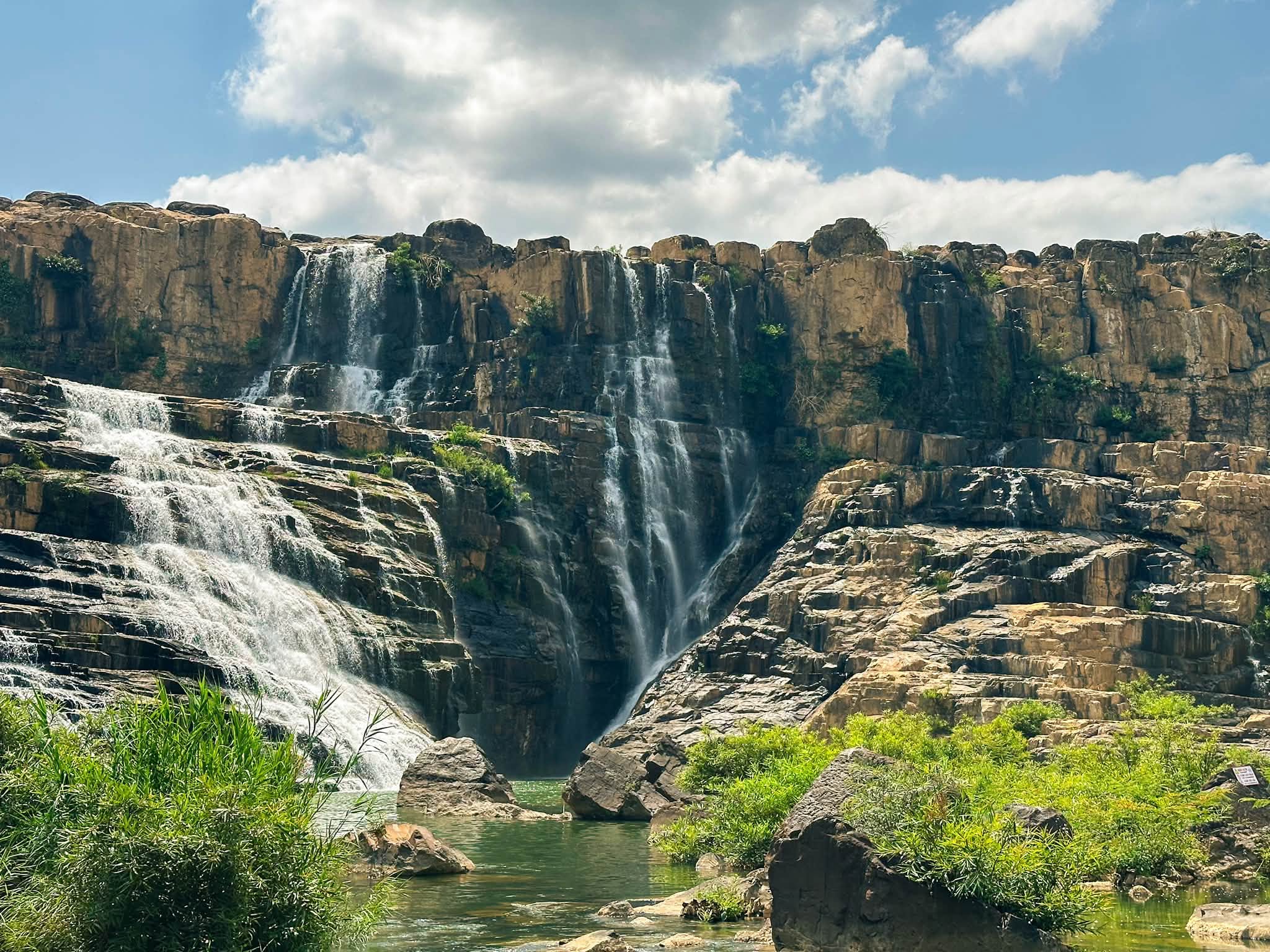
Pongour Waterfall is one of the most remarkable natural attractions in the Central Highlands of Vietnam. Known for its wild, majestic beauty, the waterfall spreads across a series of natural rock terraces, creating a spectacular landscape surrounded by forests and mountains.
Locally known as Seven-Tier Waterfall or Thien Thai Waterfall, Pongour is not only a scenic destination but also a place associated with the legends and cultural heritage of the indigenous communities of the Central Highlands.
Where is Pongour Waterfall?
Pongour Waterfall is located in Tan Hoi Commune, Lam Dong Province, approximately 50 km from Da Lat city.
From Da Lat, travelers follow National Highway 20 toward Ho Chi Minh City before turning onto the road leading to the waterfall. The final section takes visitors through a quieter landscape of forests and rural areas before reaching the waterfall.
The waterfall is set within a natural landscape of approximately 2.5 hectares, where layers of shale rock have formed distinctive stepped terraces.
The main waterfall is approximately 40 meters high, while the water cascades across a section more than 100 meters wide, creating one of the most impressive broad-flow waterfalls in the region.
Pongour Waterfall at a glance
| Feature | Details |
|---|---|
| Main waterfall height | Approximately 40 m |
| Width of the waterfall | More than 100 m |
| Natural tiers | 7 rock terraces |
| Water source | Da Nhim River system |
| Landscape area | Approximately 2.5 hectares |
| Geological formation | Shale rock forming natural stepped terraces |
The Meaning Behind the Name “Pongour”
There are several interpretations of the origin of the name Pongour, with two explanations being particularly well known.
The first theory suggests that Pongour was a French transcription of a name from the K’ho language, associated with a phrase interpreted as “the lord of the white clay land.” This explanation is linked to the area’s geological characteristics, where kaolin, a type of white clay, can be found.
Another widely circulated interpretation connects Pongour with the K’ho language and translates the name as “four rhinoceros horns.” This interpretation is associated with a traditional legend about a powerful female tribal leader named Ka Nai and her four rhinoceroses.
The Legend of Ka Nai and the Four Rhinoceroses
Among the traditional stories associated with the K’ho, Churu and other indigenous communities of the Central Highlands is the legend of Ka Nai, a female tribal leader whose story has become closely connected with Pongour.
According to the legend, Ka Nai once ruled over an area corresponding roughly to today’s Phu Hoi, Tan Hoi and Tan Ha. She was described as young, beautiful and exceptionally strong, possessing skills far beyond those of many male warriors.
Ka Nai was also known for her ability to tame wild animals, particularly rhinoceroses. Her tribe was said to have four extraordinary rhinoceroses that helped the community clear forests, reshape the land and protect their village.
The legend tells that when members of her community were captured and taken away, Ka Nai called upon neighboring highland groups to resist the invaders. Riding one of her rhinoceroses, she led her forces into battle and succeeded in rescuing many people.
After returning home, Ka Nai and her four rhinoceroses continued working to reclaim the land. Together, they were said to have pushed through mountains, leveled hills and shaped the landscape to create a new homeland for their people.
The marks left by the four rhinoceroses were eventually associated with the surrounding landscape, giving rise to the legend behind the name Pongour, or “four rhinoceros horns.”
Seven Rock Tiers and the Name “Thien Thai”
The most distinctive feature of Pongour Waterfall is its unusual structure.
Rather than plunging down a single narrow cliff, the water flows across seven successive natural rock terraces before reaching the lower pools and stream.
This distinctive formation explains the local name Seven-Tier Waterfall.
Pongour is also known as Thien Thai Waterfall, a poetic name suggesting a heavenly or enchanted realm hidden among the mountains.
During the rainy season, abundant water transforms the waterfall into a powerful and expansive cascade. In the dry season, the water level decreases, revealing more of the broad rock terraces that give Pongour its characteristic appearance.
The Pongour Festival
Pongour has also been associated with the cultural life of communities living in the surrounding areas of Lam Dong.
Historical accounts indicate that from around the 1960s, people from Duc Trong and neighboring areas would visit Pongour during the first full moon of the lunar year, or the 15th day of the first lunar month.
These spring journeys brought together people from different communities, including Kinh, Hoa and various ethnic groups living in the Central Highlands.
Visitors came not only to enjoy the landscape but also to visit temples, shrines and other cultural sites, combining traditional spring festivities with the local customs of indigenous communities.
For many years, Pongour became a lively gathering place during the Lunar New Year season, where people traveled together, explored the waterfall and celebrated the arrival of spring.
Pongour in the Cultural Landscape of the Central Highlands
What makes Pongour particularly distinctive is not simply its height or the volume of its water.
Its significance comes from the combination of natural landscapes, indigenous legends and community traditions.
The seven rock terraces define the physical character of the waterfall. The story of Ka Nai adds a layer of mythology and cultural memory. Meanwhile, the traditional spring gatherings transformed Pongour from a natural attraction into a place where different communities could meet and interact.
The legend of Ka Nai also emphasizes values such as loyalty, gratitude, courage and devotion to one’s community. In this sense, Pongour represents more than a waterfall. It is also part of the cultural memory of the people who have lived in and around the Central Highlands.
The Natural Beauty of Pongour Waterfall
The most impressive feature of Pongour is the remarkable width of its cascading waters.
Instead of concentrating into a single stream, the water spreads across the natural rock terraces, forming a broad curtain of water surrounded by greenery.
The seven levels create a sense of depth and movement. From below, the successive rock terraces rise dramatically toward the forest. From above, the landscape opens into a wider view of the surrounding hills and valleys.
When the water is abundant, the sound of the waterfall blends with the surrounding forest, creating a powerful and distinctly wild atmosphere.
A Must-Visit Destination in Lam Dong
Pongour Waterfall has evolved from a landscape deeply connected with indigenous legends into one of the best-known natural attractions in Lam Dong.
While Da Lat is famous for its cool climate, pine forests and romantic highland atmosphere, Pongour offers visitors a different side of the region: vast, rugged and deeply connected to the natural landscape of the Central Highlands.
A visit to Pongour is therefore more than a trip to a waterfall. It is an opportunity to discover a landscape shaped by water and stone, while learning about the legends and cultural traditions that have been passed down through generations.
With its seven natural terraces rising through the forest, Pongour Waterfall remains one of the most memorable landscapes of Vietnam’s Central Highlands.