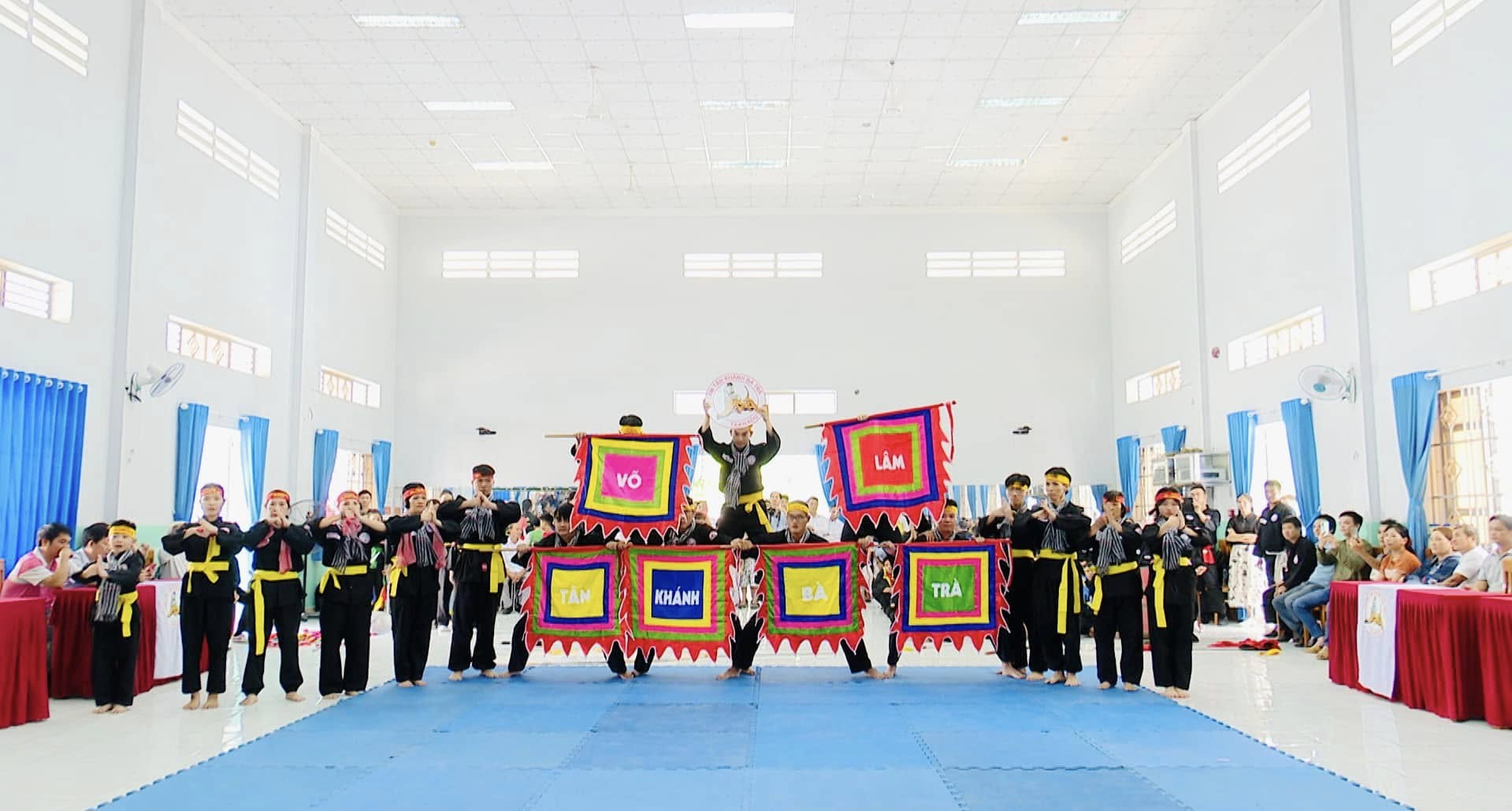
Võ Lâm Tân Khánh Bà Trà, also known as TAKHADO, is a traditional Vietnamese martial art that originated in the Tân Khánh area, now part of Tân Phước Khánh Ward, Ho Chi Minh City. From a martial tradition associated with settlement, land reclamation and self-defense in the southern region, it gradually developed into a distinct martial art system featuring unarmed techniques, kicks, traditional weapons and combat methods.
On 3 February 2021, the Ministry of Culture, Sports and Tourism issued Decision No. 599/QĐ-BVHTTDL, officially adding Võ Lâm Tân Khánh Bà Trà to the National Intangible Cultural Heritage List, under the categories of Folk Knowledge and Folk Performing Arts.
According to the tradition preserved within the martial school, Võ Lâm Tân Khánh Bà Trà developed from the experiences of early settlers who used martial arts for self-defense, protection against wild animals and survival in the process of opening up new lands. Over generations, these techniques were expanded, refined and passed down to the present day.
Today, the martial school has thousands of practitioners in numerous provinces and cities across Vietnam and abroad, continuing to practice its traditional forms, weapon techniques, combat skills and ceremonial traditions.
From Frontier Martial Arts to Võ Lâm Tân Khánh
According to accounts preserved by the martial school, the origins of Võ Lâm Tân Khánh can be traced to around the 17th century, when settlers from the Thuận Quảng region moved into Tân Khánh to clear land and establish new communities.
In an environment where wild animals and other dangers were still common, martial arts initially served as a means of self-defense and protection. Fighting techniques were passed from one generation to the next, gradually forming a martial system reflecting the conditions of the southeastern region.
By the mid-19th century, this martial tradition was believed to have developed further under the influence of Võ Thị Trà, a legendary figure remembered within the martial school for her exceptional skills and her connection with descendants of Tây Sơn military commanders.
According to traditions passed down within the school, Bà Trà was proficient in Bình Định boxing techniques and the Eighteen Traditional Weapons. Young men in the area came to learn from her, combining the techniques developed by earlier generations of settlers with the methods taught by Bà Trà.
Over time, this martial tradition became known as Võ Lâm Tân Khánh Bà Trà, linking the name of the Tân Khánh area with the legendary Bà Trà.
Bà Trà and the Martial Tradition of Tân Khánh
A popular story tells of a young woman who operated a small teahouse in Tân Khánh during the mid-19th century. A sword hanging above the counter attracted the attention of customers.
According to the story, she warned that anyone who drank without paying would have to “answer to the sword” before leaving. Some young men, offended by the challenge, attempted to test her skills but were defeated.
It was later discovered that the young woman was a servant of Võ Thị Trà. During the day she worked at the teahouse, while at night she trained in swordsmanship and martial arts under Bà Trà.
The story has become part of the local oral tradition and reflects the role attributed to women in the martial culture of Tân Khánh, while also helping explain the name Tân Khánh Bà Trà.
According to the martial school’s tradition, Bà Trà was also associated with the Truông Mây base, where she was said to have led local people against corrupt local authorities between 1850 and 1859.
Hai Ất and Ba Giá
After the generation of Bà Trà, the martial tradition of Tân Khánh was continued by two disciples, Võ Văn Ất, known as Hai Ất, and Võ Văn Giá, known as Ba Giá.
Both were renowned for their mastery of the trường côn, a traditional long staff, also known as the roi. Local oral tradition remembers the two martial artists through stories of their ability to confront wild animals, particularly tigers.
One of the most famous stories concerns their encounter with three tigers at Hố Ngỡi, near Tân Khánh village.
According to the traditional account, the confrontation lasted for more than two hours. The two martial artists used coordinated techniques involving punches, kicks and the long staff to fight the animals. The story later became an important part of the tiger-fighting tradition associated with Võ Lâm Tân Khánh Bà Trà.
The reputation of Hai Ất and Ba Giá spread further when they were reportedly invited to Bàu Lòng to deal with a tiger that repeatedly entered the village and attacked livestock.
According to the story, Ba Giá confronted the tiger directly with his staff while Hai Ất observed and positioned himself to block its escape. After the encounter, local people passed down the saying:
“Cọp Bàu Lòng, Võ Tòng Tân Khánh.”
The saying became part of the region’s oral memory surrounding the martial tradition and its legendary encounters with wild animals.
Tiger-Fighting Techniques
One distinctive feature of Võ Lâm Tân Khánh Bà Trà is its traditional system of tiger-fighting techniques.
According to martial arts master Hồ Văn Tường, the seventh-generation headmaster of the school, the traditional tiger-fighting system consists of 10 techniques, each with multiple variations. They are preserved in a Vietnamese lục bát verse:
“Thứ nhất hoành đả hỏa xa,
Thứ hai phù phóng, thứ ba roi hoành,
Thứ tư phục hổ tan tành,
Thứ năm xà địa giữ mình cho xinh,
Thứ sáu là roi đâm lèo,
Thứ bảy hồi mã đừng theo mà lầm,
Thứ tám phục hổ đạt trùng,
Thứ chín bát tự, thứ mười đâm đôi.”
These techniques are also represented on the emblem of Võ Lâm Tân Khánh Bà Trà, depicting a martial artist riding on the back of a tiger and striking the animal.
Within the martial tradition, tiger-fighting is not merely a story of combat with wild animals. It also reflects the historical environment in which people in southeastern Vietnam lived during the period of land reclamation.
Năm Vuông and the 1914 Tiger Fight
An additional historical account was published in Vũ Thuật, New Series No. 2, in Chợ Lớn on 1 February 1953, describing Võ Thị Vuông, known as Năm Vuông, the daughter of martial artist Võ Văn Ất.
According to the account, in 1914, during the opening ceremony of Bến Thành Market, a public match between a human fighter and a tiger was organized. Năm Vuông, who was then in her twenties, was chosen by her father to face the tiger.
The account states that she deliberately avoided attempting to end the fight quickly. Instead, she followed her father’s instruction to prolong the encounter and gradually exhaust the animal.
The fight reportedly lasted from early morning until around noon. After repeated attacks and counterattacks, the tiger became increasingly exhausted, and Năm Vuông eventually ended the encounter with a decisive strike.
Her name is also remembered in the local place name Truông Bà Năm Vuông, near Tân Phước Khánh. According to oral tradition, she once used a carrying pole to defend herself against a group of robbers attempting to steal her goods.
Stories about Hai Ất, Ba Giá and Năm Vuông form an important layer of the oral tradition surrounding Võ Lâm Tân Khánh Bà Trà, where martial arts are closely associated with settlement, survival and community memory.
Seven Generations of Transmission
According to the school’s tradition, Võ Lâm Tân Khánh Bà Trà has passed through seven generations of headmasters.
The first generation consisted of Vietnamese settlers who cleared and established communities in the Tân Khánh area from approximately the 17th century to the early 19th century.
The second generation is associated with Võ Thị Trà, who lived in the mid-19th century.
The third generation includes the founders Võ Văn Ất and Võ Văn Giá.
They were followed by Võ Văn Trực, known as Sáu Trực, a disciple of Võ Văn Ất and the fourth-generation master.
Võ Văn Phiên, known as Bảy Phiên and a disciple of Võ Văn Trực, represented the fifth generation.
Hồ Văn Lành, also known as martial arts master Từ Thiện and a disciple of Võ Văn Phiên, represented the sixth generation.
The seventh generation is represented by martial arts master Hồ Văn Tường, the son of Hồ Văn Lành.
This transmission demonstrates an important characteristic of Võ Lâm Tân Khánh Bà Trà: the martial art has been preserved not only through formal techniques and exercises, but also through teacher-student relationships, direct practice and the collective memory of successive generations of martial artists.
Characteristics of Võ Lâm Tân Khánh Bà Trà
Võ Lâm Tân Khánh Bà Trà is characterized by combined and continuous offensive techniques, integrating punches, kicks, body movement and traditional weapons.
According to the school’s tradition, its techniques developed in an environment where southeastern Vietnam once contained large areas of wilderness, wild animals and other dangers associated with frontier settlement. The martial system therefore emphasized flexibility, variety and the ability to respond to changing situations.
The first characteristic is a relatively extensive system of techniques combining hand and leg movements from different directions to maintain continuous attacks.
The second is the combination of hand and kicking techniques. Practitioners may use fists, palms, arms, the edges of the hands, elbows, knees, calves, feet, shins and heels.
The third is the system of the Eighteen Traditional Weapons, among which the long staff is particularly prominent. The staff could be made from locally available materials such as bamboo, tầm vông, căm xe and mật cật wood.
The school also preserves techniques using various weapons derived from agricultural tools and everyday objects. Among them is the traditional fan, which can be used as a defensive and combat weapon.
The fourth characteristic is adaptability across different distances and circumstances, from long-range to close combat, reflecting the self-defense requirements of communities during the settlement of the southern frontier.
Representative Martial Forms
Throughout its development, Võ Lâm Tân Khánh Bà Trà has preserved numerous traditional boxing and weapon forms.
In 2013, 2014 and 2015, three martial forms from the school were included in the national training and competition program of the Vietnam Association of Physical Fitness and Wellness:
- Bát Tiên Quyền
- Tứ Linh Đao
- Tứ Môn Côn
These forms represent important elements of the martial tradition and have contributed to the systematic teaching and public performance of Võ Lâm Tân Khánh Bà Trà.
Martial Arts Master Hồ Văn Lành and the Promotion of the School
In the modern history of Võ Lâm Tân Khánh Bà Trà, martial arts master Hồ Văn Lành, also known as Từ Thiện, played an important role in preserving and promoting the tradition.
He established the Từ Thiện Martial Arts School in Saigon and trained numerous students. According to the school’s records, he won all seven of his competitive bouts during his younger years.
Many of his students achieved medals at martial arts competitions in Vietnam and abroad. Before 1975, his students reportedly won two gold medals, five silver medals and two bronze medals at the Southern Vietnam Martial Arts Championship. Three male fighters were also selected to compete against champions from Thailand, Laos and Cambodia.
In 2003, Hồ Văn Lành received the Medal for Contributions to Physical Education and Sports from the Vietnamese state.
Martial Arts Master Hồ Văn Tường and the Transmission of Knowledge
Following Hồ Văn Lành, Hồ Văn Tường continued to develop and promote Võ Lâm Tân Khánh Bà Trà.
In 1981, he established a martial arts class at the Ho Chi Minh City Youth Cultural House. In 1995, he opened an additional free TAKHADO class there for students and university students, providing opportunities for physical training and self-defense.
He also documented, compiled and disseminated martial arts knowledge. According to the school’s materials, he has authored approximately 20 books on martial arts and uploaded around 200 boxing forms, kicking techniques, weapon forms and other techniques to YouTube to introduce the tradition to learners in different locations.
Many students trained through these classes later became martial arts instructors and masters, continuing to teach new generations.
Martial Chess and Creative Performance
One notable contribution by Hồ Văn Tường was the development of Martial Chess in 1989, in cooperation with martial arts master Lê Văn Vân of the Bình Định Sa Long Cương school.
In this performance form, human performers represent chess pieces on a large outdoor board. When a piece moves or captures another piece, martial artists use Võ Lâm Tân Khánh Bà Trà techniques to illustrate the movement or combat between the pieces.
The Martial Chess team of the Ho Chi Minh City Youth Cultural House subsequently performed at cultural, sporting and chess events in various parts of Vietnam.
This combination demonstrates how traditional martial arts can extend beyond training spaces to become a form of cultural performance, bringing together sport, traditional arts and community entertainment.
Võ Lâm Tân Khánh Bà Trà Today
According to the provided materials, Võ Lâm Tân Khánh Bà Trà classes are currently offered in numerous localities, including Ho Chi Minh City, Đồng Nai, Bình Phước, Bến Tre, Đồng Tháp, Kiên Giang, Lâm Đồng, Đắk Lắk, Tiền Giang and Tây Ninh, with approximately 5,000 practitioners.
Some practitioners of the school have also applied TAKHADO techniques in competitions involving Muay Thai, Kickboxing and Kun Khmer.
The presence of the martial tradition within contemporary combat sports illustrates how a traditional martial system has adapted to modern training and competitive environments.
Ancestral Ceremony and the Living Tradition
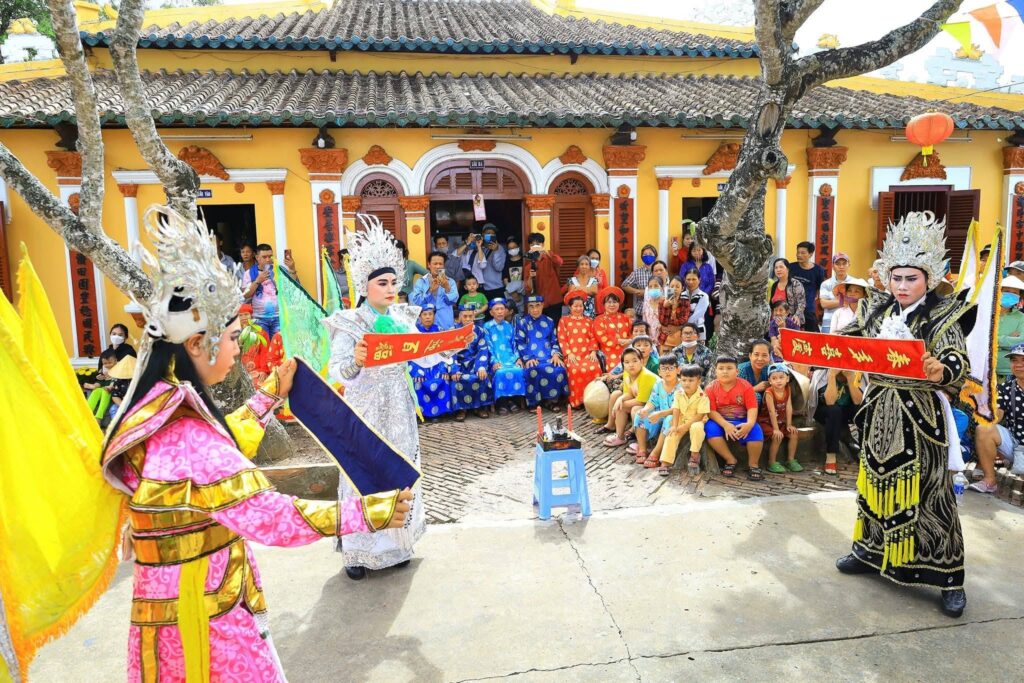
Every year on the 27th day of the tenth lunar month, Võ Lâm Tân Khánh Bà Trà holds its ancestral memorial ceremony to commemorate the founders and those who contributed to establishing and transmitting the martial tradition.
The ceremony also provides an opportunity for practitioners from different localities to meet, honor previous generations, review the history of the school and exchange training experience.
The ancestral ceremony therefore carries not only a spiritual meaning but also helps preserve teacher-student relationships, respect for predecessors and the collective memory of the martial community.
National Intangible Cultural Heritage
Võ Lâm Tân Khánh Bà Trà represents an important connection between martial arts, the history of settlement and community culture in southeastern Vietnam.
From self-defense techniques developed among early settlers, the tradition gradually evolved into a comprehensive system of boxing, kicking, weapons and combat techniques. Over generations, martial forms, oral traditions, training methods, teacher-student relationships and ancestral ceremonies have together created a cultural system extending beyond the practice of martial arts alone.
On 3 February 2021, the Ministry of Culture, Sports and Tourism issued Decision No. 599/QĐ-BVHTTDL, adding Võ Lâm Tân Khánh Bà Trà to the National Intangible Cultural Heritage List, under the categories of Folk Knowledge and Folk Performing Arts.
The recognition provides an important foundation for preserving, transmitting and promoting the martial knowledge accumulated through generations.
Today, Võ Lâm Tân Khánh Bà Trà continues to be taught in numerous localities, preserving traditional forms while adapting to contemporary training and performance environments. From the historic land of Tân Khánh, the martial art has become part of the cultural memory and martial tradition of southern Vietnam.
Quick Information
| Item | Information |
|---|---|
| Heritage | Võ Lâm Tân Khánh Bà Trà |
| Other name | TAKHADO |
| Heritage type | Folk Knowledge; Folk Performing Arts |
| Place of origin | Tân Khánh area |
| Present location | Tân Phước Khánh Ward, Ho Chi Minh City |
| Origins | Associated with land reclamation, settlement and self-defense in southeastern Vietnam |
| Traditional period of formation | According to the martial tradition, from around the 17th century |
| Figures associated with its development | Võ Thị Trà, Võ Văn Ất, Võ Văn Giá and successive generations of headmasters |
| Generations of transmission | 7 generations |
| Main characteristics | Boxing, kicking, long staff and traditional weapons |
| Tiger-fighting tradition | A system of 10 traditional techniques |
| Representative forms | Bát Tiên Quyền, Tứ Linh Đao, Tứ Môn Côn |
| Training network | Numerous provinces and cities in Vietnam and abroad |
| Number of practitioners | Approximately 5,000, according to the provided materials |
| Ancestral ceremony | 27th day of the tenth lunar month annually |
| National Intangible Cultural Heritage | Listed in 2021 |
| Decision | Decision No. 599/QĐ-BVHTTDL, 3 February 2021 |
| Outstanding values | Traditional martial arts, folk knowledge, performing arts, settlement history and community culture |
Location: Tân Khánh area, now Tân Phước Khánh Ward, Ho Chi Minh City.