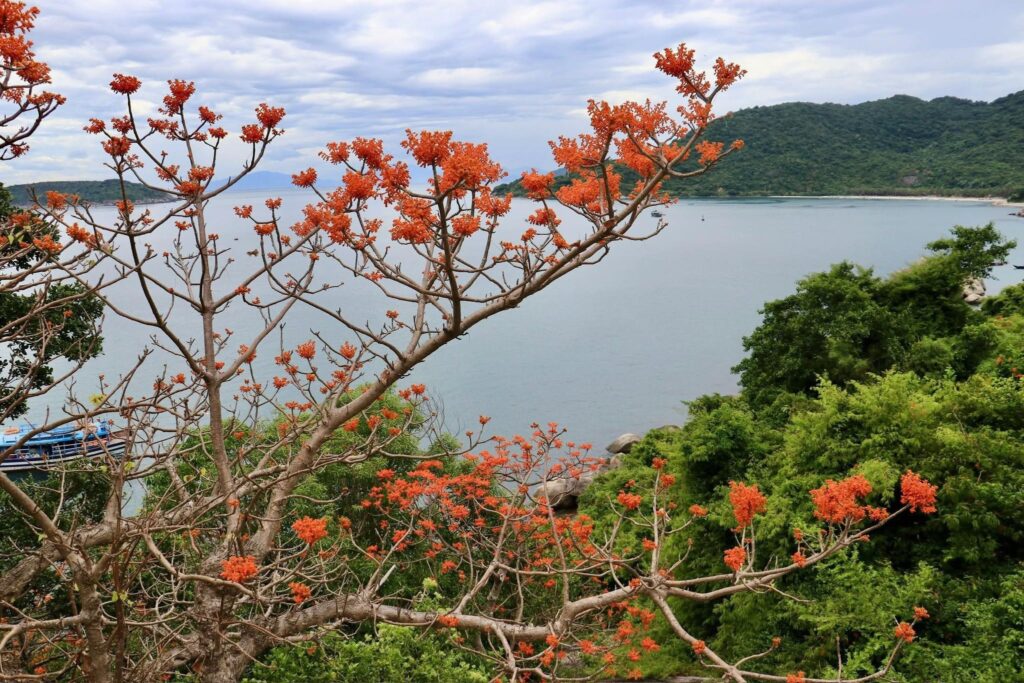



Hon Tai and Hon Trac are two small islands located in Con Son Bay, part of the Con Dao Archipelago in Ho Chi Minh City, Vietnam. Beyond their natural beauty, these islands are associated with a fascinating local legend about two brothers, forbidden love, family loyalty, and sacrifice.
From Ton Duc Thang Street along the coast of Con Son Island, visitors can admire the peaceful bay, where emerald-green waters stretch toward small islands on the horizon.
Among these islands, Hon Tai and Hon Trac hold a special place in local folklore. Their names are linked to a tragic love story that has been passed down through generations of Con Dao residents.
Where Are Hon Tai and Hon Trac Islands?
Hon Tai and Hon Trac belong to the Con Dao Archipelago, a group of 16 islands located off Vietnam’s southeastern coast.
The islands lie offshore from Con Son, the largest and most populated island in the archipelago.
Visitors exploring the coastal areas of Con Son, particularly Ton Duc Thang Street, can enjoy views across the bay toward the surrounding islands.
While Con Dao is widely known for its historical prison complex, beautiful beaches, and protected marine ecosystems, it also has a rich collection of traditional stories associated with local landmarks.
The legend of Hon Tai and Hon Trac is one of these stories.
According to local folklore, the islands were named after twin brothers who participated in the resistance against French colonial rule during the late 19th century.
The Legend of Phong Tai and Trac Van
The story begins during the reign of Emperor Ham Nghi, when the Can Vuong Movement encouraged Vietnamese patriots to resist French colonial rule.
According to the legend, two twin brothers from the Dang family, named Phong Tai and Trac Van, joined the resistance.
The brothers looked so similar that even people who knew them sometimes struggled to tell them apart.
During the conflict, Phong Tai was captured and exiled to Con Dao around the end of 1888.
His younger brother, Trac Van, managed to escape and continued participating in the resistance movement.
However, Trac Van was eventually captured and also sent to Con Dao.
Their unexpected reunion on the island marked the beginning of a tragic story that would later become part of Con Dao’s local folklore.
Minh Nguyet, the Beautiful Woman of An Hoi
During his exile on Con Dao, Phong Tai met a local woman named Dao Minh Nguyet.
According to the legend, Minh Nguyet was the daughter of a prosperous family in An Hai Village.
She was admired for her beauty and was affectionately known as the “Fairy of An Hoi.”
Phong Tai and Minh Nguyet eventually married.
Her family provided the couple with a garden where they could establish their home and begin a new life.
For a time, they lived peacefully together.
Everything changed when Trac Van, Phong Tai’s twin brother, arrived on Con Dao.
One day, while Phong Tai was away, Trac Van visited his brother’s home.
Because the two brothers looked almost identical, Minh Nguyet mistook Trac Van for her husband and rushed forward to welcome him.
Trac Van immediately explained that he was Phong Tai’s younger brother, recently exiled to the island.
After the misunderstanding, Trac Van began living with his brother and sister-in-law.
A Complicated Love Story
As time passed, Minh Nguyet gradually developed feelings for Trac Van.
Although she knew he was her husband’s brother, she found herself increasingly attracted to him.
Trac Van became aware of her feelings but maintained his distance.
He respected his older brother and did not want to destroy the family’s happiness.
One day, while Phong Tai was away fishing, Minh Nguyet approached Trac Van and pretended to mistake him for her husband once again.
Trac Van gently rejected her.
Realizing that the situation could eventually lead to conflict and suffering, he decided that the best solution was to leave.
Rather than remain in the same household, Trac Van chose to live alone on a small island offshore.
How Did Hon Tai and Hon Trac Get Their Names?
According to the legend, Trac Van built a simple raft and crossed the sea to a small island in front of Con Son Bay.
When Phong Tai learned that his brother had left, he became deeply concerned and decided to follow him.
However, by the time Phong Tai reached the island, Trac Van had already moved to another nearby island, closer to the Da Trang Cape area.
Phong Tai realized that continuing to follow his brother might only cause him to move farther away.
He therefore decided to remain on the first island, close enough to know that his brother was nearby.
The two brothers lived separately on neighboring islands for the rest of their lives.
According to local tradition, the islands were later named Hon Tai and Hon Trac in memory of Phong Tai and Trac Van.
This explanation belongs to local folklore and should not be considered a historically verified account of the islands’ names.
The Sad Fate of the Fairy of An Hoi
While the two brothers lived apart on the islands, Minh Nguyet remained behind.
The woman once celebrated for her beauty and happiness was left alone, separated from both her husband and the man she had secretly loved.
Her sorrow became an important part of the legend.
Over generations, Con Dao residents preserved the story through traditional verses expressing longing, loneliness, and enduring affection.
One version of the folk poem reads:
Ai sang Hòn Trác, Hòn Tài
Cho tôi nhắn gởi một vài câu thơ
Đêm sương gió lặng sao mờ
Trăng khuya chếch bóng vẫn chờ đợi mây
Chừng nào núi Chúa hết cây
Côn Lôn hết đá, dạ này hết thương.
English Interpretation
If someone travels to Hon Trac or Hon Tai,
Please carry a few verses of mine.
Through misty nights, when the winds fall still,
Beneath fading stars, I wait with longing.
Only when Mount Chua has lost its trees,
And Con Lon has lost its stones, will my love disappear.
The verses express a love that endures despite distance and separation.
References to Mount Chua and Con Lon also connect the story to the natural landscape and historical identity of Con Dao.
The English version above is a literary interpretation intended to convey the meaning of the traditional Vietnamese verses rather than a word-for-word translation.
Hon Tai and Hon Trac in Con Dao Folklore
The legend of Hon Tai and Hon Trac is part of Con Dao’s traditional cultural heritage.
Although the archipelago is best known for its historical prison system, revolutionary heritage, and natural attractions, local communities have also preserved many stories explaining the origins of geographical names.
These legends offer insights into traditional Vietnamese values, including family loyalty, personal responsibility, love, and sacrifice.
The story of Phong Tai, Trac Van, and Minh Nguyet reflects the emotional conflicts that can arise between individual desires and family obligations.
For travelers interested in local culture, such stories provide another perspective on the islands beyond their historical monuments and scenic landscapes.
Enjoying the Views of Hon Tai and Hon Trac
Today, visitors to Con Dao can enjoy beautiful views of Con Son Bay from coastal roads and viewpoints around the main island.
Ton Duc Thang Street is one of the most accessible places to appreciate the scenery along the waterfront.
On clear days, the surrounding islands create a picturesque landscape against the blue waters of the bay.
Travelers interested in the legend can combine sightseeing with visits to other attractions, including Con Dao Museum, historical prison sites, beaches, and the central area of Con Son.
Access to individual offshore islands may be subject to environmental protection regulations and local travel restrictions.
Visitors should check current conditions and authorized tour options before planning a boat trip.
A Timeless Legend from the Con Dao Islands
Hon Tai and Hon Trac are more than geographical landmarks in the waters surrounding Con Son.
Through local storytelling, the two islands have become symbols of brotherhood, loyalty, sacrifice, and unfulfilled love.
The legend of Phong Tai, Trac Van, and Minh Nguyet adds a cultural dimension to the natural beauty of Con Dao.
Although its characters and events have not been independently verified as historical facts, the story remains an interesting part of the archipelago’s oral traditions.
For travelers who enjoy discovering the stories behind local place names, the legend of Hon Tai and Hon Trac offers a memorable introduction to the folklore and cultural heritage of Con Dao, Vietnam.