Traditional Knowledge and Techniques of Writing on Palm Leaves among the Khmer People is a distinctive form of folk knowledge preserved by the Khmer community in Southern Vietnam, particularly within Khmer pagodas in the Seven Mountains region of An Giang. The heritage encompasses knowledge of selecting and processing palm leaves, techniques for engraving Old Khmer and Pali scripts, as well as traditional methods for preserving palm-leaf manuscripts passed down through generations.
The thin, yellow-brown leaves are far more than simple writing materials. They preserve Buddhist scriptures, teachings, folk tales, poetry, epics, moral teachings, and knowledge associated with Khmer spiritual life. Palm-leaf manuscripts therefore possess linguistic, literary, religious, historical, artistic, and craft values, while also playing an important role in the religious life of Khmer communities practicing Theravada Buddhism.
Basic Information
- Heritage: Traditional Knowledge and Techniques of Writing on Palm Leaves among the Khmer People
- Other names: Palm-leaf manuscripts, Satra
- Type: Folk knowledge
- Cultural community: Khmer people in Southern Vietnam
- Transmission environment: Khmer pagodas, particularly in the Seven Mountains region of An Giang
- Representative areas: Tri Tôn and Tịnh Biên
- Scripts: Old Khmer and Pali
- Material: Palm leaves
- National Intangible Cultural Heritage: January 23, 2017
- Decision: 217/QĐ-BVHTTDL
- Province: An Giang
Palm-Leaf Manuscripts and Their History
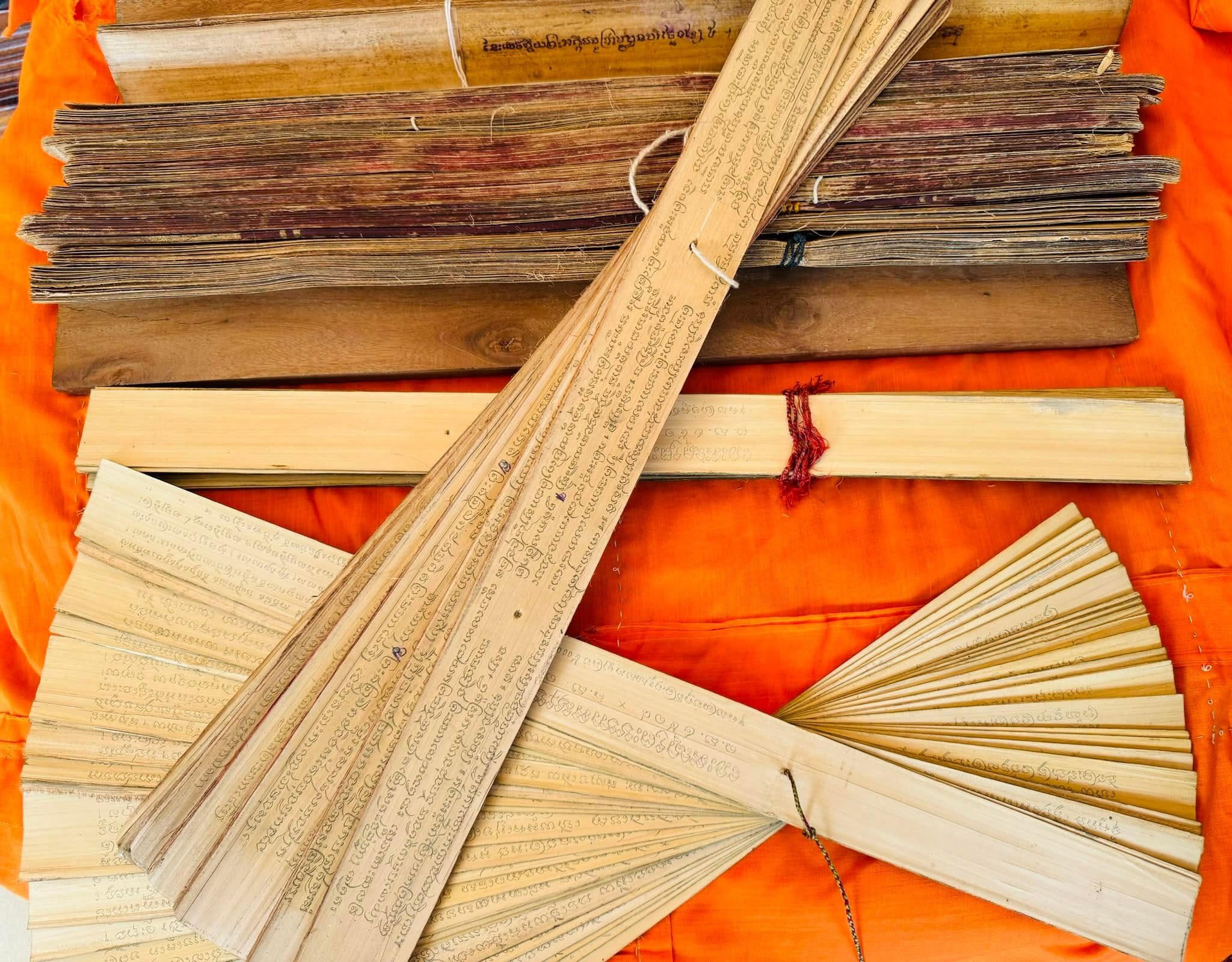
Known in Khmer as Satra, palm-leaf manuscripts are an ancient form of written record created by engraving characters directly onto specially prepared palm leaves. According to the source materials, this form of manuscript appeared in the cultural life of the Khmer community in An Giang from approximately the 19th century, closely associated with Khmer pagodas and Theravada Buddhism.
The manuscripts were written in Old Khmer or Pali. Pali played a particularly important role in recording Buddhist scriptures and teachings within the Theravada tradition. The surviving manuscripts demonstrate that palm leaves served not only as a medium for religious texts but also as a means of preserving community knowledge at a time when modern printing technologies were not yet widespread.
The contents of palm-leaf manuscripts can be divided into several broad groups, including Buddhist scriptures, traditional folk stories, festivals and folk games, and folk moral teachings. Buddhist texts include sermons, teachings, poetry, epics, and moral instructions encouraging people to do good and avoid wrongdoing.
Some manuscripts were opened and used only during important occasions in Khmer religious life, including Buddha’s Birthday, Kathina, Thvai Pres Khe (Moon Offering), and Dolta (Ancestor Offering).
Because palm-leaf manuscripts are regarded as repositories of the Buddha’s teachings, they are deeply respected by the Khmer community. They are not simply ancient texts, but sacred objects associated with pagodas, monks, and the spiritual life of Buddhist followers.
The Craft of Creating Palm-Leaf Manuscripts
The distinctive value of palm-leaf manuscripts begins with the preparation of the raw material.
Palm leaves are selected while still in the form of young buds on the tree. To produce leaves with the appropriate shape and quality, the leaves may be placed within a frame during their growth while being protected from direct sunlight for approximately three to five months. They are then cut, dried, and further processed before being used for manuscript production.
When creating a manuscript, the craftsman does not use ink in the conventional way. Instead, a metal stylus or iron engraving tool is used to scratch the characters directly into the surface of the leaf.
After the characters have been engraved, the surface is treated with a mixture containing charcoal and oil to make the engraved lines more visible. Because palm leaves are durable and flexible, and because the engraving technique allows for precise work, writing can appear on both sides of the leaf.
The process requires a high degree of patience and precision. A single incorrect engraving can damage an entire leaf because the craftsman cannot simply erase the characters and rewrite them as they could on paper.
The manuscript maker therefore needs knowledge of Old Khmer or Pali, together with precise control over hand pressure, engraving angle, and the depth of each stroke. The craft consequently represents a combination of manual knowledge, linguistic knowledge, and religious knowledge.
Structure and Value of a Palm-Leaf Manuscript
A palm-leaf manuscript set is relatively compact but can contain a substantial amount of information. A complete set may be approximately 5–8 centimeters thick, weigh between 300 and 600 grams, and contain around four to ten volumes.
Each volume may contain between 20 and 60 leaves. A single leaf generally contains approximately five lines of writing, with numerous characters carefully engraved across its surface.
These figures illustrate the considerable amount of work required to produce a complete manuscript. Every page passes through numerous stages, from selecting and processing the leaves to drying, shaping, engraving, and darkening the engraved lines.
In terms of content, palm-leaf manuscripts can be regarded as a repository of Khmer folk knowledge. Alongside Buddhist scriptures and teachings, they preserve stories, verses, poetry, epics, folk games, and moral lessons associated with community life.
Through these texts, palm-leaf manuscripts reflect the worldview, ethics, beliefs, and concepts of life transmitted among the Khmer people across generations.
Palm-Leaf Manuscripts in Khmer Pagoda Life
The most important environment for preserving and using palm-leaf manuscripts is the Khmer pagoda.
Within the Khmer Theravada Buddhist tradition, the pagoda is not only a place of religious practice but also a center for preserving writing, scriptures, knowledge, and community education. The preservation of palm-leaf manuscripts in pagodas therefore has significance far beyond that of an ancient written document.
According to historical materials from An Giang, there were periods when numerous Khmer pagodas in the Seven Mountains region preserved dozens of palm-leaf manuscript sets. However, war and inadequate preservation conditions caused the number of surviving manuscripts to decline significantly. Some were damaged or lost, while many of those that remain are already several hundred years old.
At some pagodas, palm-leaf manuscripts are regarded as precious communal assets. Opening the manuscripts, delivering teachings, or using them during important religious ceremonies is carried out with solemnity and respect.
This also explains why the craft of producing manuscripts has a spiritual dimension. The maker must work carefully, maintaining concentration and composure throughout the engraving process.
Decline and Efforts to Pass on the Tradition
For many decades, the knowledge and techniques of writing and engraving on palm leaves have faced the risk of disappearing.
One of the greatest challenges is the availability of suitable raw materials. Palm leaves of sufficient quality for manuscript production have become increasingly difficult to obtain, while some leaves must be purchased from Cambodia. At the same time, preserving palm leaves in a hot and humid climate is challenging. Humidity, temperature, insects, and the passage of time can all contribute to the deterioration of the manuscripts.
Another serious challenge is the shortage of people who possess the necessary skills. Reading Old Khmer or Pali is already demanding, while actually producing a manuscript leaf requires years of additional practical training.
At one point, only a small number of people in the Seven Mountains region retained the ability to perform this technique. Venerable Chau Ty, abbot of Soài So Pagoda, is recognized in the source materials for preserving and teaching the techniques of engraving Old Khmer and Pali scripts on palm leaves.
Subsequent training programs created opportunities for younger monks to learn the craft. At Mỹ Á Pagoda, monks from several Khmer pagodas in Tịnh Biên participated in specialized classes on palm-leaf engraving techniques.
Transmission is particularly important because learners need not only technical skills but also an understanding of Old Khmer and Pali. Only by mastering both language and technique can they continue producing manuscripts and passing the knowledge on to future generations.
One of the most important requirements in learning the craft is patience. Beginners may complete only a small number of leaves each day. The engraving tool must be controlled with moderate pressure. If too much force is applied, the leaf may be damaged or the engraved lines may fail to meet the required standard.
The Values of a Folk Knowledge Heritage
Traditional knowledge and techniques of writing on palm leaves are particularly significant because several layers of knowledge are preserved within a single practice.
It represents knowledge of nature, expressed through the selection and processing of palm leaves.
It represents technical knowledge, demonstrated through shaping, drying, processing, and engraving characters onto an organic material.
It represents linguistic knowledge, through the use of Old Khmer and Pali scripts.
It represents religious knowledge, expressed through Buddhist scriptures, teachings, and rituals of Khmer Theravada Buddhism.
It is also community cultural knowledge, because the manuscripts preserve stories, poetry, moral teachings, folk games, and concepts of life within Khmer society.
From an artistic perspective, each manuscript leaf also demonstrates the skill and refinement of its maker. The small, even, and deeply engraved characters require precise control of the hand. A complete manuscript is therefore simultaneously a religious object, a handmade work, and an ancient form of written record.
The heritage’s recognition as a National Intangible Cultural Heritage in 2017 demonstrates that its value lies not only in the surviving manuscripts themselves, but also in the system of knowledge and skills required to create them.
Safeguarding the Knowledge for Future Generations
Safeguarding palm-leaf manuscripts requires action on two interconnected fronts: protecting the surviving manuscripts and maintaining a community of people capable of continuing the craft.
For existing manuscripts, appropriate storage conditions are essential to minimize the effects of temperature, humidity, insects, and other environmental factors. Research, digitization, and documentation can also help reduce the need to frequently open and handle original manuscripts.
For the craft itself, training programs for young Khmer monks are particularly important. Teachers pass on not only the physical techniques of engraving but also knowledge about materials, scripts, tools, and the spiritual principles associated with manuscript production.
Cooperation among Khmer pagodas, artisans, monks, cultural institutions, museums, and researchers can further contribute to the development of a long-term preservation network.
Palm-leaf manuscripts do not preserve the past only through the words engraved upon them. The technique used to create those words is itself an essential part of the heritage.
In the Seven Mountains region, every surviving manuscript represents the legacy of generations of Khmer people who used palm leaves to preserve Buddhist teachings, folk knowledge, and community stories. When a young person learns how to engrave a manuscript leaf, they are not simply acquiring a craft skill. They are also receiving a part of their community’s cultural memory.
For this reason, safeguarding the Traditional Knowledge and Techniques of Writing on Palm Leaves among the Khmer People means preserving an entire system of knowledge connecting palm leaves, writing, Buddhism, Khmer pagodas, and the cultural life of the Khmer people in the Seven Mountains region. It is one of An Giang’s distinctive cultural heritages, where a simple natural material has become a medium for preserving the memories, beliefs, and knowledge of generations.