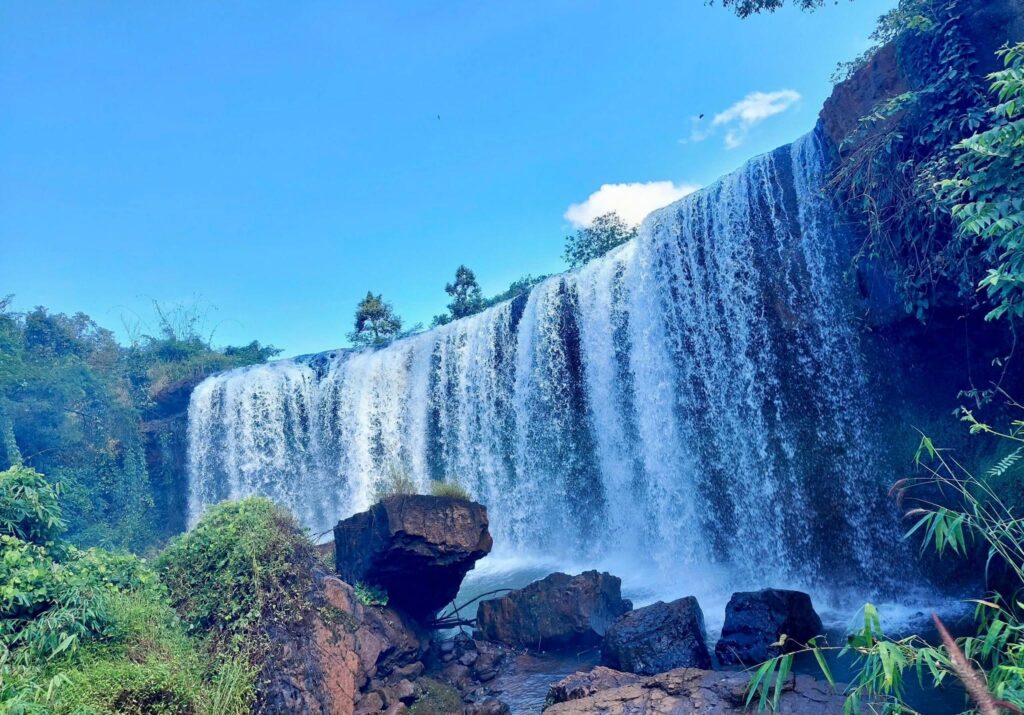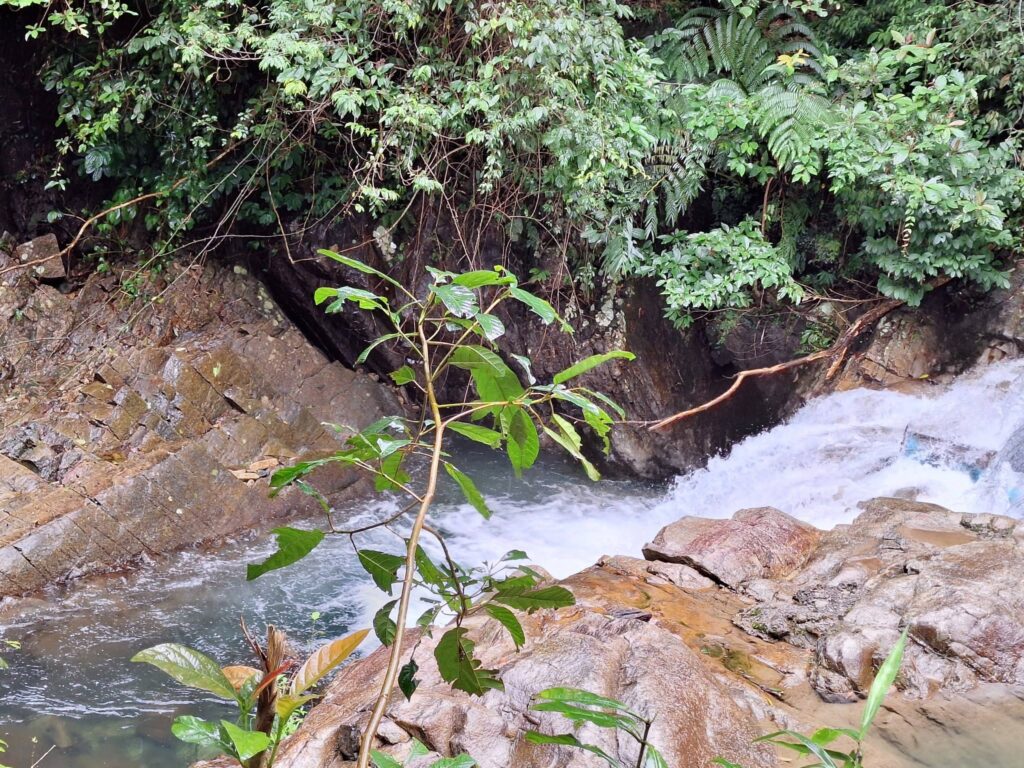
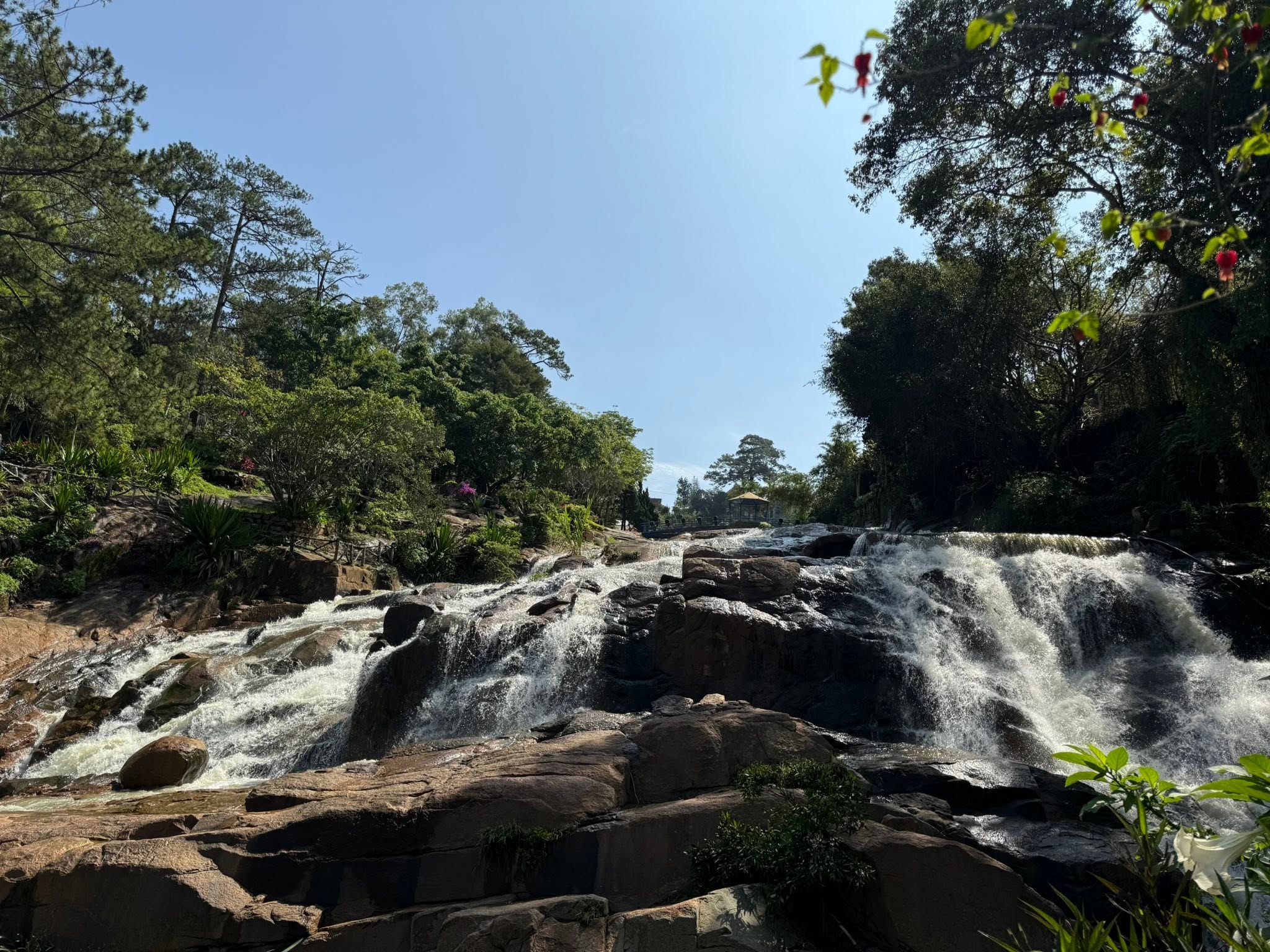
Located more than 2 km west of central Da Lat, Cam Ly Waterfall is one of the natural landmarks most closely associated with the highland city. The waterfall forms where the Cam Le Stream flows over massive granite boulders and drops from a height of around 30 meters, surrounded by pine-covered hills and green vegetation.
For generations, Cam Ly has been part of Da Lat’s visual identity, appearing in poetry, music, paintings and publications about Indochina. Today, the waterfall remains a distinctive destination where visitors can observe the stream from different viewpoints and follow its journey through the rocky landscape.
The Stream That Forms Cam Ly Waterfall
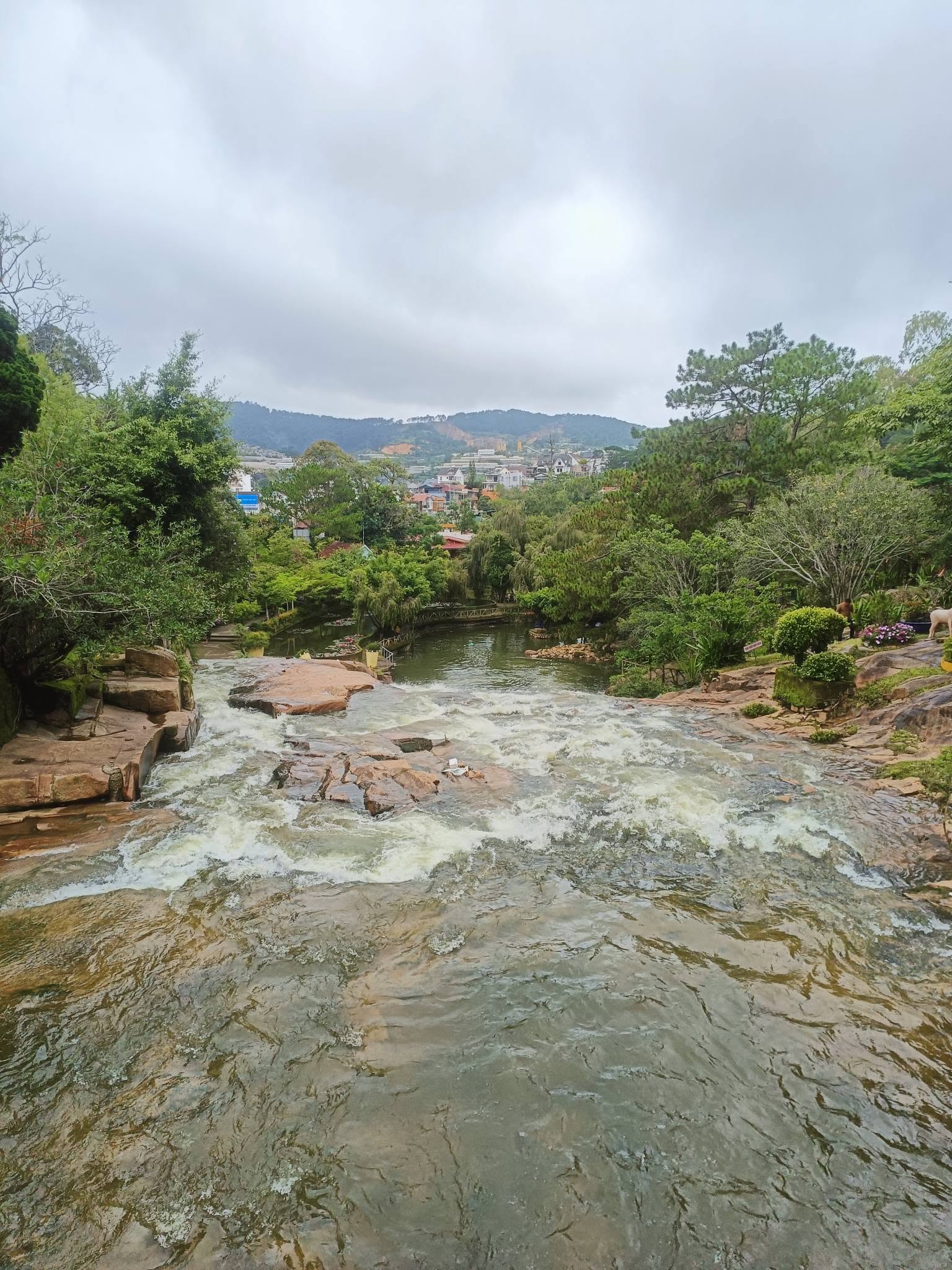
Visitors walking around Xuan Huong Lake may encounter parts of the Cam Ly stream system. One branch flows into the lake from the north, while another flows southward from the lake, passing through the area near the bridge and bus station. A dam in this area helps regulate the lake’s water level.
From Xuan Huong Lake, the stream continues westward. After approximately 2 km, the water encounters a section of terrain blocked by large granite boulders. The stream flows over these rocks and plunges downward, forming Cam Ly Waterfall.
During the rainy season, water from upstream flows much more strongly. Large volumes of water rush over the rocks and fall into the basin below, creating a white curtain of spray. Mist fills the surrounding air, making the area feel cool and atmospheric. This is when Cam Ly most clearly reveals the powerful character of a waterfall shaped by the Central Highlands landscape.
During the dry season, however, the volume of water decreases considerably, and the waterfall loses some of its dramatic force. The seasonal changes give Cam Ly distinctly different appearances throughout the year.
A Landmark Woven into Da Lat’s Memory
The beauty of Cam Ly has long inspired poetry, music and painting. Images of the waterfall were also featured in Revue Indochine and other French publications during the colonial period.
Over time, Cam Ly became one of the familiar landmarks associated with Da Lat. The image of water cascading among rocks, trees and rolling hills contributed to the city’s reputation as a place where romance and nature exist side by side.
The area was once also associated with a pine forest known as “Rừng Ái Ân” (Bois d’Amour), or the Forest of Love. Although the original forest landscape has changed considerably, the name remains part of the historical memory surrounding Cam Ly and the early development of tourism in Da Lat.
In the early 20th century, the area along the Cam Ly stream was characterized by wetlands and dense sedges. Water from Xuan Huong Lake and tributaries around Phan Dinh Phung flowed into the area. The combination of sloping terrain and large rocks created a natural series of cascades, eventually forming the waterfall.
From a relatively wild landscape, Cam Ly gradually became a scenic attraction within the growing city. This remains one of its distinctive characteristics: visitors can experience a recognizable natural waterfall without traveling far beyond the urban center.
The Story Behind the Name Cam Ly
There are several explanations for the origin of the name Cam Ly.
According to a story passed down by local elders, the name has roots in the K’Ho language. A K’Ho chief named K’Mly once led a Lat community living near the stream. The local people named the stream after him in remembrance of the chief and his role in caring for the community. Over time, the name K’Mly is said to have evolved into Cam Ly.
Another interpretation suggests that Cam Ly has a Sino-Vietnamese origin. Under this explanation, “cam” can refer to sweetness, while “ly” is interpreted in connection with absorption or permeation. The name is therefore associated with the idea of a sweet-water stream that once captivated travelers.
Whatever its precise origin, Cam Ly has become an inseparable part of Da Lat’s place names and cultural memory.
Exploring Cam Ly Waterfall
One of the interesting features of Cam Ly is that visitors can experience its landscape from several different viewpoints. From the upper area, the stream can be observed before following paths toward the lower part of the waterfall. Roads and bridges around the site also provide different perspectives of the flowing water.
Sloping hills, winding paths, vegetation and surrounding greenery create a varied sightseeing environment. The area has also featured a number of decorative scenes inspired by highland life, including deer, a highland woman carrying a water gourd, birds, buffalo, eagles, mushrooms, traditional baskets, communal houses and longhouses.
The combination of the waterfall, granite rocks, vegetation and Central Highlands-inspired elements creates a landscape that blends natural scenery with a traditional tourism setting.
The Waterfall and Its Environmental Story
Alongside its scenic value, Cam Ly today also faces environmental pressure associated with urban development and water quality.
According to the source material, the Cam Ly stream system is approximately 64.1 km long and forms an important waterway within Da Lat, contributing to the city’s landscape and drainage system. The Phan Dinh Phung branch is approximately 5.7 km long and passes through residential, service and agricultural areas.
Over the years, domestic, commercial and agricultural wastewater has reportedly placed pressure on water quality. Sediment accumulation and non-biodegradable waste, including packaging, plastic containers, glass bottles and metal cans, have also affected the stream and its surrounding landscape.
Monitoring information cited in the source material indicates that at some upstream and downstream locations, certain pollution indicators have exceeded applicable standards on several occasions. These findings reflect the continuing challenges faced by the Cam Ly stream system.
During the rainy season or after heavy rainfall, stronger flows can temporarily change the appearance of the water and surrounding landscape. During prolonged dry periods, however, discoloration and unpleasant odors may reappear. This affects both the visitor experience and the image of a waterfall that was once regarded as one of Da Lat’s iconic natural attractions.
Protecting a Waterfall for Da Lat
In recent years, various activities have been carried out to improve the area, including waste collection, stream cleaning, flower planting and landscape improvements along the banks. Environmental awareness campaigns have also sought to encourage local residents and the wider community to take greater responsibility for protecting the stream.
However, protecting Cam Ly cannot begin and end at the waterfall itself. Water quality depends on the entire watershed, making upstream pollution control particularly important.
Measures discussed in the source material include strengthening centralized wastewater collection and treatment systems, controlling wastewater discharge from households and service establishments, and reducing pollution from agricultural activities. Urban management, land-use planning and community awareness also need to be addressed together.
Improving water quality would give Cam Ly a better opportunity to recover some of its natural character. Protecting the waterfall is therefore not only an environmental issue, but also a way of preserving a landmark that has been connected with Da Lat for generations.
Cam Ly Waterfall – A Part of Da Lat’s Memory
Today, Cam Ly remains among the hills, granite rocks and green spaces of the highland city. Water continues to pass over the rocks that shaped the waterfall’s identity, while the surrounding landscape changes with the seasons and the growth of the urban area.
From a waterfall surrounded by a relatively wild natural environment, Cam Ly has become a scenic landmark within Da Lat itself. Its story is therefore not simply the story of a tourist attraction. It is also a story about the relationship between a growing city and the natural landscape around it.
For those who love Da Lat, keeping Cam Ly clean and healthy also means preserving a part of the city’s identity, a place once remembered through its waterfall, pine forests, granite rocks and curtains of falling water.
When the stream is protected, Cam Ly Waterfall can not only regain more of its natural beauty, but also continue to hold its place as a landmark woven into the memory and character of Da Lat.