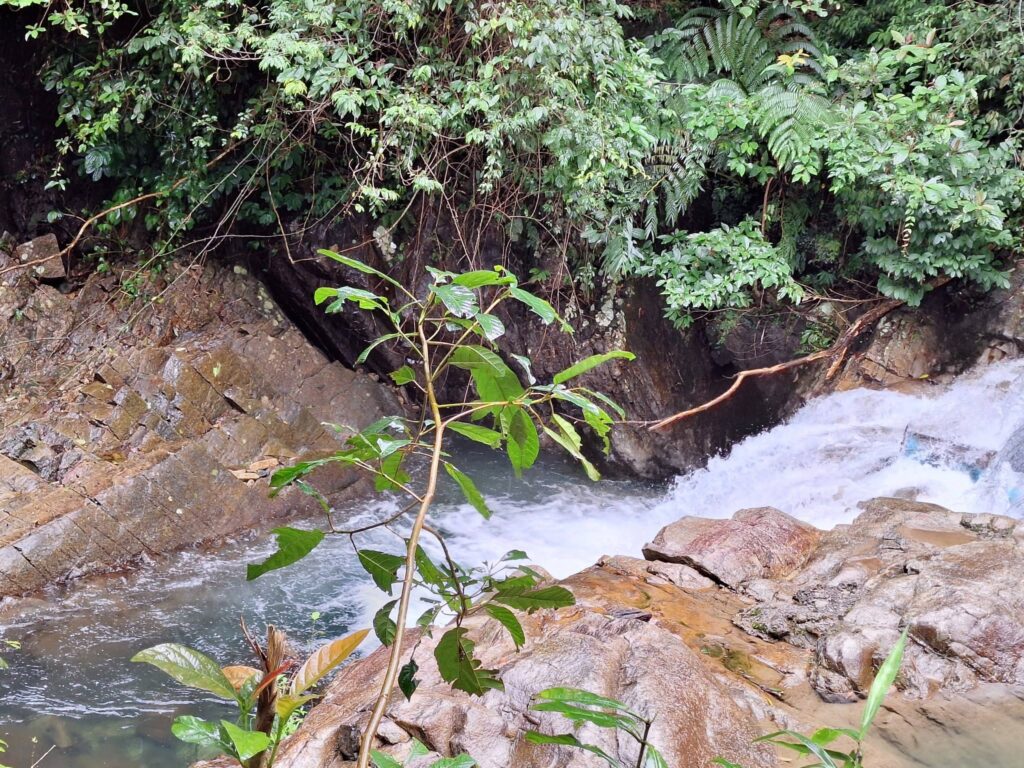
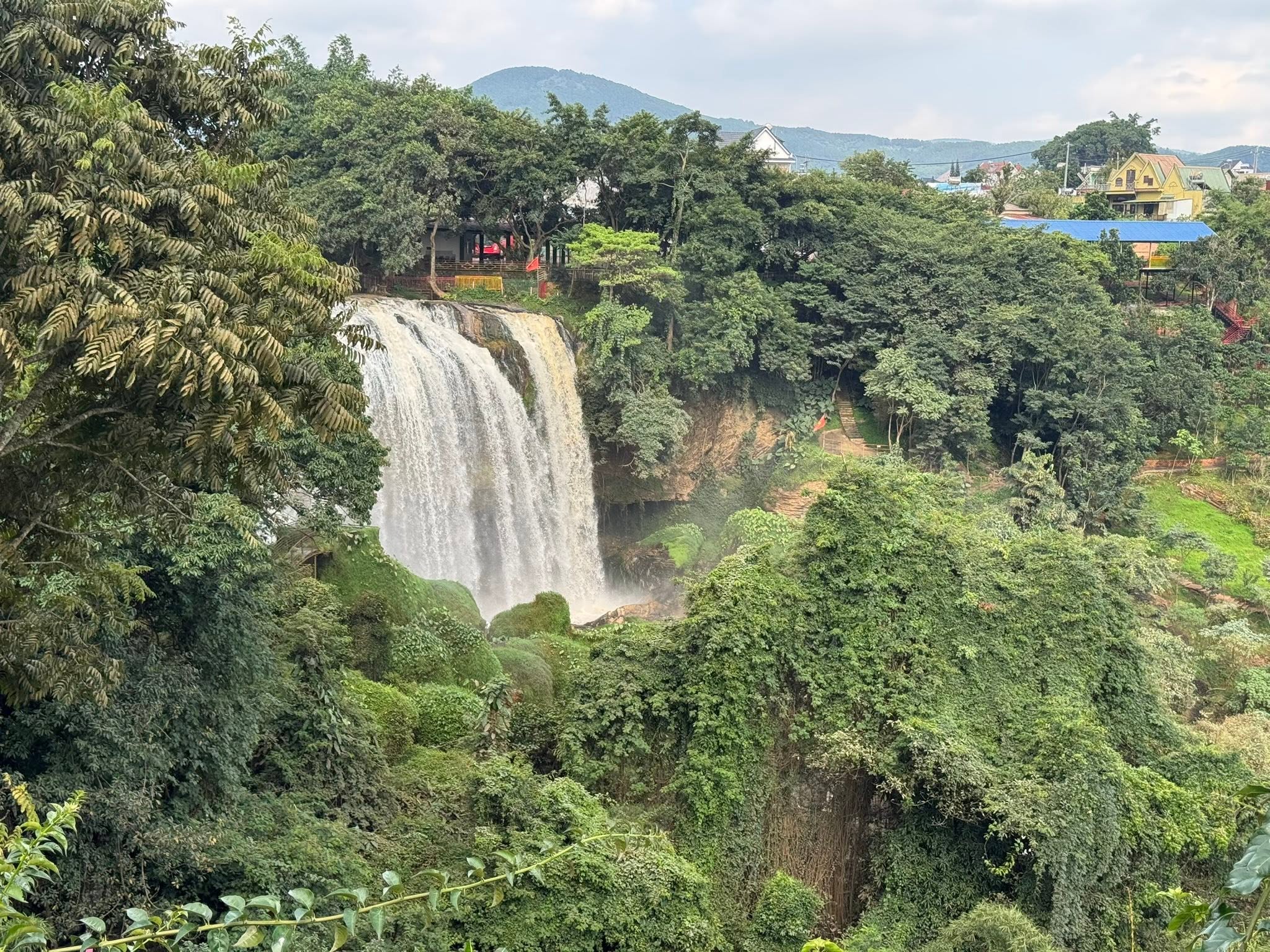
Known locally as Lieng Rwoa Waterfall, Elephant Waterfall is one of the most impressive and atmospheric natural attractions in Lam Dong Province. Hidden among the forests of the Central Highlands, the waterfall combines dramatic scenery with an ancient K’Ho legend about love, loyalty and a herd of elephants turned to stone.
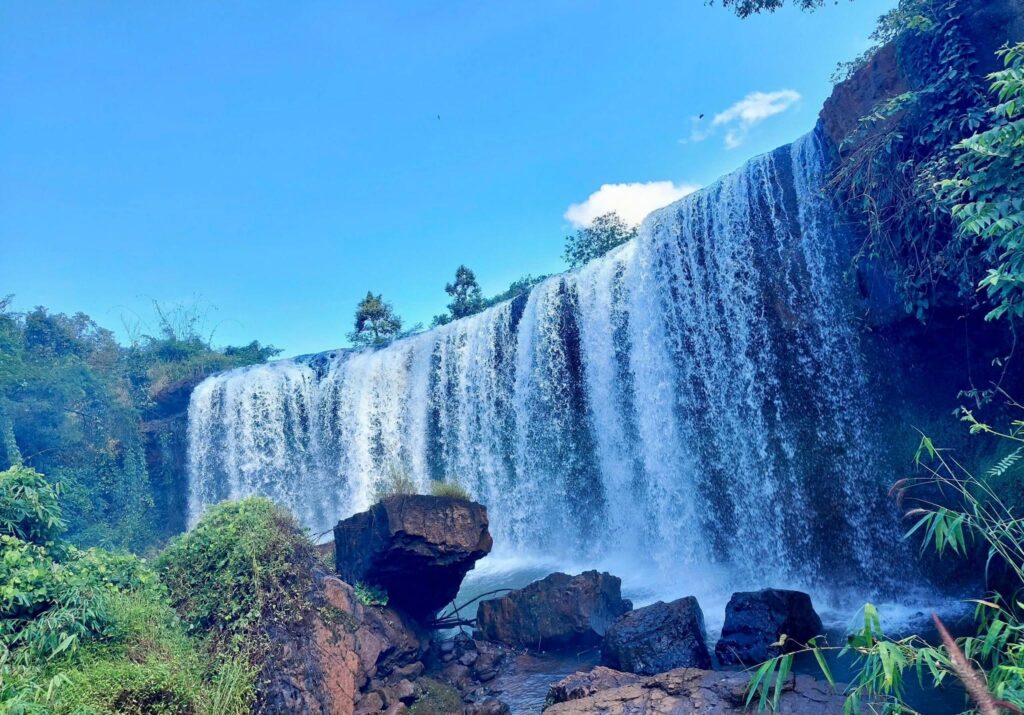
The waterfall plunges from a height of approximately 30 meters, crashing over enormous rocks and creating a powerful white curtain of water surrounded by dense greenery.
Where is Lieng Rwoa Waterfall?
Lieng Rwoa Waterfall is located in Nam Ha Commune, Lam Dong Province, approximately 28–30 km southwest of Da Lat.
The route from Da Lat passes through Ta Nung Pass before reaching the Nam Ban area and the waterfall. The journey offers changing views of pine forests, mountains, coffee-growing areas and the rural landscapes of western Lam Dong.
The waterfall is approximately 30 meters high and 15–20 meters wide. Water rushes down the steep rocky terrain before continuing into the stream below.
Lieng Rwoa Waterfall at a glance
| Feature | Details |
|---|---|
| Local name | Lieng Rwoa Waterfall |
| Common name | Elephant Waterfall |
| Location | Nam Ha Commune, Lam Dong Province |
| Distance from Da Lat | Approximately 28–30 km southwest |
| Height | Approximately 30 m |
| Width | Approximately 15–20 m |
| Landscape | Forest, large rocks and natural caves |
| Access to the base | Around 145 stone steps and paths along the mountainside |
Why is it called Elephant Waterfall?
The local K’Ho name Lieng Rwoa is associated with the meaning “Elephant Waterfall.”
Large rocks scattered around the waterfall resemble elephants kneeling or resting among the forest. These unusual formations have become closely associated with the traditional legend explaining the origin of the waterfall.
For generations, the story has been passed down among K’Ho communities living in the region.
The Legend of the K’Ho Maiden and the Stone Elephants
According to the traditional story told by K’Ho elders, the area around Jơi Biêng was once ruled by a powerful tribal chief who had a beautiful daughter.
She was known for her extraordinary voice. Whenever she sang, the birds would fall silent and the leaves of the forest seemed to pause and listen.
The young woman fell in love with the son of a neighboring tribal chief. He was a strong and courageous warrior, admired by his community for both his appearance and bravery.
The two promised to become husband and wife.
But before they could marry, the young man left to fight in a war.
One moon passed, then another, but he never returned.
Heartbroken, the young woman went to a remote mountain where the couple had once met. There, she sang day after day, hoping that her voice would somehow bring her beloved back.
Moved by her sorrow, a flock of B’ling birds flew far into the distance to search for news of the warrior.
When they returned, they brought the heartbreaking message: the young man had died in battle.
The young woman refused to accept the truth.
She continued to sing, pouring all her longing and grief into her voice, until she finally collapsed from exhaustion and never rose again.
The elephants that had gathered around her to listen to her songs remained there in silence.
Then, according to the legend, a tremendous sound shook the mountains. The earth trembled, the mountain split open, and a powerful stream of water suddenly burst forth, forming the waterfall.
The elephants were said to have turned to stone as they knelt around the place where the young woman had sung.
The sound of the waterfall, the rustling forest and the songs of the birds became an eternal continuation of her final song.
The K’Ho therefore named the waterfall Lieng Rwoa Jơi Biêng, recalling the elephants that knelt and turned to stone before a love that remained faithful to the end.
A Wild Landscape of Rocks and Forest
Unlike the gentle streams found elsewhere in the highlands, Lieng Rwoa is powerful and dramatic.
The water crashes down the rocky cliff, creating clouds of spray before disappearing among the rocks below. Around the waterfall, ancient trees, vines and moss-covered rocks create a dense forest landscape.
Visitors descend approximately 145 stone steps along the mountainside to reach the lower section of the waterfall. Some sections follow naturally formed stone steps carved into the rock, while others pass along narrow paths and wooden bridges beside steep drops.
The deeper visitors descend into the valley, the louder the waterfall becomes.
On sunny days, sunlight passing through the forest canopy and the fine mist rising from the waterfall can create colorful rainbows above the rocks.
The Stone Elephants
One of the most fascinating features of Lieng Rwoa is the collection of enormous rocks around the base of the waterfall.
Some of them have naturally formed shapes that resemble elephants kneeling or resting beside the stream.
When the waterfall roars through the forest, these massive rocks make the old legend feel remarkably vivid. Nature and folklore seem to occupy the same landscape.
For visitors, the stone formations provide one of the most distinctive visual features of Elephant Waterfall.
Caves Behind the Waterfall
The rocky landscape around Lieng Rwoa also contains natural caves, including Bat Cave and Wind Cave.
Bat Cave extends deep into the ground, with unusual rock walls shaped and colored by natural geological processes. Tree roots and vines grow through cracks in the rocks, adding to the mysterious atmosphere.
Wind Cave has a relatively narrow entrance but opens into a larger space inside. Air moving through the rock formations creates a distinctive whistling sound, giving the cave its name.
Together, the caves, cliffs and waterfall form a dramatic natural environment that has long contributed to the mysterious character of Lieng Rwoa.
A Place of Historical Significance
Lieng Rwoa is also connected with the modern history of the region.
During the wars against the French and later the Americans, the rugged forests and caves around Elephant Waterfall served as a revolutionary base and shelter for local resistance forces.
The area’s difficult terrain, dense vegetation and natural caves provided strategic protection.
Today, the waterfall therefore carries not only natural and cultural value but also historical significance.
In 2001, Elephant Waterfall was officially recognized as a National Scenic Site.
Visiting Lieng Rwoa from Da Lat
Lieng Rwoa Waterfall makes an excellent addition to a journey through western Lam Dong.
From Da Lat, travelers can follow the scenic route through Ta Nung Pass and Nam Ha Commune, combining the waterfall with other attractions in the area, including Linh An Pagoda, coffee-growing areas and local agricultural destinations.
The journey provides a different perspective on Lam Dong, away from the urban atmosphere of Da Lat and deeper into the forests and rural landscapes of the Central Highlands.
Because the paths around the waterfall can be steep, wet and slippery, visitors should wear suitable footwear and take extra care when descending toward the base of the waterfall or exploring rocky areas and caves.
Lieng Rwoa – Where Nature Keeps an Old Love Story
Lieng Rwoa is more than a waterfall.
Its dramatic cascade, enormous rocks, dense forest and mysterious caves create an unforgettable natural landscape. But it is the K’Ho legend of the faithful young woman and the stone elephants that gives the place its deepest sense of identity.
Amid the roar of the water and the whisper of the forest, the old story of love and loyalty continues to live on.
Lieng Rwoa Waterfall remains one of the most distinctive natural and cultural landmarks of Lam Dong, where the landscape itself seems to have preserved a love story in stone and water.