


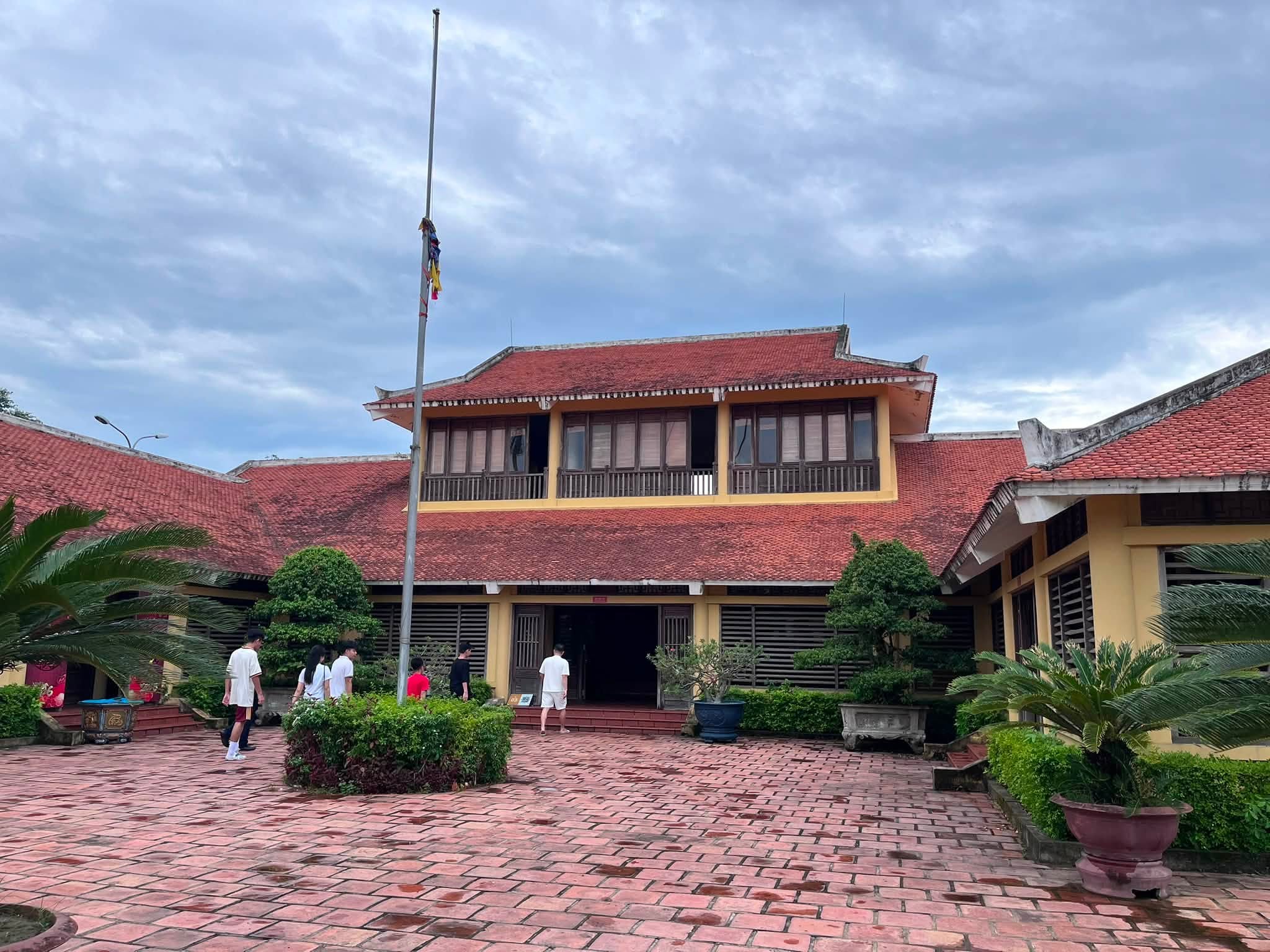
The Nguyen Du Memorial Complex is located in Tien Dien Commune, Ha Tinh Province, in the cultural landscape of Nghi Xuan along the Lam River. The site preserves and promotes the cultural values associated with the life and literary career of Nguyen Du, one of Vietnam’s greatest classical poets. It also preserves important remains of the Nguyen family in Tien Dien, a distinguished lineage with a long tradition of scholarship, literature, and public service.
The memorial complex should be distinguished from the broader system of historical sites associated with Nguyen Du and the Nguyen family in Tien Dien. The memorial complex itself covers approximately 28,562 square meters and contains memorial structures, places of worship, exhibition spaces, gardens, documents, and artifacts related to Nguyen Du. Other important sites, including Nguyen Du’s tomb, the temples and tombs of Nguyen Nghiem and Nguyen Trong, the Van Su mausoleum area, and Nguyen Du’s former garden, are located separately throughout Tien Dien and together form a larger historical and cultural landscape.
Nguyen Du and Tien Dien
Nguyen Du (1765–1820), whose courtesy name was To Nhu and literary name Thanh Hien, was one of the most important figures in Vietnamese medieval literature. He is best known as the author of Doan Truong Tan Thanh, commonly known as The Tale of Kieu.
Nguyen Du was born in Thang Long in 1765 into a prominent aristocratic and scholarly family under the Le-Trinh regime. His father, Nguyen Nghiem (1708–1775), was a highly educated official, poet, and scholar who held important positions at the Le-Trinh court and was later granted the title of Xuan Quan Cong. His mother, Tran Thi Tan, came from Kinh Bac and was also from a family with a literary tradition.
Although Nguyen Du was born in Thang Long, his paternal homeland was Tien Dien in Nghi Xuan, Ha Tinh. This was the ancestral home of the Nguyen family, where several generations of his relatives lived and maintained a strong intellectual and cultural tradition. During the turbulent years of his life, Nguyen Du returned to Tien Dien several times and maintained a private garden there.
The Nguyen family of Tien Dien had a long history of scholarship and public service. According to family genealogies and historical records, the family ancestor Nguyen Doan Dich passed the Tham Hoa examination in 1481 during the reign of King Le Thanh Tong. Later generations included many distinguished figures such as Nguyen Nghiem, Nguyen Trong, Nguyen Khan, Nguyen Dieu, Nguyen Ne, and Nguyen Hue.
For this reason, the heritage sites of Tien Dien tell a story that extends beyond one poet. Together, they reflect the history of a scholarly family whose influence developed over several centuries and whose cultural environment played an important role in shaping Nguyen Du.
Life and Literary Legacy
Nguyen Du lived through one of the most turbulent periods in Vietnamese history. During the late 18th century, the decline of the Le-Trinh government, the Tay Son movement, changes of dynasty, and the establishment of the Nguyen dynasty transformed Vietnamese society.
In 1783, Nguyen Du took the regional civil service examination at Son Nam and passed the third level. He later served as an official, including under the Le dynasty, but his career was repeatedly affected by political upheaval.
After the Nguyen dynasty was established, he entered government service under Emperor Gia Long and held several official positions. In 1813–1814, he was sent on a diplomatic mission to China, an experience that left a significant mark on his classical Chinese poetry.
Nguyen Du died in Hue in 1820. Four years later, in 1824, his descendants brought his remains back to Tien Dien for reburial.
His literary legacy includes works written in both classical Chinese and Nom script. Major collections include Thanh Hien Thi Tap, Nam Trung Tap Ngam, and Bac Hanh Tap Luc, together with works such as Van Te Thap Loai Chung Sinh, Van Te Truong Luu Nhi Nu, Thac Loi Trai Phuong Non, and, most famously, Doan Truong Tan Thanh.
The Tale of Kieu is Nguyen Du’s best-known work. Based on the Chinese novel The Tale of the Jade Bracelet by Qing scholar Thanh Tam Tai Nhan, Nguyen Du transformed the original story through the Vietnamese luc bat poetic form and the expressive power of the Vietnamese language.
The enduring importance of The Tale of Kieu lies not only in its literary artistry. Through the life of Thuy Kieu, Nguyen Du expressed deep compassion for human beings, particularly talented people whose lives were marked by suffering and those whose dignity and choices were constrained by social circumstances and power.
Themes of love, talent, dignity, fate, power, wealth, and social injustice are explored through a deeply humanistic voice that continues to resonate more than two centuries after the poet’s death.
The Memorial Complex and Associated Heritage Sites
The Nguyen Du Memorial Complex was established in Tien Dien in 1965, on the occasion of the 200th anniversary of the poet’s birth. Earlier, on April 28, 1962, the Ministry of Culture had recognized the shrine and tomb of Nguyen Du as a national historical and cultural relic.
Today, the memorial complex covers approximately 28,562 square meters. It includes memorial structures, places of worship, exhibition spaces, gardens, and collections of documents and artifacts related to Nguyen Du and the Nguyen family of Tien Dien. Recent local information indicates that the exhibition area preserves more than 2,000 documents, artifacts, and images.
Among the important structures is the Tu Van House, which is associated with the scholarly and literary traditions of the Nguyen family and the wider Tien Dien community. According to historical records, Nguyen Nghiem built the house in 1785 in the ancestral garden. It served as a meeting place where scholars and literary figures gathered to discuss literature and scholarship.
The Nguyen Du Shrine is another important structure within the memorial complex. It serves as a place of worship and remembrance for the poet. It should be distinguished from Nguyen Du’s tomb, which is located outside the 28,562-square-meter memorial complex and forms a separate site within the wider heritage landscape.
The exhibition house provides an overview of Nguyen Du’s life, literary career, family history, and the continuing legacy of The Tale of Kieu. Its collections include manuscripts, editions of The Tale of Kieu, calligraphy, research publications, writing implements associated with Nguyen Du, and historical materials relating to the Nguyen family.
One particularly valuable aspect of the collection is the variety of versions of The Tale of Kieu, including Nom editions, printed and handwritten copies, calligraphic versions, translations, and scholarly studies. Together, they illustrate how a literary work can continue to live through different forms of preservation, interpretation, and cultural transmission.
Beyond the memorial complex itself, Tien Dien contains a wider network of sites associated with Nguyen Du and his family. These include Nguyen Du’s tomb, the tomb and temple of Nguyen Nghiem, the tomb and temple of Nguyen Trong, the Van Su mausoleum area, and Nguyen Du’s former garden.
Nguyen Du’s tomb is located in the Dong Cung area of Tien Dien and is not included within the 28,562-square-meter memorial complex. After his death in Hue in 1820, his remains were brought back to Tien Dien for reburial in 1824. The tomb was later restored and marked by a stele bearing the inscription “Tomb of Nguyen, a native of Tien Dien.”
The temple and tomb of Nguyen Nghiem are particularly important for understanding Nguyen Du’s family background. As his father, Nguyen Nghiem was a major scholar and official of the Le-Trinh period and played an important role in creating the intellectual environment in which Nguyen Du grew up.
The former garden of Nguyen Du is also significant because it recalls the poet’s personal connection with Tien Dien. He returned here during periods when he was away from official duties, and the garden represents a more intimate dimension of his life beyond his career as an official and writer.
Together, these sites form a broader cultural landscape. The memorial complex provides a place for interpretation and exhibition, while the surrounding temples, tombs, gardens, and historical remains allow visitors to follow the physical traces of Nguyen Du and successive generations of the Nguyen family.
Cultural Significance and Recognition
The Nguyen Du Memorial Complex has value not only as a place commemorating a great poet but also as a historical record of the Nguyen family of Tien Dien, the scholarly traditions of the region, and the cultural life of Nghi Xuan.
The heritage of Nguyen Du includes both tangible and intangible elements: temples, tombs, memorial structures, inscriptions, manuscripts, artifacts, genealogies, literary works, oral traditions, and the continuing cultural life of The Tale of Kieu.
On October 25, 2013, at the 37th session of the UNESCO General Conference in Paris, Nguyen Du was honored by UNESCO as a World Cultural Figure, in recognition of the 250th anniversary of his birth in 2015. The recognition reflected his lasting contribution to Vietnamese literature and culture and the humanistic values expressed in his works.
On September 27, 2012, the Prime Minister issued Decision No. 1419/QD-TTg, recognizing the Nguyen Du Memorial Complex in Nghi Xuan District, Ha Tinh Province, as a Special National Relic.
On June 21, 2024, the People’s Committee of Ha Tinh Province issued Decision No. 1520/QD-UBND recognizing the Nguyen Du heritage site as a provincial-level tourist attraction.
The preservation of Nguyen Du’s heritage therefore extends beyond a single memorial building. It encompasses the broader cultural landscape of Tien Dien, where the poet’s family history, personal life, burial place, literary legacy, and the traditions of a distinguished scholarly lineage remain connected.
More than two centuries after Nguyen Du’s death, The Tale of Kieu continues to be read, recited, studied, performed, translated, and interpreted in many forms. Visiting Tien Dien is therefore not simply a journey to a memorial site. It is an opportunity to explore the life of a poet, the history of a family, the culture of a homeland, and a literary legacy that has become an enduring part of Vietnamese cultural identity.


