


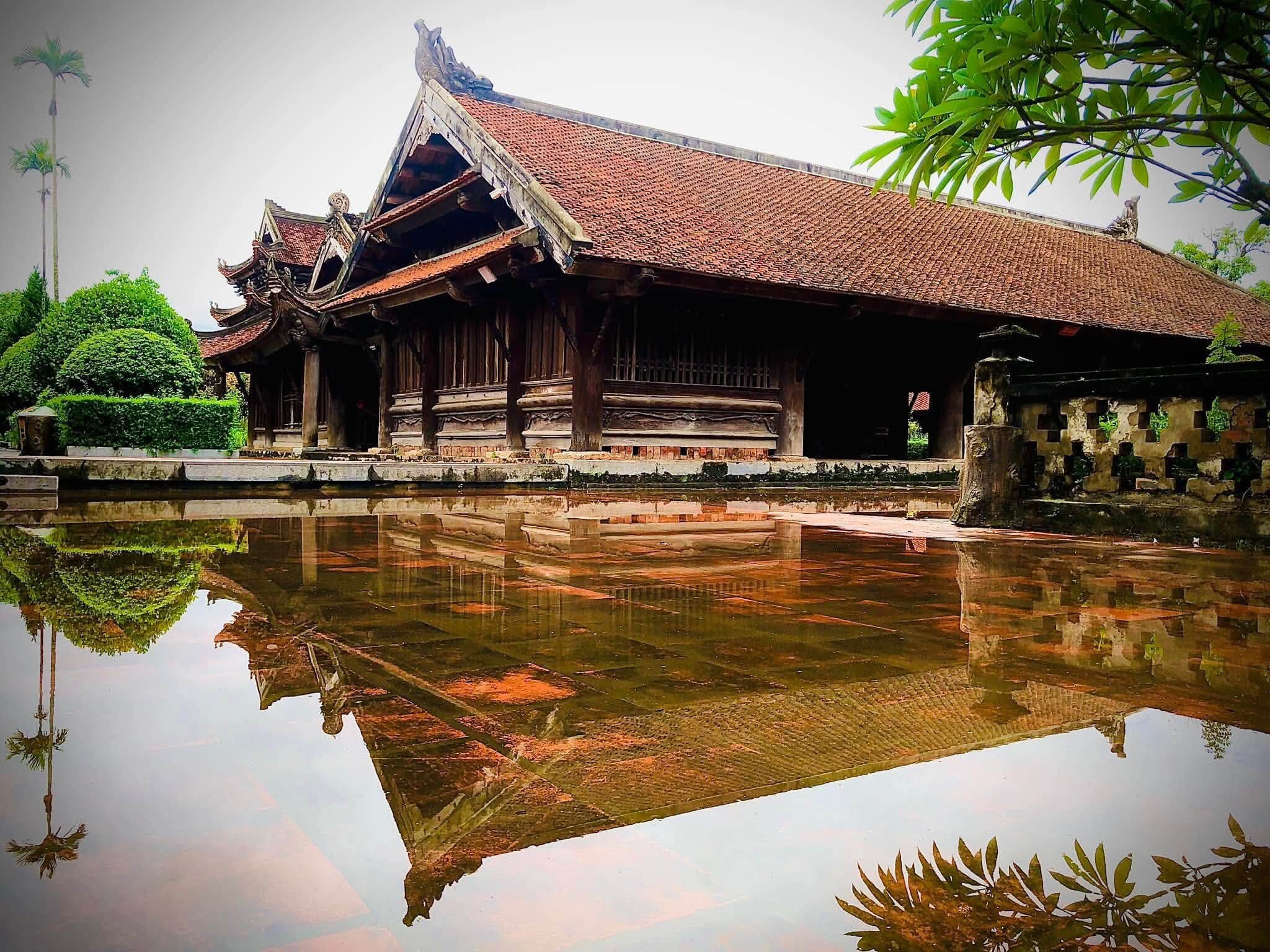
Keo Pagoda, officially known as Thần Quang Tự, is one of Vietnam’s most remarkable ancient Buddhist architectural complexes. The pagoda is now located in Vũ Tiên Commune, Hưng Yên Province, in what was formerly Duy Nhất Commune, Vũ Thư District, Thái Bình Province. With a history spanning nearly four centuries at its present site, a remarkable collection of traditional timber architecture, and a long-standing festival associated with Zen Master Dương Không Lộ, Keo Pagoda is one of the outstanding cultural heritage sites of the Red River Delta.
Keo Pagoda was recognized as a Special National Relic for architectural and artistic values by the Prime Minister under Decision No. 1419/QĐ-TTg dated September 27, 2012. The Keo Pagoda Festival was added to Vietnam’s National Intangible Cultural Heritage List in 2017.
From Nghiêm Quang Pagoda to Keo Pagoda
According to historical records and local traditions, Nghiêm Quang Pagoda was founded in 1061 during the reign of Emperor Lý Thánh Tông in the ancient Giao Thủy area, associated with the old Keo settlement. In March 1167, during the reign of Emperor Lý Anh Tông, the pagoda was renamed Thần Quang Tự.
The name Keo is closely associated with the community of residents from the former Keo settlement and their migration across the Red River. In 1611, a major flood and riverbank erosion caused the old pagoda to collapse and disappear. The residents of Keo were forced to leave their original settlement and divided into two communities. One group moved to the southeastern side, on the right bank of the Red River, while another settled on the northeastern side, on the left bank.
After the migration, the two communities rebuilt their respective pagodas. Because both communities originated from the same Keo settlement, both temples continued to be known locally as Keo Pagoda. To distinguish them, they later became commonly known as Keo Pagoda in Nam Định and Keo Pagoda in Thái Bình.
The Keo Pagoda now located in Vũ Tiên Commune, Hưng Yên Province is the temple rebuilt on the left bank of the Red River, in the area formerly belonging to Thái Bình.
The present complex was the result of a large-scale reconstruction during the Later Lê period. Construction began in 1630 and was essentially completed in November 1632.
According to local historical records, Marquis Hoàng Nhân Dũng and his wife Lại Thị Ngọc Lễ played important roles in mobilizing support for the reconstruction. The project involved numerous groups of craftsmen and used valuable timber and other materials contributed by the local community.
Despite nearly four centuries of natural disasters, historical upheavals, repairs and restorations, Keo Pagoda has retained many of the defining characteristics of 17th-century Later Lê architecture. The Ministry of Culture, Sports and Tourism has recognized it as one of Vietnam’s outstanding ancient Buddhist architectural monuments.
Zen Master Dương Không Lộ and the Legends of Keo Pagoda
Keo Pagoda is renowned not only for its architecture but also for its close association with Zen Master Dương Không Lộ, one of the best-known Buddhist figures of the Lý dynasty.
According to local legends and hagiographical traditions, Dương Không Lộ was born as Dương Minh Nghiêm in 1016 into a family of fishermen. From an early age, he was described as intelligent, studious and deeply devoted to Buddhism.
At the age of 29, he entered monastic life. During his religious studies, he became associated with Zen masters Từ Đạo Hạnh and Giác Hải. Local traditions further recount that the three monks traveled westward to India, traditionally referred to as Tây Trúc, in search of Buddhist teachings.
After returning to Vietnam, Dương Không Lộ traveled extensively throughout the Red River Delta, founding pagodas, spreading Buddhist teachings and helping local communities. He became known as an influential Buddhist master of the Lý dynasty.
According to historical and religious traditions, Dương Không Lộ cured an illness suffered by Emperor Lý Thánh Tông and was subsequently appointed Royal Preceptor. He died in 1094, during the reign of Emperor Lý Nhân Tông.
In 1167, Emperor Lý Anh Tông ordered Nghiêm Quang Pagoda to be renamed Thần Quang Pagoda, a name associated with the continued veneration of the eminent monk.
Today, Keo Pagoda serves two principal religious functions: Buddhist worship and the worship of Dương Không Lộ as a sacred figure. This dual religious structure is reflected in the traditional spatial arrangement known as “Buddha in front, Saint behind”, with the Buddhist sanctuary occupying the front section and the shrine to Dương Không Lộ situated farther inside the complex.
The Architectural Complex of Keo Pagoda
One of the most outstanding features of Keo Pagoda is its remarkably coherent system of traditional timber buildings.
According to the current tourism authorities of Hưng Yên, the surviving complex comprises 17 buildings with 128 bays, covering an area of more than 40,000 square meters. Earlier historical documents sometimes give different figures because they may include auxiliary buildings or reflect different stages in the development of the complex.
The architectural ensemble is organized along a north-south axis, with the main entrance facing south. The buildings are arranged sequentially from the outer gate to the Buddhist worship area, the Saint’s sanctuary and finally the bell tower.
The overall layout reflects the traditional principles of “Buddha in front, Saint behind” and “inner public, outer national”, while several structures also demonstrate the traditional “house above, pond below” arrangement, in which buildings, courtyards, water features and circulation paths form an integrated landscape.
Outer Three-Entrance Gate
The Outer Three-Entrance Gate marks the beginning of the main architectural axis of Keo Pagoda.
The building consists of three bays and two side compartments, supported by a traditional timber frame and covered with curved traditional roof tiles. Its structural system incorporates traditional Vietnamese timber techniques, including the giá chiêng and chồng rường frameworks.
In front of the gate is a stone-paved courtyard with ornamental pillars. Behind it lies a square pond, creating a transitional space between the surrounding village landscape and the sacred architectural complex.
The Outer Gate therefore serves not only as an entrance but also as the first architectural transition into the religious and cultural world of Keo Pagoda.
Inner Three-Entrance Gate
The Inner Three-Entrance Gate stands behind the square pond.
It is one of the most artistically significant structures in the complex. Built primarily of timber and covered with traditional curved tiles, the building features a sophisticated system of wooden frames joined through traditional carpentry techniques.
Particularly notable are the central doors, whose original carvings are associated with the artistic style of the Later Lê period. Dragons, clouds, waves and other decorative motifs are carved with remarkable delicacy.
The original doors are now preserved at the Vietnam Fine Arts Museum, while the doors currently installed at Keo Pagoda are reconstructed versions.
The Buddhist Area
Beyond the Inner Three-Entrance Gate lies the Buddhist worship area, consisting of a sequence of interconnected buildings, notably Chùa Hộ, the Ống Muống passage hall and the Tam Bảo sanctuary.
Chùa Hộ, also known as Chùa Ông Hộ, consists of seven bays and features a traditional timber frame with curved tiled roofs. Numerous wooden structural components are richly carved, reflecting the high level of craftsmanship of the Later Lê period.
The building houses guardian figures, worship objects, altars and other religious artifacts associated with the history of the pagoda.
The Ống Muống Hall connects Chùa Hộ with the Tam Bảo sanctuary. Unlike enclosed buildings, it has an open timber structure without full surrounding walls, creating a continuous and airy transition between the different parts of the Buddhist complex.
The Tam Bảo Sanctuary is the principal area for Buddhist worship. It houses numerous Buddhist statues together with traditional ritual furnishings, altars, lacquered and gilded objects, horizontal boards, parallel couplets and other works of religious art.
The combination of sculpture, architecture and ritual objects creates a richly layered artistic environment in which traditional Vietnamese wood carving plays a central role.
The Saint’s Sanctuary
Behind the Buddhist area is the sanctuary dedicated to Saint Dương Không Lộ.
This is one of the most distinctive aspects of Keo Pagoda. The complex is not simply a Buddhist temple but also a sacred site dedicated to a historical religious figure who has been revered by local communities for centuries.
The Saint’s Sanctuary includes several interconnected buildings, including Giá Roi, the Incense-Burning Hall, the Ống Muống passage hall and the Upper Sanctuary.
The Giá Roi Hall occupies the transitional area between the Buddhist and Saint’s sections, creating a clear spatial boundary between the two forms of worship.
Inside the innermost sanctuary is a wooden statue of Dương Không Lộ made from fragrant agarwood. According to local tradition, the statue was carved following the death of the Royal Preceptor and became one of the most important objects of worship at the pagoda.
The story of the statue illustrates the close interaction between history, religious belief and folk tradition that characterizes the cultural heritage of Keo Pagoda.
The Bell Tower
The bell tower is perhaps the most recognizable architectural feature of Keo Pagoda.
Built in the traditional multi-tiered timber tower style, the structure consists of three levels and twelve roofs. The entire framework is made of timber and assembled using traditional mortise-and-tenon techniques.
The overlapping roofs rise in graceful curved eaves, giving the structure a light and elegant appearance despite its substantial timber frame.
Standing at more than 11 meters high, the bell tower is one of the outstanding examples of Vietnamese timber architecture from the Later Lê period. It occupies the end of the principal north-south axis, creating a powerful visual conclusion to the architectural ensemble.
The tower is also one of the defining symbols of Keo Pagoda and is recognized as Vietnam’s tallest traditional wooden bell tower according to the Vietnam Record Book system.
Eastern and Western Corridors
Two long corridors on the eastern and western sides enclose the Buddhist and Saint’s sections of the complex.
Built with traditional timber frames and tiled roofs, the corridors function both as architectural boundaries and as circulation routes connecting the major buildings.
Their arrangement contributes to the enclosed character of the complex while maintaining the clarity of the main architectural axis.
Auxiliary Buildings
In addition to the principal structures, Keo Pagoda contains several auxiliary buildings serving religious and community functions, including monastic quarters, guest houses and administrative facilities.
Although these buildings are less visually prominent than the main gates or bell tower, they contribute to the continued religious and communal life of the pagoda.
Architecture and Woodcarving
The architectural value of Keo Pagoda does not rest on any single building. Instead, it comes from the combination of site planning, timber construction, traditional carpentry, wood carving, sculpture and ritual furnishings.
Most of the principal structural components are joined using traditional mortise-and-tenon techniques. This allows the buildings to support substantial loads without relying on modern metal structural systems.
The wooden components preserve a rich repertoire of traditional Vietnamese decorative motifs, including dragons, clouds, flowers, foliage, mythical creatures and geometric patterns.
The woodcarving of Keo Pagoda reflects many characteristics of 17th-century Later Lê art. These motifs were not merely decorative. They also conveyed religious symbolism, aesthetic ideals and traditional conceptions of the sacred.
For this reason, Keo Pagoda is widely regarded as one of the outstanding examples of traditional Vietnamese timber architecture from the 17th century.
Artifacts and Antiquities
Alongside its architecture, Keo Pagoda preserves a valuable collection of historical and artistic artifacts.
These objects were made from various materials, including wood, stone and bronze, and reflect different stages in the history, religious practices and conservation of the pagoda.
Among the most significant objects is the Keo Pagoda Altar, an exceptionally elaborate wooden ritual altar decorated with intricate carvings characteristic of the Later Lê period.
On December 25, 2021, the Prime Minister recognized the Keo Pagoda Altar as a National Treasure under Decision No. 2198/QĐ-TTg. The artifact is considered an outstanding example of historical, cultural, artistic and technical achievement in traditional Vietnamese wood carving.
The pagoda also preserves Buddhist statues, ritual objects, stone inscriptions, horizontal lacquered boards, parallel couplets, ceremonial palanquins and other objects associated with Buddhist worship and the veneration of Saint Dương Không Lộ.
The Keo Pagoda Festival
While the architecture represents the tangible heritage of Keo Pagoda, its festival is a form of living heritage, maintained by the local community across generations.
Traditionally, Keo Pagoda holds two major annual festivals: the Spring Festival and the Autumn Festival.
The Spring Festival takes place on the fourth day of the first lunar month. It contains many elements of traditional agricultural festivals of the Red River Delta. Alongside religious ceremonies, the festival features folk activities and competitions such as fire-making, cooking, sticky-rice preparation and duck catching.
Among these activities, the cooking competition is one of the best-known features of the Spring Festival. Participants must coordinate several stages of preparation in a highly traditional setting, creating an atmosphere that combines competition, ritual and community entertainment.
The Autumn Festival is the more important of the two major celebrations. It takes place around the middle of the ninth lunar month and is closely associated with the birth and death anniversaries of Saint Dương Không Lộ.
The ceremonial program includes incense offerings, traditional rituals, processions and religious ceremonies. The festive program features folk games, cultural performances and traditional sporting activities.
Today, the festival continues to serve the religious and cultural needs of the local community. Some traditional rituals and performances have been adapted to contemporary conditions, while the core elements of the festival continue to be maintained.
In 2017, the Keo Pagoda Festival was officially added to Vietnam’s National Intangible Cultural Heritage List, recognizing its historical, religious and community-based cultural values.
Keo Pagoda and the Cultural Life of the Red River Delta
Keo Pagoda provides a remarkable example of the interaction between Buddhism and Vietnamese folk beliefs.
Buddha and Buddhist deities are worshipped in the Buddhist section, while Saint Dương Không Lộ is venerated in the Saint’s sanctuary. Although the two religious spaces coexist within the same architectural complex, each retains its own functions and ritual traditions.
The spatial arrangement known as “Buddha in front, Saint behind” reflects the ability of Red River Delta communities to integrate different layers of religious and cultural traditions.
The pagoda remains a place where local people come to worship, pay their respects to Saint Dương Không Lộ and participate in community cultural activities, particularly during the annual festivals.
Its significance therefore extends beyond the age of its buildings. Keo Pagoda continues to maintain the connection between heritage, faith and community life.
Recognition as a Special National Relic
On September 27, 2012, the Prime Minister issued Decision No. 1419/QĐ-TTg, recognizing Keo Pagoda, then located in Vũ Thư District, Thái Bình Province, as a Special National Relic for architectural and artistic values.
Earlier, on April 28, 1962, Keo Pagoda had been recognized as a national historical and cultural relic. Its elevation to Special National Relic status in 2012 represented a higher level of official recognition of the outstanding value of its architectural complex.
The significance of the site comes from the combination of its long history, 17th-century timber architecture, woodcarving, Buddhist sculpture, historical artifacts, the worship of Dương Không Lộ and the traditional festival maintained by the local community.
Most importantly, Keo Pagoda has retained a relatively coherent overall architectural composition, allowing visitors to experience not merely individual ancient buildings but the spatial relationships between them.
Visiting Keo Pagoda
A visit to Keo Pagoda can begin at the Outer Three-Entrance Gate, continue through the pond and Inner Three-Entrance Gate, and then proceed through the Buddhist area, Saint’s Sanctuary and finally to the bell tower.
Visitors who have more time should look beyond the major buildings and pay attention to the details of the carved wooden beams, doors, roof structures, ritual objects and ancient sculptures.
A meaningful visit can be approached through three interconnected layers of heritage.
The first is history, including the story of Nghiêm Quang Pagoda, the renaming as Thần Quang Pagoda, the migration of the Keo community and the reconstruction of the present complex in the 17th century.
The second is architecture, represented by the gates, Buddhist buildings, Saint’s Sanctuary, corridors and especially the bell tower.
The third is culture, represented by Buddhist worship, the veneration of Saint Dương Không Lộ and the traditional festivals maintained by the community.
Together, these three layers form the distinctive identity of Keo Pagoda.
The Outstanding Value of Keo Pagoda
Nearly four centuries after its reconstruction in the 17th century, Keo Pagoda remains one of Vietnam’s most important surviving traditional timber architectural complexes.
Its significance lies not simply in the survival of individual ancient structures but in the preservation of relationships between buildings within a coherent architectural ensemble. From the Outer Three-Entrance Gate to the Inner Gate, Buddhist sanctuary, Saint’s Sanctuary, corridors and bell tower, the complex follows a carefully organized architectural axis.
The bell tower has become the architectural symbol of Keo Pagoda. Its curved tiled roofs, timber frame and traditional construction techniques demonstrate the high level of craftsmanship achieved by Vietnamese artisans during the Later Lê period.
The festival represents another dimension of the heritage. While architecture is preserved through materials, structures and conservation techniques, the festival survives through memory, ritual practice and the active participation of the community.
The combination of ancient architecture, woodcarving, Buddhism, folk beliefs and community festivals gives Keo Pagoda its distinctive cultural value.
Today, Keo Pagoda is not only an important religious destination but also a significant site for the study of Vietnamese architecture, traditional art, Buddhism and the cultural history of the Red River Delta.
For visitors, Keo Pagoda offers an opportunity to encounter Vietnamese history through its timber roofs, carved beams, dragon-decorated doors, ancient sculptures, ritual objects, bells and ceremonies that have been passed down through generations.
Its enduring value lies precisely here: Keo Pagoda is not simply an ancient monument preserved in time. It remains a living part of the cultural landscape and community life of northern Vietnam.


)